Fleur’s, the upscale French restaurant in Kensington, is closing after seven months
“We had to look at some very hard truths about operating at the level of loss we’ve been operating at,” says George Sabatino, the chef and a partner at the Kensington restaurant.
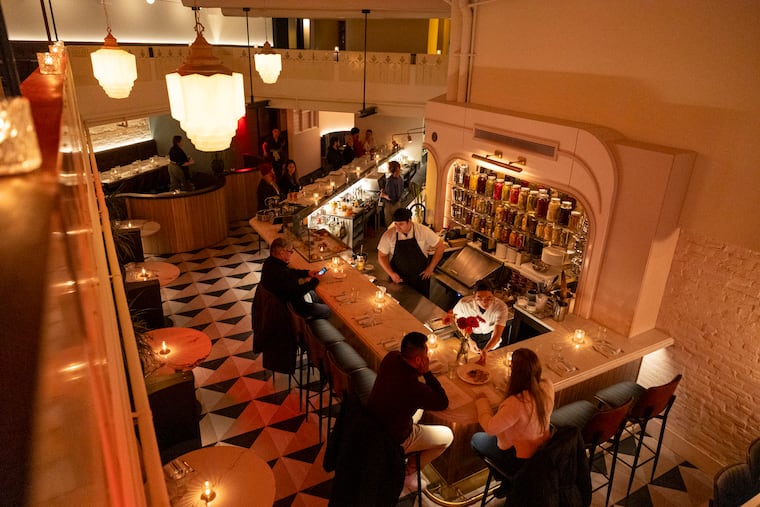
Fleur’s closed Sunday, exactly seven months after the cozy, French-leaning restaurant opened to acclaim — but not enough business — inside a former furniture store in Kensington.
The owners — chef George Sabatino, Josh Mann, and Graham Gernsheimer — told staff this month that service would end April 12, saying they wanted to be direct about the restaurant’s financial position while they could still meet payroll and cover bills.
“We had to look at some very hard truths about operating at the level of loss we’ve been operating at,” Sabatino told The Inquirer. “We were never a well-capitalized startup.”
They said their next move will be determining a path forward. They are considering a new concept, more compatible with the neighborhood.
Fleur’s — its name a tweak of Fluehr’s, the family that owned the five-story building for a century — opened to the kind of attention that usually suggests momentum.
Inquirer restaurant critic Craig LaBan praised Sabatino’s comeback, the restaurant’s ambition, and its French-inflected cooking, while also suggesting that pricing might need adjustment. The Infatuation called Fleur’s “stunning” and said the food — including foie-filled pastries and oysters with watermelon mignonette — “almost never disappoints.” Resy repeatedly featured it on its Hit List, highlighting the adaptive reuse of the 19th-century building and the 130-seat restaurant’s ambitions. Eater added Fleur’s to its map of best new restaurants and called it “a seasonal stunner filtered through a French lens.”
Public reaction was similarly positive. Fleur’s has maintained a 4.8 Google rating, with diners often praising the room, cocktails, and signature dishes. But the recurring complaint has been value — that portions and prices did not always line up. Also working against Fleur’s was the weather: Snowstorms crushed prospective business after LaBan’s review was published on Jan. 9, they said.
Sabatino, a decorated chef with multiple stops over the last 14 years, said the restaurant succeeded in one part of its mission. “We set out to do something ambitious, and I do believe we achieved the destination-restaurant part of our original idea,” he said. “We also wanted to be accessible to the neighborhood, and for whatever reasons, we missed the mark on part of what we set out to do.”
Gernsheimer said Fleur’s never generated the neighborhood traffic or weekday business it needed. “In some ways, our price point deterred some people from either coming or returning,” he said. “We tried to create a menu that could work both as an accessible night out and as a splurge, but the consensus seemed to be that it was more fun to splurge on it.”
The owners chose April 12, Sabatino said, because “we know we can cover payroll through then, as well as some vendor debt and other obligations.”
That calculation also shaped how they handled the closing internally among their 38 employees. They said they wanted staff to hear the news clearly and early enough to make plans. Sabatino said he had been determined not to let the restaurant drift into missed paychecks.
“I was very pushy about not ever taking the risk of missing payroll,” Sabatino said. “I’ve worked for owners like that, and I never wanted to be in that position.”
To Gernsheimer, “it was absolutely vital to us to be transparent with them and to make sure they would be appropriately paid for all the work they put in.”
The building itself at 2205 N. Front St. — whose sale price was $870,000, according to public records — was part of the ambition and part of the challenge. Initially, the partners envisioned a broader mixed-use project including a hotel and a roof deck. But financing conditions changed since the building went under contract in 2022.
“There was so much potential for a mixed-use property that could benefit the neighborhood and serve as a community gathering place,” Gernsheimer said. “What we eventually encountered was a lending market that was less open to risk and less accommodating of a larger project. So we had to pivot and phase it in. Phase one became Fleur’s as we know it now.”
Fleur’s also opened in a part of Kensington that has seen restaurant growth, but with limits. For the last 15 years, one of Philadelphia’s most active dining growth corridors has pushed north along Frankford and Front Streets from Fishtown into Norris Square and Kensington, with the strongest momentum south of Lehigh Avenue. Fleur’s, near the York-Dauphin El stop, sat closer to the northern edge of that expansion, in a neighborhood where new investment exists alongside poverty and worries about displacement.
“That was certainly on our minds,” Gernsheimer said of Kensington. “But I don’t blame the neighborhood. It’s on us to have made this work. I don’t think it’s the neighborhood’s fault in any way.”
Other restaurateurs nearby have encountered similar realities. Last May, Percy opened five blocks south of Fleur’s with lofty ambitions.
Six months later, owners reset the concept to an all-day diner. Partner Seth Kligerman said mixed reviews and customer feedback made clear that Percy’s original approach “was not fulfilling the need in the community.” Even with a location “on the beaten track,” near popular restaurants Kalaya, Suraya, and LMNO, Percy struggled early, he said. “It took us nearly a year to figure out our place in the neighborhood.” He said last month was Percy’s best.
Kligerman said the neighborhood’s burst of development can exaggerate how much customer density actually exists.
“With all the new commercial builds comes more competition,” he said. “It might look like there’s density there, but there really isn’t. Every block farther up you go, it’s going to be harder and harder to garner attention, even for a spot as nice as Fleur’s.”
Michael Brenfleck, chef-owner of Little Walter’s, the acclaimed Polish restaurant about five blocks east of Fleur’s, said he understood the risk when he signed a lease three years ago. “I knew things probably needed to go about as well as they have for it to work,” said Brenfleck, whose 45-seat restaurant opened in 2024 and later landed on the New York Times’ list of best restaurants and best dishes.
Still, he said, the location’s proximity to Philadelphia Brewing Co. and other nearby destinations helped persuade him to take the chance.
Farther north in Kensington, though, safety concerns have posed steeper challenges. They helped drive the closure last November of Cantina La Martina, the Mexican restaurant led by Dionicio Jimenez, a 2023 James Beard Award finalist for Best Chef Mid-Atlantic and a 2024 semifinalist for Outstanding Chef.
At Fleur’s, Sabatino and Gernsheimer said they have not ruled out some future version of their restaurant, perhaps with fewer service days, shorter hours, and a more neighborhood-oriented format. They said their immediate focus is helping staff land elsewhere and determining whether any reopening is viable after a pause.
The closing still feels personal.
“This is definitely a loss,” Sabatino said. “It’s a mourning period.”