One of Philly’s winningest high school basketball coaches died last month. The Speedboys can still feel his impact.
Joey Goldenberg wasn't as heralded as some other Philly high school hoops names. He won at a higher clip than nearly all of them.
Every three or four months, on Saturday mornings at 9, a group of men filter into the Royal Diner in Lansdowne. They head straight to the back, where a couple of tables are pushed between two booths.
For hours, the men sit and laugh over coffee and eggs, sharing stories of their youth. Most are in their 50s and 60s, some younger, but all attended West Philadelphia High School, and almost all were on the basketball team.
This tradition was started by Vince Ross, a Penn alum who played at West from 1975-78. Not long ago, he realized he was only seeing his former teammates at funerals and wakes. He set out to change that.
Now, as many as 40 Speedboys descend on the restaurant off of Baltimore Pike. It’s such a regular occurrence that they don’t call ahead. The staff at the Royal has come to expect them.
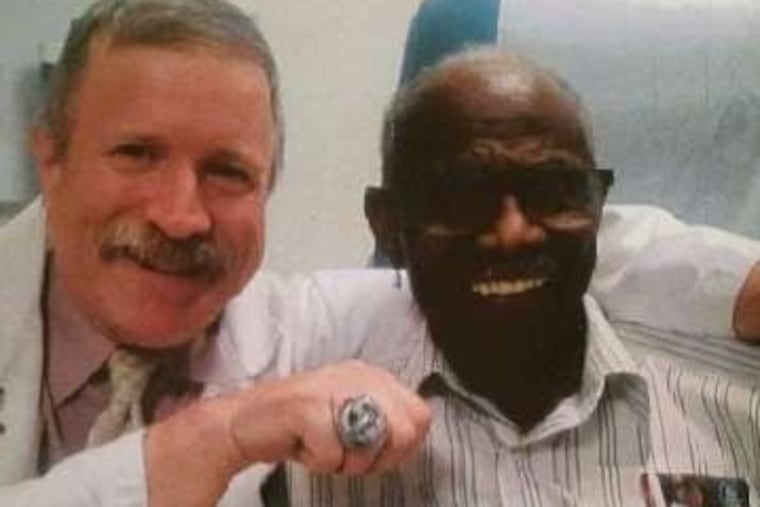
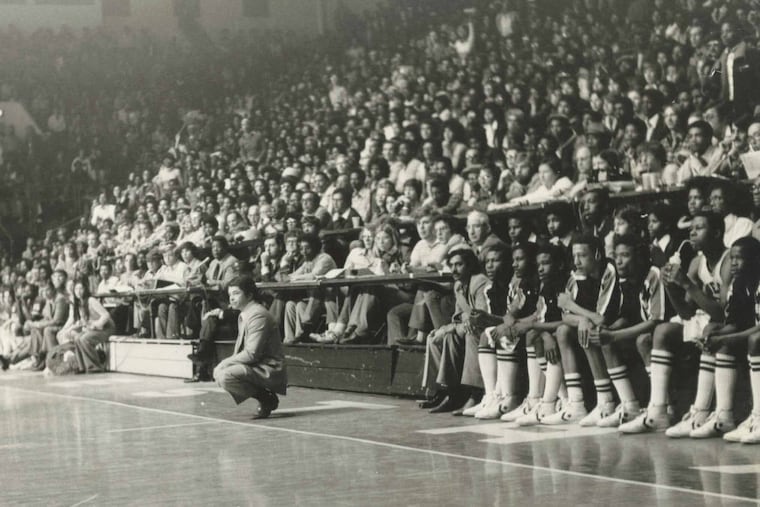
There was one man who stood out among the rest. He was short (5-foot-7), and in his 80s, often wearing a collared shirt. Players knew Joey Goldenberg as “Mr. G,” “Coach G,” or “G,” but no matter how they referred to him, he was always present.
Over his 21 seasons at West Philly, Goldenberg led the Speedboys to a record of 410-86 (.827). Only Andre Noble at Imhotep (.829) owns a higher winning percentage for a high school boys’ basketball coach in the city’s history. From 1974-78, Goldenberg’s teams won five straight Public League championships and four straight city titles, including the 1976-77 squad that went 30-0.
Goldenberg put a premium on conditioning, which allowed his players to trap and force turnovers with pressure defense, and then fast break on offense. The Speedboys’ depth enabled them to keep a quick pace throughout games. The result was a relentless style of play, one that proved formidable for even local college teams that the teenagers scrimmaged.
But despite all of this success, the coach’s impact transcended sport. Gene Banks, a six-year NBA forward who was a standout at Duke, said Goldenberg was “like my white Jewish father.”
Other Speedboys concurred. Darryl Warwick, Class of 1977, credited Coach G with helping him on his journey to sobriety. Arnett Woodall, Class of 1982, noticed that Goldenberg would make an extra effort to check on him, because he knew he had an inactive parent.
Luther Collins, Class of 1975, never made the team. But that didn’t stop Coach G from finding the high schooler a spot. Before long, Collins was sitting at the scorer’s table, keeping the book.
“[Goldenberg] wanted me to follow a path, no matter if I played on the court or not,” he said.
Once the coach heard about the Speedboys’ quarterly breakfasts, he began to attend them all. At the end of each meal, players would reach for their wallets, quibbling over who would pay G’s bill.
The answer was no one.
“We were always fighting [about that],” recalled Greg McKinley, Class of 1978. “And he always refused. He said, ‘I’m one of the guys, I’m a real Speedboy. I’ll pay for my breakfast like everybody else.’”
Goldenberg wasn’t as locally renowned as Speedy Morris or Bill Ellerbee, but in West Philadelphia, he was a titan. So, when he died last month at age 89, his players were distraught.
But they’re determined to live by the lessons he taught them; to spread the gospel of Goldenberg, wherever they go.
“To let him down and not carry on, and be the way that he taught us to be, it would be blasphemy,” said Woodall. “To not follow on like coach.”
Becoming ‘Coach G’
Goldenberg grew up in the same community as many of his pupils, on the 5000 block of Windsor Street in Southwest Philadelphia. He attended the same high school — West Philly — where he was a starting point guard, facing Overbrook teams that included Wilt Chamberlain.
By the time he left for Temple in 1955, to play basketball for Harry Litwack, the demographics of his birthplace had started to shift. West Philadelphia was in the midst of a transition, from a majority white to a majority Black neighborhood.
When Goldenberg returned to his alma mater in 1963, the school looked completely different. Not everyone embraced this at the height of the civil rights movement, but the health and physical education teacher did.
As he worked his way up from cadet coach (10th grade), to junior varsity coach, to varsity head coach in 1969, Goldenberg developed a reputation for being tough but fair. He went beyond the typical duties of his job, getting to know his roster on a deeper level.
These interpersonal relationships allowed him to tailor his approach. Goldenberg was aware of whether a player’s father or mother was in their life. He’d notice if a player’s family wasn’t regularly in the stands.
From there, he’d give them the support they needed.
“Even though he was teaching us, he was also understanding how Black kids live, too,” said Warwick. “You try dealing with different [personalities] every day, all of us coming from different living environments. And [some] don’t want to play ball some days, and you argue with this person, argue with that person.
“Not one time, while I was on the team, did I see anybody try to start a fight with him. Very few people argued with him. He understood that none of us was perfect.”
His patience did have a limit, though. Woodall and a teammate, Howard Evans, remember a day in the early 1980s when a Speedboy burglarized the locker room. Woodall returned from practice to find his hard-earned money stolen from his pants pocket. He was incensed.
So was Goldenberg, who had the player expelled. But before Woodall could retaliate, the coach pulled him aside.
He explained that the burglar was gone. There was no need for the teenager to take his anger out.
“He said, ’Thirty seconds can change the course of your life,’” Woodall recalled. “I still use that quote today.”
Incidents like these were rare. Goldenberg ran a disciplined program, and most of his players obliged. This was in part because the roster was competitive to make. West Philadelphia was brimming with basketball talent, honed at local recreation centers like Sherwood and Cobbs Creek.
It was not unheard of for 150 high schoolers to try out for varsity. And if you were lucky enough to get a spot, there was no guarantee you’d get one the following year. So, the players heeded Coach G’s rules.
The high schoolers were always on time. They embraced the 45 minutes of fundamentals at the start of each workout. They didn’t add any creative flourishes (behind-the-back passes, gratuitous dribbling) and dutifully hustled through his drills (which Banks said were harder than those at Duke, where he played for Bill Foster and Coach K, Mike Krzyzewski).
Above all, the Speedboys made sure to never miss a practice. Especially not ahead of a game. Banks learned this the hard way. On March 9, 1977, the day before the Public League Championship, practice was moved to the Palestra.
Banks was sick and stayed home from school. He showed up at West Philly that afternoon, looking for his teammates. They were nowhere to be found. Goldenberg decided to hold firm, benching the McDonald’s All-American in one of the biggest games of his high school career.
(The Speedboys won without him, defeating Overbrook, 61-51).
This punishment sent a message that endured for years to come. Evans was generally a strong student, but received a D on a test in the fall of 1984. His mother contacted Goldenberg, asking that her son only play two quarters.
Evans hoped his coach would make an exception. But then he remembered Banks.
“And I’m thinking, if he sat him, there’s no way he’s going to let me get by,” Evans said. “If he did that to Gene Banks, he’s going to crucify me.”
(Goldenberg did not, in fact, let him get by. But he did allow the point guard to choose his quarters).
Abiding by this code wasn’t easy. But the familial environment that Goldenberg created made it all worth it. He and his wife, Claire, would routinely host players for barbecues and dinners.
Over the summer, the couple ran a sleepaway camp in Bucks County. More than a few Speedboys came along, working in the kitchen to make some extra money and get out of the city.
Many of the West Philadelphia natives took their first flight because of Goldenberg. In the 1970s, his teams began to travel to tournaments across the country. They started with cities within driving distance — New York, Washington, Pittsburgh — but eventually expanded to places as far as North Carolina, Florida, and Las Vegas.
It didn’t take long for the coach to appreciate the impact. On one road trip in 1976, to Johnstown, Pa., Goldenberg saw one of his players, Terry Scott, holding a portable TV. He asked him why he’d brought it.
Scott explained that he wanted something to watch in his hotel room. It dawned on the coach that his substitute guard had never stayed in a hotel before. He turned to the group and informed them that each room would have its own color TV.
“The bus went berserk,” Goldenberg told the Daily News in 1982. “Guys were yelling and screaming. That was my first awakening. I realized how beneficial it was to take the kids out of Philadelphia.”
His greatest expedition came in 1983, when the Speedboys flew to Honolulu. Getting there took a year of fundraising. Every morning, before school, Goldenberg and his assistant coach, Phil Umansky, would pick up soft pretzels, selling one for a quarter and five for a dollar.
Thirty-four thousand pretzels later, they were on their way to The Aloha State, to compete in the Iolani Classic.
Players walked along Waikiki Beach in their spare time. One day, a couple of them went snorkeling. Evans can still remember the water; so clear he could see the fish below.
“I’m used to the city, with brown water,” he said. “That water over there, it was clean. I think everybody smiled for the first two or three days.”
A West Philadelphia legacy
To Goldenberg, there was no shelf life on a coach’s love. His commitment to his players transcended their time at West. The PE teacher went to their games and college graduations. Sometimes, he’d just call to check in.
Even after Goldenberg retired, in 1990, he found another job in the sport, running the Wildwood Basketball Coaches Clinic with a few friends, before he was hired as director of the Sixers’ youth basketball camps. But through it all, he always made time for his Speedboys.
Warwick was one of Goldenberg’s brightest stars, earning a scholarship to Hampton University, prior to entering the 1981 NBA Draft. The Atlanta Hawks selected him in the sixth round, but Warwick was released during the preseason, later signing with some minor basketball leagues.
In the mid-1980s, the former point guard began to struggle with substance abuse. One night in 1986, he awoke in a University of Pennsylvania hospital to find Coach G and Claire standing by his bedside.
Warwick was overcome with emotion. He hadn’t seen his coach in years; all of a sudden, Goldenberg was sharing the same refrains he did in high school, reminding his pupil to give himself grace.
“It was so uplifting,” Warwick said. “He didn’t give a damn about basketball at the time. He cared about me. [Coach G] and his wife cared about me.”
His struggles continued until 1991, when he got clean. Goldenberg saw Warwick shortly after. He grabbed the young man’s cheeks, and looked at his face, buoyant and vigorous, and could tell that he was doing something right.
Warwick has been sober ever since. He eventually became a social worker, staying in that role for 28 years, joining a number of Speedboys who have given back to their community.
In 2004, Woodall opened West Phillie Produce, a market that provides fresh fruits and vegetables at an affordable price. Collins spends Tuesday nights at his alma mater, helping students prepare for college and job opportunities.
Goldenberg’s son, Mike, said that if anything, this is what his father was proudest of. Not the records, or the titles, but the players who poured into West Philadelphia, just as he did long ago.
And if anyone questions this legacy, they can head to the Royal Diner, at 9 on a Saturday morning. There, they’ll find a group of joyous middle-aged Speedboys, taking up tables and booths in the back, sharing stories of a man who did so much more than win.