The owners of Penn’s Cave want it to become a state park. Otherwise, they say it would be developed.
Penn’s Cave, which opened in 1885, is hoping to become Pennsylvania’s 126th state park.
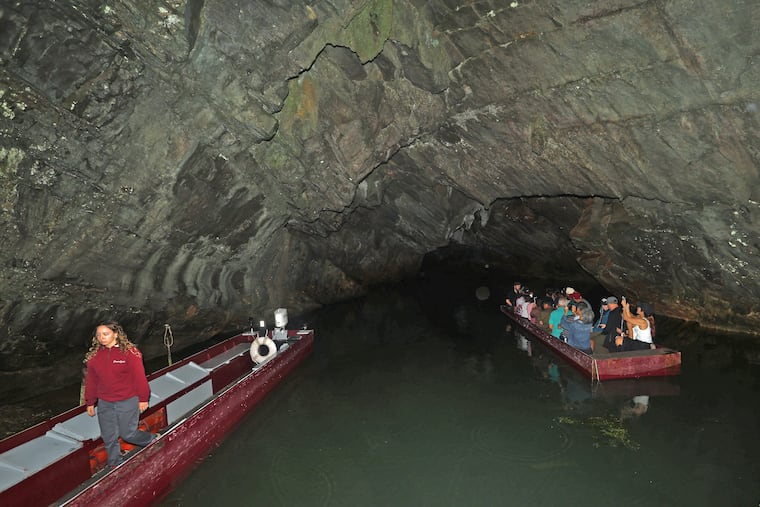
In 1795, an Irish pastor went down a hole in Central Pennsylvania and discovered a vast underground cave full of stalactites, stalagmites, and frigid water.
On a recent Sunday morning in July, visitors simply had to go through the gift shop to visit Penn’s Cave, the only all-water cavern in the country. The boat tours in the cave and the adjoining 1,400-acre wildlife park full of bison, wolves, elk, and one very large black bear attract thousands of visitors per year just east of State College in Centre County.
According to several published reports in recent months, Penn’s Cave and Wildlife Park, which opened in 1885 and has been run by the same family since 1908, is hoping to become Pennsylvania’s 126th state park by transferring the property to the state’s Department of Conservation and Natural Resources. Penn’s Cave ownership and management declined to comment during a recent visit, directing The Inquirer to public statements made earlier this summer.
Penn’s Cave CEO Russ Schleiden, during a July 7 Centre County Commissioners meeting, said the decision was “difficult.”
“But we feel that it’s a very important part of not only Centre County, but the Commonwealth of Pennsylvania, and that it should be preserved in perpetuity.”
Schleiden’s daughter, Jeanine Watson, was brought to tears when she spoke to the commissioners.
“We want it to be preserved and to be taken care of,” Watson said. “We’ve always felt we were the stewards of that. We would hate to see this go into development and, unfortunately, that would be the alternative.”
During the meeting, Watson said Penn’s Cave had been discussing the proposal with DCNR for several years. She did not say why development would be the only alternative.
The proposal received the support of Centre County’s commissioners and State Rep. Kerry Benninghoff, (R., Bellefonte).
“I can’t think of a better time in our country and our county’s history at the Semiquincentennial to make this reality,” Benninghoff said in July, according to statecollege.com. “If you want to look at Americana in its best, the park I think exemplifies that.”
Benninghoff told The Inquirer that his proposed legislation did not make it into the state budget by July.
“It just didn’t work out in this budget cycle. My ultimate goal is to preserve this property,” Benninghoff said. “You couldn’t ask for a better place to preserve.”
Wesley Robinson, a DCNR spokesperson, said department staff has visited Penn’s Cave and engaged in discussions about “potentially taking over stewardship of this significant geoheritage site.”
“Penn’s Cave’s natural and cultural resources could make it a strong addition to Pennsylvania’s state park system and provide expanded opportunities for the public to access and enjoy the site,” Robinson said in a statement.
Robinson said acquiring Penn’s Cave may require legislation and that the agency would continue conversations with stakeholders.
Coincidentally, Pennsylvania’s 125th state park is a former privately owned cave. Laurel Caverns State Park, in Fayette County, opened in April and is the first cave system to become a state park.
Laurel Caverns, the biggest cave system in Pennsylvania, opened as a tourist attraction in 1964. It’s also home to the biggest bat hibernaculum — where animals can hibernate in winter — in the Northeast.
“Parks like Laurel Caverns give our kids a new place to learn, our families a place to make memories, and all of us a chance to get away, take a breath, and just enjoy nature,” Gov. Josh Shapiro said in April during a press conference in the cave.
Laurel Caverns was donated to the state. It’s unclear how DCNR would take ownership of Penn’s Cave if the process moved forward or what its operating costs would be. The attraction employs dozens of seasonal and full-time workers and includes a large gift shop and snack stand.
On a tour of Penn’s Cave in July, a lone bat flapped around between the stalactites, but the experience is quite different from Laurel Caverns and would present a unique challenge to operate as a state park.
For one, visitors to Laurel Caverns walk through the cave system. Tours of Penn’s Cave are conducted via boat with a guide, on a frigid, subterranean offshoot of Penns Creek that’s filled with large rainbow trout.
“To the left here, we have our tallest stalagmite. We call this one our Statue of Liberty,” guide Kara Hoffman explained.
Hoffman also discussed the cave’s geology, early attempts at tours with torches, and its earliest visitors, the Indigenous Seneca who used the cave for shelter.
Laurel Caverns, with 400 acres above ground, does not offer camping. The Penn’s Cave property is 1,500 acres, and consists of rolling farmland and animal enclosures. It’s unclear if the state would maintain the wildlife exhibits, which include large elk, Texas longhorns, and mountain lions, but Benninghoff said he believed camping would be part of the state park.
In 2024, The Inquirer wrote about DCNR’s plan to build a campground in Chester County and the pushback it received from a vocal group of residents concerned about traffic and campers.
Robinson said that the project is still in the works and currently in “cultural review.”
Meanwhile, Penn’s Cave, about 190 miles northwest of Philadelphia, remains open for tours, and Benninghoff said he hoped to draft legislation for the next budget.