Philly is beta testing its own version of Boston’s Freedom Trail. I tried it and you should too.
The Path to Democracy will connect 21 sites in Philadelphia's Historic District via a walking trail of colorful ceramic tiles and mosaics.
Following my first visit to Boston two years ago, I penned a column (against my better judgment) bemoaning what a surprisingly good time I had there (against my will).
I was particularly taken with the city’s Freedom Trail, a 2.5-mile walking path embedded in Boston’s sidewalks that leads to 16 historic sites. Far from being half-baked, I had to admit this Beantown tourist attraction was “annoyingly great.”
Why didn’t we have anything like this in Philly, I wondered, and could we get our own version in time for the nation’s 250th anniversary?
I was flooded with emails in response from readers who not only agreed with me, but offered route suggestions and names for a potential Philly path. I also received a cryptic message from someone at Visit Philadelphia who said they had some things up their sleeves.
That was more than two years ago and I’d all but given up hope. Then I received an email this month from Jenea Robinson, vice president of communications for Visit Philadelphia.
“Because you wrote that delightfully, ‘annoyingly accurate’ story about Boston’s Freedom Trail a few years ago, I wanted to make sure you got the first look at Philadelphia’s answer to it: Path to Democracy,” she wrote.
Could it be true? Are we actually getting our own historic trail and did someone really call my work “annoyingly accurate?!?” Be still my craggy, Philly heart!
‘A legacy project’
Still in its early phases, there are currently only six stops on the Path to Democracy as it undergoes public beta testing through Labor Day. The full path, which is slated for next summer, will have 21 stops and is based on a self-guided tour Visit Philly has had on its website for years, said Kyle Stein, senior marketing project manager for Visit Philly.
“This is something we wanted to introduce to people this year and have it be a legacy project for years to come,” he said.
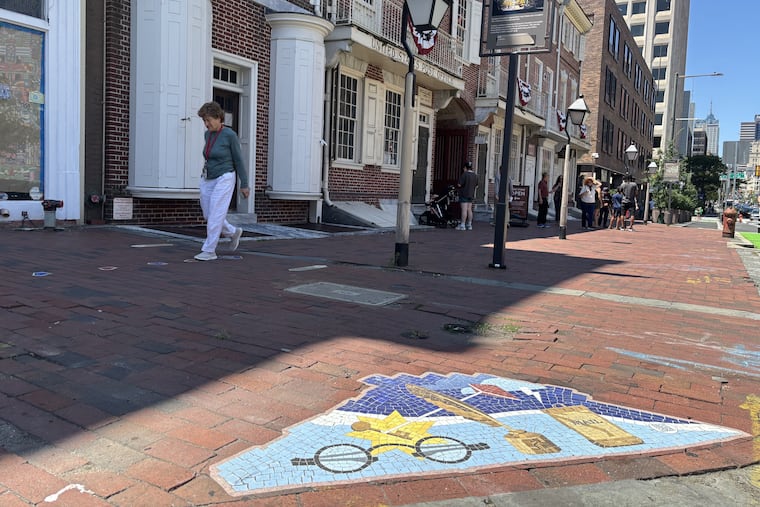
In its final iteration, the Path to Democracy will be marked by colorful ceramic tiles, brass directional plaques, and large tile mosaics embedded in the sidewalks that will pay “homage to all of the art across Philadelphia” and particularly, to that of Isaiah Zagar, Stein said.
“Whatever look and feel we went with had to be authentic to Philadelphia,” he said.
For now, Visit Philly is using sturdy, eye-catching vinyl decals that resemble tiles and mosaics to mark the path and stops along it. Zagar’s studio wasn’t consulted on the project, but Stein said Visit Philly would love to work with them going forward.
The Path to Democracy will not only be unique from Boston’s trail in look but in substance as well. The Freedom Trail traces Revolutionary War history, but Philly’s path will highlight sites and people that have shaped American democracy over the years.
“It’s not just something that happened in 1776,” Stein said. “Democracy is something that is an evolving thing.”
I knew there was only one way to suss out this path and that was to walk it myself. Plus, Stein said feedback from locals is essential during beta testing, and who doesn’t love being essential and opinionated in Philly?
Choose-your-own adventure
I snagged a parking space on Race Street near Second last week, knowing that the sites are all within a four-block radius from Front to Fourth and from Market to Arch Streets.
My first stop wasn’t planned. I just kept my eyes on the ground until something caught them, which happened at the corner of Second and Arch Streets. I spotted a blue vinyl tile that said “We” (written in the script of the Declaration of Independence) and two vinyl directional decals that said “Path to Democracy” with QR codes that led to an accompanying website. One pointed up Arch Street to Third and the other pointed down Second Street to Market.
I decided I’d follow the arrow pointing right up Arch Street. As I walked, I spotted gem-shaped blue-and-red vinyl decals that were peppered like breadcrumbs down the sidewalk and led me straight to the Betsy Ross House.
On the sidewalk outside of the site, I spotted a lovely vinyl mosaic of a needle and thread superimposed upon a multicolored flag. A QR code on it took me to a mobile-friendly webpage about Ross. I listened to a 51-second audio clip about her life and read about the mosaic before me. Also provided on the page was the Betsy Ross House’s address, operating hours, and other useful visitor information.
At the bottom of the site was a nifty little guide showing me that I was currently a four-minute walk away from Christ Church in one direction and a two-minute walk away from the Arch Street Meeting House in the other.
“All right, this is pretty cool,” I whispered.
Confusing corners
I chose to follow the blue-and-red vinyl decals to the Arch Street Meeting House where a vibrant vinyl mosaic of a dove and the word equality was plastered on the sidewalk. The QR code led to a page about the meetinghouse and to an audio clip about how “Religious radicals founded Philly.”
When I was done, I discovered I’d reached the end of the path, much to my chagrin. I didn’t realize it wasn’t a continuous loop and I had to retrace my steps back past the Betsy Ross House to the next site, Christ Church.
From there, the vinyl decals led me to the southwest corner of Second and Market Streets, where a directional decal with arrows on both ends pointed me toward Front Street on my left and also to Third Street on my right.
“Well this is confusing,” I thought.
I decided to follow the path up Market Street past Third Street to Franklin Court, where I spotted a large vinyl mosaic decal of a key, kite, quill pen, and spectacles.
I headed inside Franklin Court and walked around. I always forget how many privies there are in there (the place had more johns than the Second Continental Congress!).
Franklin Court marked another terminus of the path, so I turned around and headed back down Market Street to Front to check out the other direction of the trail I’d forgone.
Lesser-known sites
On the southeast side of Second Street as it crosses Market, I found a large mosaic decal of a man operating a printing press. Scanning the QR code, the website told me this was once “Printers’ Row,” where many important documents — including the first copies of the Declaration of Independence — were made.
Unlike the other sites along the path, there was nothing already at this one to indicate it was of any importance, aside from an easy-to-miss plaque embedded in a crumbling wall of a vacant building nearby.
I appreciated this more-obscure site being highlighted on the path. Stein said its inclusion in the beta test was very intentional.
“Not every historic site in Philly is one people can enter. We wanted a tried-and-true one, like the Betsy Ross House, and lesser-known ones, like Printers’ Row,” he said.
Following the decals, I reached my final stop at the corner of Front and Market Streets. There, a vinyl mosaic decal of a tree, animals, and human figures was situated on the sidewalk catty-corner to the Chief Tamanend statue at the I-95 on-ramp.
As I listened to the accompanying audio via the QR code, I found myself staring at the statue.
Then, I did something I’ve never done before — I crossed the street and approached it. I stood below Chief Tamanend’s feet, I looked up at him and the eagle on his shoulder, I marveled at the details of his clothing, I read the accompanying bronze plaque.
And I couldn’t believe that it took me this long and this path to do so.
A worthy pursuit
I spent about two hours walking the path, but I backtracked often and took my time. You could feasibly do it in 30-60 minutes.
After my walk, I filled out the pilot program survey via the QR code.
“I want more sites and would love for it to be a circular path you could start at any place and keep going around until you get back where you started, like a Phlash bus loop,” I wrote.
Stein said the goal is to have the path be multidirectional.
“I think in the future we’re considering the best way to actually connect the sites,“ Stein said. ”Printers’ Row and Chief Tamanend was an opportunity to test out a spur. That will be something we may come up against in the future, some sites may not fall within a perfect pathway."
While I didn’t see anyone else following the path as I was exploring it, Visit Philly’s Robinson told me about 50 people a day have been scanning the QR codes.
Though there are still some kinks to work out, the Path to Democracy shows a lot of promise. Like democracy itself, we don’t know where it will lead, but it’s a worthy pursuit — and one that requires our participation to succeed.
So before Labor Day, go try it out and provide feedback. You could help shape a path in Philly that may be walked for generations to come.
“We just want Philadelphians to be proud of this and be aware of it,” Stein said. “I think that this path is another way for us as Philadelphians to celebrate how great this city and these sites are.”