An all-cat band is performing this weekend in Philly. Good luck getting a ticket.
Tuna and the Rock Cats are on tour.
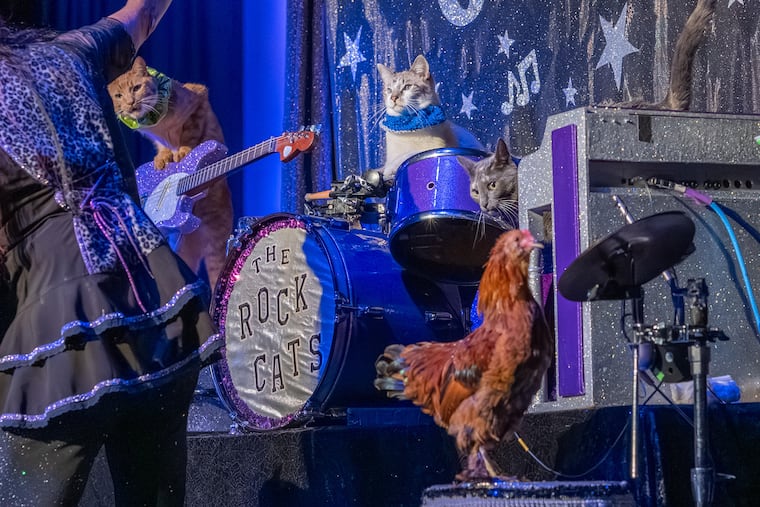
Even by rock and roll standards, the egos and drama within Tuna and the Rock Cats are something to behold.
Sometimes, in the middle of a show, the band’s lead guitarist — St. Claude — will decide that he’d prefer to play Christmas music, and begin performing “Jingle Bells.”
Roux, on clarinet, is a prodigy. But Annie, who plays the chimes, can be volatile; sometimes, if it gets too hot during a show, she’ll simply lie down onstage, refusing to continue.
“Annie also plays guitar,” says Samantha Martin, the band’s founder. “But she wants to beat up the keyboard player, and we can’t have brawls onstage.”
Behind the meowsic
Despite this artistic anarchy — or perhaps because of it — Tuna and the Rock Cats have become an extremely hot ticket. Billed as the world’s only all-cat band, the Georgia-based group has been selling out venues across the country for years — strumming guitars, pawing piano keys, and batting at chimes from Seattle to St. Louis.
Just how big are The Rock Cats?
In Philadelphia, their current stop on a two-month U.S. tour, they were originally slated to play four shows at the 350-seat Suzanne Roberts Theatre on Broad Street.
When those quickly sold out, a fifth show was added.
On Instagram, the group has nearly 100,000 followers. They’ve been featured on the Netflix series Cat People. A couple years ago, they left Theo Von mesmerized during an appearance on his wildly-popular podcast, This Past Weekend.
“It really is just fascinating to think about them cats and everything they’re doin’,” Von gushed.
Martin, a former wildlife educator, has been directing this Meowtly Crüe for about two decades, in addition to training animals for TV and film.
Early in her career, she gravitated toward “misfit” animals: snakes, spiders, rats. (“Rats will never let you down,” she explains.) But then she eventually met Tuna, a cat “so brilliant I said, ‘Let’s give this cat thing a try.’”
The band’s first show was in 2006, at an art gallery in Chicago. The group had only three members then, but when people heard there was a troupe of cats ready to perform, they lined up to get in.
The show, Martin says, was “horrible.”
Which is to say, it went fabulously.
“People loved that the show was horrible,” Martin says. “They love the fails more than the successes.”
Since then, she’s taught an array of cats to “play” a variety of instruments, some better than others. During performances, Martin joins the band onstage, giving visual and verbal cues — she mimes a tapping motion when she wants a cat to paw its instrument, for instance — and doling out treats for a job well done.
How are the Rock Cats, musically?
That depends who you ask.
While their commercial success is undeniable, critical acclaim has been mixed. One reviewer, in Seattle, described the group’s style as “an unpredictable assortment of instrument clanging,” adding that “rarely does it sound like the cats are playing the same song, let alone an actual, fully realized piece of music.” Another bemoaned the fact that, at a Christmas-themed performance, the band did not actually play much holiday music — though this critique seemed a bit harsh.
They are, after all, cats.
On the road
Tour life is not all bottle-service and Fancy Feast.
Packed onto their tour bus at any given time are Martin, tour manager Ashley Murnan, tour assistant Amanda Fenick, feline care coordinator Willie Zamora, roughly 15 cats, and a chicken named Cluck Norris, who plays the cymbal.
While the cats largely have the run of the bus, “the humans have a six-foot, coffin-sized bunk in a drawer,” says Murnan. Earlier on their current tour, in Baltimore, their generator — which powers the entire bus — went out for two weeks, putting them 10 days behind schedule.
And this is to say nothing of the challenge inherent in managing 16 distinct personalities — a mixed bag of climbers, swatters, and what have you.
“The band is chaos,” says Martin. “They’re all over the place.”
She never misses a show.
Martin has performed with a broken foot, with cancer, and with a voice so raspy it could hardly be heard through her microphone. Once, she paid to have the band’s broken-down tour bus towed from Wisconsin to Chicago in order to get to a show on time.
“It was a $2,000 tow,” she says, “but we made it.”
Despite the drama, Martin adores the cats, all of whom were once orphans, rescues, or strays. When they’re not touring, they live with her in Georgia, where she cooks them fresh chicken and salmon and turkey. (Martin also runs a nonprofit — Rock Cats Rescue, Inc. — that partners with local organizations to get cats adopted.)
Even Miki — her impossibly apathetic trumpet player who was found abandoned in a discarded Huggies box — has stolen her heart.
“They put a roof over my head,” she says. “Granted, it’s leaky and the gutters are falling off.”