Top U.S. commander visits aircraft carrier, discusses mental health issues
Adm. Brad Cooper said he witnessed "camaraderie, teamwork, and resilience," but that mental health is a high priority.
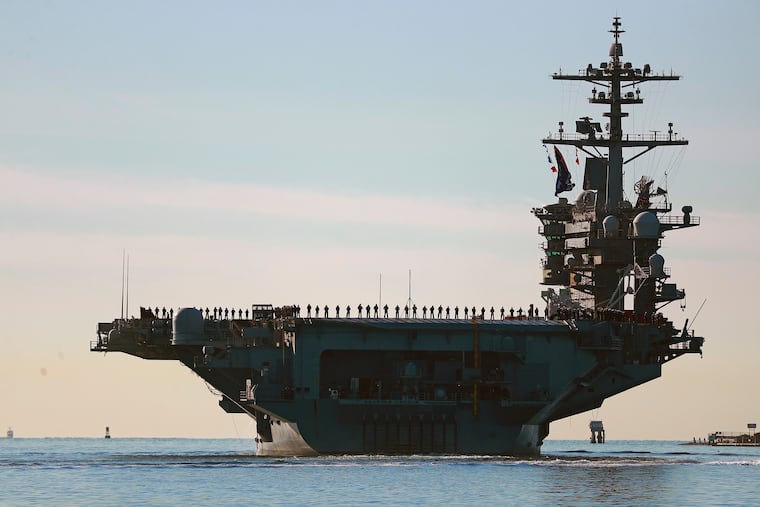
The senior U.S. officer overseeing the war in Iran said addressing mental health concerns was a high priority for the military, days after reports emerged of burnout and poor conditions aboard USS Abraham Lincoln. But Adm. Brad Cooper also said some of the concerns that had surfaced were “old news.”
Cooper, the head of U.S. Central Command, visited the USS Lincoln on Saturday during a Middle East tour. He called his time aboard the aircraft carrier “awe inspiring” and said he witnessed “camaraderie, teamwork, and resilience.”
“This doesn’t mean that all is perfect,” the admiral said as he acknowledged that long stretches at sea are “uniquely challenging and tough.” He said mental health is “another aspect of individual health and requires our attention just like physical health and spiritual health.”
The USS Lincoln’s deployment has stretched more than a month past its planned seven-month schedule. Senate Democrats have pressed military leaders on reports of food and supply shortages, water contamination, sewage problems, deteriorating morale, and attempted suicides on the ship.
The Military Times reported last week that at least two sailors have attempted to jump overboard, with the wife of one sailor saying burnout caused her husband to try to jump.
Defense Secretary Pete Hegseth downplayed the reports last week, saying the situation has been “completely misrepresented.” When asked Friday whether the deployment of the USS Lincoln had gone on too long, President Donald Trump dismissed that, saying it was “not nearly long enough.”
Cooper, in a separate opinion piece Sunday in the Wall Street Journal, said that “issues related to food, hot water, and other concerns” were raised “months ago” and addressed by leadership.
“What I found aboard the Lincoln is that many elements of those stories are old news,“ he said, referring to the issues of morale and ”operational tempo.“
U.S. officials have confirmed that the USS Abraham Lincoln would return home soon as part of a planned rotation. The Pacific-based aircraft carrier USS George Washington is expected to replace it
Acting Navy Secretary Hung Cao said in a statement Friday that the crew has been deployed in a combat zone for more than 200 days, carried out 10,000 sorties, and dropped 1.5 million pounds of ordnance.
It is “also true,” Cao said, that “a small number of mental health cases” were treated with no loss of life and “meal plans were adjusted when fresh resupply was unavailable.” Calls home were also limited when the operational threat was too high, he said.
While emphasizing that mental health is a “leadership priority” for the senior officers aboard the Lincoln, Cooper said that of the Navy’s 11 active aircraft carriers, “the Lincoln currently has among the lowest number of cases related to mental health.”
Adm. Mike Mullen, former chair of the Joint Chiefs of Staff, told ABC’s This Week on Sunday that he spoke with Cooper after his visit and said the news that the crew members were coming home had boosted their morale.
Mullen on ABC News said the reports of the ship’s conditions “were certainly of great concern” but that military officials are “working these issues hard.”
“I also believe the truth probably lies somewhere in the middle,” he said.