Kennedy Center stood as a symbol of the importance of arts for over 50 years
Here are some key moments in the Kennedy Center’s storied history, and what could be lost if it disappears.
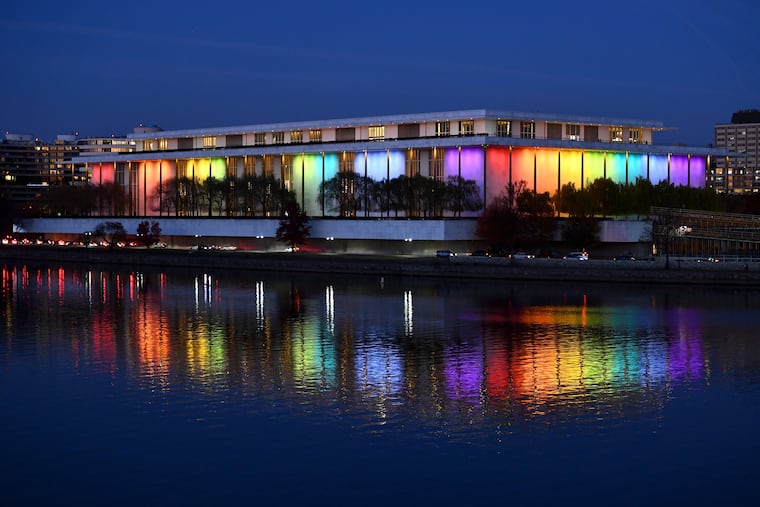
For more than 55 years, the white marble facade of the John F. Kennedy Center for the Performing Arts has presided over a portion of the eastern bank of the Potomac River. Thousands of performing artists have graced its stages, bringing to life what was envisioned decades ago as a symbol of the importance of the arts in a democratic society.
Now, the storied institution is closed. The center’s board of trustees voted Tuesday to shut down the venue, which has been beset by financial and legal troubles that snowballed after President Donald Trump and his allies took over its stewardship last year. Here are some key moments in the Kennedy Center’s storied history, and what could be lost if it disappears.
1955-1958
Eisenhower envisions ‘an artistic mecca’
In 1955, President Dwight D. Eisenhower creates a commission tasked with planning a new public auditorium in Washington. On Sept. 2, 1958, he signs the National Cultural Center Act into law, authorizing the fundraising for and construction of what he imagined would be “an artistic mecca” in the nation’s capital.
1961-1963
Kennedy boosts fundraising efforts
After President John F. Kennedy assumes office, he takes the lead in promoting and raising money for the center. On Nov. 29, 1962, he hosts a black-tie fundraiser, “An American Pageant of the Arts,” in Washington. The televised event includes performances by the National Symphony Orchestra, singer Marian Anderson, pianist Van Cliburn, poet Robert Frost, and a 7-year-old cello prodigy named Yo-Yo Ma.
“Art and the encouragement of art is political in the most profound sense,” Kennedy said in a speech that evening. “Not as a weapon in the struggle, but as an instrument of understanding of the futility of struggle between those who share man’s faith.”
Kennedy, who was in the midst of navigating the Cold War, also argued that the United States had a “special responsibility to the arts” as a democratic society.
“For art is the great democrat calling forth creative genius from every sector of society, disregarding race or religion or wealth or color,” Kennedy said.
Jan. 23, 1964
The center is officially renamed to honor Kennedy
Two months after Kennedy’s assassination, Congress unanimously passes a bill to rename the National Cultural Center as the John F. Kennedy Center for the Performing Arts, and to dedicate it as a “living memorial” to the late president.
“I am confident we have chosen well that the institution now given the breath of life will have a long and distinguished future,” President Lyndon B. Johnson said at the bill’s signing on Jan. 23, 1964. “All those who worked in this cause can now know that they are not only honoring the memory of a very great man, but they are enriching our whole American life.”
Dec. 2, 1964
Johnson breaks ground
Johnson breaks ground using the same gold-plated spade that Presidents William Taft and Franklin Roosevelt used at the Lincoln Memorial and Jefferson Memorial groundbreaking ceremonies. Johnson is flanked by a model of the Kennedy Center, designed by architect Edward Durrell Stone, and by members of the Kennedy family.
Sept. 8, 1971
Kennedy Center opens
The Kennedy Center officially opens on a Wednesday evening, with a gala and the world premiere in its opera house of Leonard Bernstein’s Mass: A Theatre Piece for Singers, Players and Dancers, choreographed by Alvin Ailey.
In the inaugural program, President Richard Nixon hails the Kennedy Center’s opening as “the fulfillment of a dream shared by Americans in every walk of life.”
The following day, the concert hall opens with a performance by the National Symphony Orchestra, which would call the center its home for the next five decades. The Eisenhower Theater opens on Oct. 18, 1971, with a performance of Henrik Ibsen’s A Doll’s House.
Dec. 3, 1978
Inaugural Kennedy Center Honors awarded
The center holds its inaugural Kennedy Center Honors, a lifetime achievement award that celebrates individuals who have “an impact on the rich tapestry of American life and culture through the performing arts.”
The inaugural ceremony was hosted by Leonard Bernstein, and honorees that year were Marian Anderson, Fred Astaire, George Balanchine, Richard Rodgers, and Arthur Rubinstein.
Since then, the Kennedy Center Honors have been bestowed on more than 260 artists in music, dance, opera, theater, film, and television.
1997
Millennium Stage offers free performances
Chairperson James A. Johnson proposes a somewhat radical idea: putting on a different free performance at the Kennedy Center every day at 6 p.m. to make the arts more accessible. Nearly 30 years later, free performances of all kinds continue to take place at the Millennium Stage on “select days of the week.” Most are livestreamed.
2019
The Reach expansion opens
The Kennedy Center expands for the first time since 1971 with the opening of the Reach campus, a $250 million project that adds rehearsal rooms and outdoor performance spaces.
The American sculptor Joel Shapiro gifts Blue, a giant stick figure preparing to leap, to the center in honor of the expansion.
“It’s about action and risk and performance and energy. It’s a celebration of possibility,” Shapiro said in a video about Blue.
2025
Trump shakes up Kennedy Center board, adds his name to building
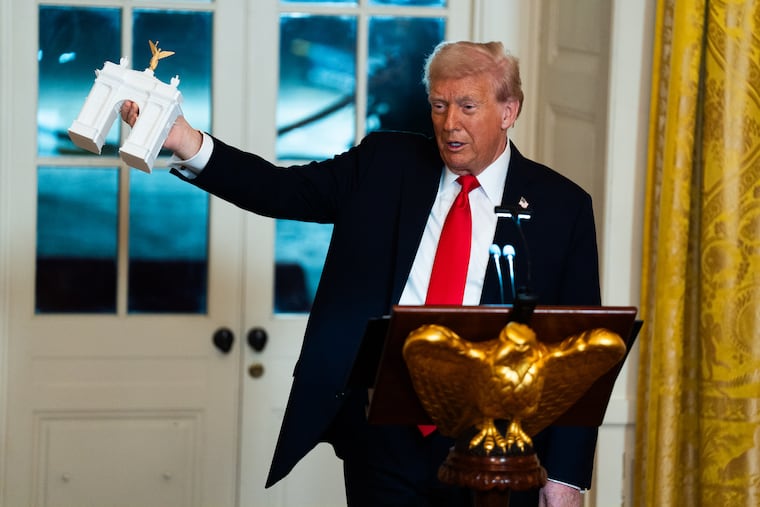
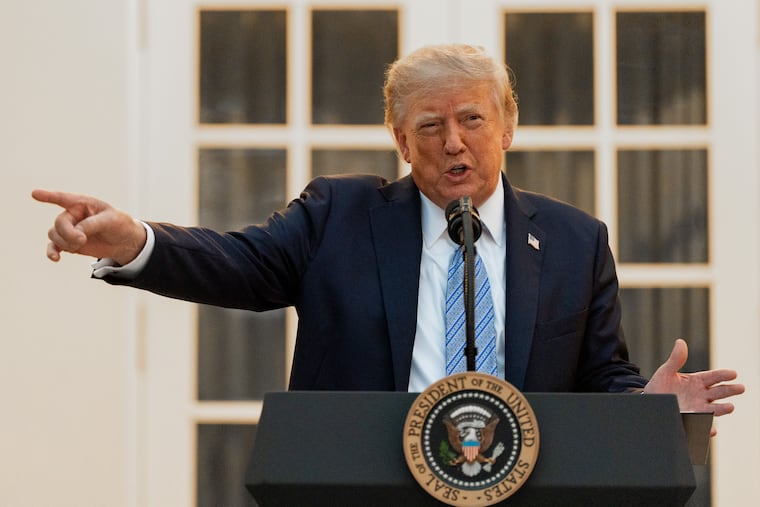
A few weeks after President Donald Trump starts his second term in office, he announces that he is firing several Kennedy Center board members, including the chairperson, because they “do not share our Vision for a Golden Age in Arts and Culture.” He also names himself the new board chairperson.
In December, the new board, stacked with Trump loyalists, votes to rename the center “The Donald J. Trump and The John F. Kennedy Center for the Performing Arts,” and a crew adds Trump’s name to the facade of the building the next day. The move causes ticket sales and fundraising to collapse.
2026
Legal battles plague center
Amid canceled performances and boycotts of the center, Trump announces in February that the Kennedy Center will close for about two years to undergo renovations.
“This important decision, based on input from many Highly Respected Experts, will take a tired, broken, and dilapidated Center, one that has been in bad condition, both financially and structurally for many years, and turn it into a World Class Bastion of Arts, Music, and Entertainment, far better than it has ever been before,” Trump wrote then.
In May, a federal judge orders that Trump’s name be removed from the center’s facade and that officials halt its renovation plans. Workers remove Trump’s name in the middle of the night.
The legal challenges continue. The board’s trustees have continued pushing for the center to be renovated and for Trump’s name to be inscribed on the building, including renaming the center’s grounds the “President Donald J. Trump Plaza.”