Trump arrives in China focused on friendship, not spy scandal
Left unaddressed was the recent revelation that Jensen Huang, CEO of Nvidia, had an extramarital affair with a business executive who U.S. intelligence agencies believe was spying for China.
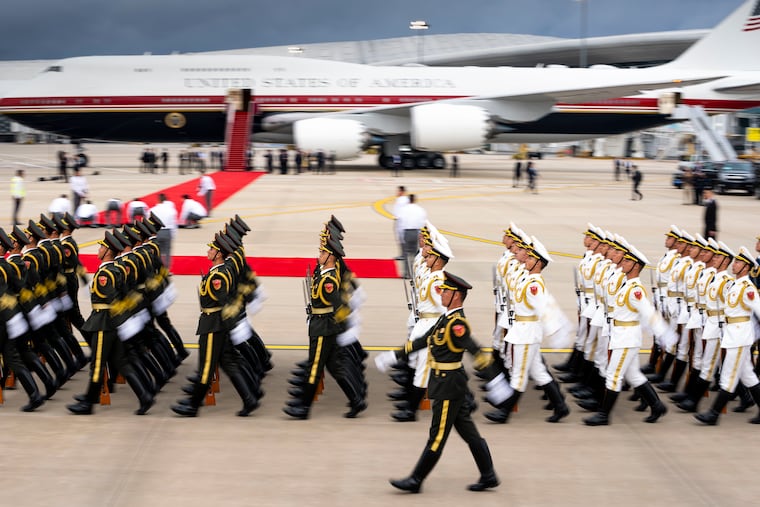
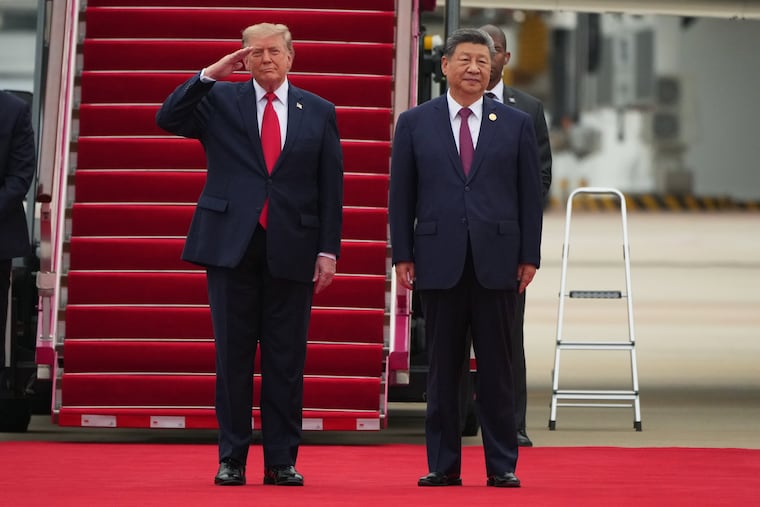
SHENZHEN, China — President Donald Trump was welcomed to China on Wednesday with a warm embrace both figuratively and literally, as he arrived for a fraught visit shadowed by a major spy scandal that he seemed determined to ignore.
Upon landing in Shenzhen, a bustling technology center, for a series of meetings, Trump was greeted at the airport by President Xi Jinping of China, who hugged him on a red carpet as a colorfully dressed crowd waved flowers and flags and chanted “warm welcome” in Mandarin.
The visit, however, may have a see-no-evil, hear-no-evil quality because Trump has said he does not intend to raise the biggest China spy scandal of recent years, one that has upended one of America’s technology giants and pitted members of his own administration against each other. Instead, Trump prioritized a show of friendship amid the allegations of espionage.
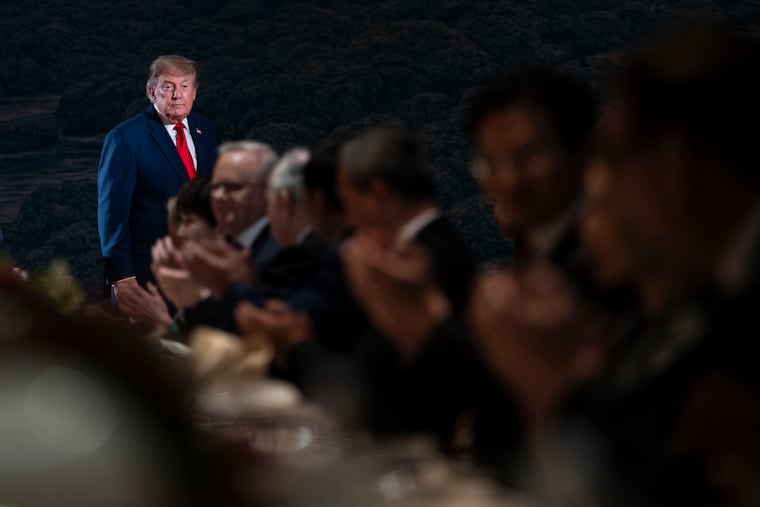
Trump reveled in the pageantry of the moment as he joined Xi for a banquet dinner that opened the annual meeting of the Asia-Pacific Economic Cooperation forum, a group of 21 major economies in the region. The two leaders toasted future prosperity and looked forward to meeting separately Thursday as well as together with President Vladimir Putin of Russia in a much-anticipated trilateral summit.
Xi’s decision to personally welcome Trump at the airport was a rare act by the Chinese leader. He did not do so when Trump visited Beijing in May. But Trump made a point of traveling to Joint Base Andrews outside Washington to greet Xi in September, an uncommon move for a U.S. president and the first time Trump had done so for a foreign visitor.
So, Xi returned the gesture Wednesday. “China is a nation of etiquette with a tradition of reciprocity,” Xi said, according to Chinese state media.
By contrast, Xi sent lower-level officials to greet Putin and other regional leaders arriving for the summit meeting, as is customary.
Still, Xi met separately with Putin for more than two hours in advance of the three-way meeting planned for Thursday, and he hailed the Chinese-Russian relationship as “steadfast as a rock through wind and rain.”
The two encounters underscored Xi’s efforts to balance relations with Russia and the United States. While Russia has become a close partner in recent years and Xi and Putin have developed a bond over dozens of meetings, China has a far more extensive and important economic relationship with the United States.
The atmosphere at the summit with other leaders was sometimes tense. Xi barely offered a smile to Prime Minister Sanae Takaichi of Japan, with whom he is in a bitter, yearlong diplomatic spat. Trump and Prime Minister Mark Carney of Canada, who have an uneasy relationship as they tussle over trade, had their first in-person meeting of the year. Days earlier, Carney angered the Trump administration by repeating that he would look elsewhere, including to China, if Trump did not lift tariffs on Canada’s auto exports.
Left unaddressed was the recent revelation that Jensen Huang, CEO of Nvidia, had an extramarital affair with a business executive who U.S. intelligence agencies believe was spying for China. The executive, Alice Huang, who is not related, worked for Megaspeed, a Singapore-based data center firm and was suspected of gathering intelligence for Beijing.
Jensen Huang resigned under pressure and Trump’s senior advisers have been squabbling over administration policy on chip exports that could benefit China. The administration announced earlier this week new rules meant to restrict remote access to advanced chips and servers that could help develop Chinese artificial intelligence.
Scott Bessent, the treasury secretary, has blamed Howard Lutnick, the commerce secretary, for resisting restrictions on chip sales. Bessent and Lutnick are both accompanying Trump on his Asia trip, though they were seen standing apart.
The Nvidia scandal has put Trump on the defensive because of his close relationship with Huang, who joined the president’s trip to China in May. Trump has denied being told about the matter, despite reporting by The New York Times that he was informed at least twice, including en route to China in May. He has said he does not know if Alice Huang was a spy and urged Jensen Huang to fight for his job. Even after Jensen Huang’s resignation, Trump voiced support for his reinstatement.
This is not the first time Trump has opted not to confront Xi with allegations of Chinese interference in the sensitive U.S. matters. In a primetime address to the nation in July, Trump accused China of hacking or purchasing U.S. voter rolls, but then said nothing about it publicly when he hosted Xi for a lavish state visit at the White House in September.
Although Trump once regularly lashed out at China over its trade practices, he has become more intent over the past year on forging closer ties between the world’s two largest economies. “We have a very good relationship with China, and you don’t want to insult them,” he said before leaving the United States.
Trump arrived in China after a stop in Manila, Philippines, for the annual meeting of the Association of Southeast Asian Nations, or ASEAN. He met with President Ferdinand Marcos Jr. of the Philippines, who engaged in some fast-food diplomacy with Trump, who is known for his taste for greasy meals.
Marcos said he sent some fried chicken to Trump at his hotel the night before from Jollibee, a chain that is considered a national treasure in the Philippines. “Since you’re strapped for time, I thought a taste of Manila might be good,” he said. Trump did not say whether he ate the food.
He did, however, make a point of paying a visit to Marcos’ mother, Imelda Marcos, 97, the former first lady of the Philippines, who got to know Trump at New York parties in the 1990s.
“Welcome to the Philippines,” she told Trump. She handed him a gift and blew him a kiss as he walked away with her son.
“She’s always the most beautiful,” Trump said.
While Trump failed to sign a trade deal with Thailand that had been expected to be finalized during his stop in Manila, he announced that he did unexpectedly reach a trade agreement with the Philippines. “We didn’t know that was going to take place, but it took place very quickly and it’s a magnificent deal for both,” he said.
Marcos’ office later said the deal would cover energy and food security, without providing further details. Trump said on social media that the deal would benefit American farmers.
There was no such accord between Trump and Carney after their tense encounter in Shenzhen later in the day. In a statement, Carney’s office said the two leaders “discussed the work underway to reach a mutually beneficial trade agreement” but offered no further details.
Much attention was focused on Trump’s meeting with Xi and Putin on Thursday. The White House said Trump will also meet separately with Putin, their first get-together since a much-ballyhooed Alaska summit failed to produce an agreement to end the war in Ukraine.
Putin arrived in Asia with a show of force. Even as he landed in Shenzhen, Russian strategic nuclear bombers landed in Vietnam. It was the first time that Russian strategic nuclear bombers had deployed to Vietnam since the Soviet era and served as a reminder before the trilateral talks that Moscow remains the world’s largest nuclear power.