Plaque by plaque, Russia erases the memory of the Gulag’s horrors
A society hungry for truth and justice collected victims’ names and erected memorials, hoping that establishing a historical record would keep such abuses from happening again.
ZAPOLYARNY, Russia — Mikhail R. Smiryaka has lived all his life in a desolate outpost of the Russian Arctic because eight decades ago his grandfather was branded an “enemy of the people” and taken to toil in Josef Stalin’s Gulag.
When he was a child, his family’s kitchen was the only place considered safe for frank conversations about the state repression that sent his grandfather to a brutal labor camp nearby, after his wife stole grain during a famine after World War II.
Smiryaka, 52, said his mother taught him that everything around him — the coal mines surrounding the nearby city of Vorkuta like numbers on a clock, the municipal institutions, even the theater — was “built on the bones of prisoners.”
In the Soviet period’s last years, the horrors of the Gulag camps finally came to light. A society hungry for truth and justice collected victims’ names and erected memorials, hoping that establishing a historical record would keep such abuses from happening again.
Now, that effort is being snuffed out. The government of President Vladimir Putin is waging a national campaign to suppress the memory of millions who, like Smiryaka’s grandfather, were swallowed by the Gulag from the 1920s to the 1950s. About 1.5 million of those imprisoned — both political dissidents and ordinary criminals — died from extreme cold, starvation, disease, and intense labor.
A new official narrative has reframed Stalin as the essential architect of the Soviet victory in World War II and played down the repressions as an unavoidable byproduct of building a modern Soviet state.
“A Russian person is supposed to remember only the good things, only the victories,” Smiryaka, an unemployed former coal miner who lives in the shrinking town of Zapolyarny, said during an impromptu interview one subzero afternoon.
The rehabilitation of Stalin has accelerated during Russia’s war in Ukraine. Russian authorities have made memory of World War II a secular religion of sorts, as Putin has falsely portrayed his fight against Ukraine as an extension of the Soviet fight against Nazism.
By minimizing Stalin’s crimes, historians say, the Kremlin hopes to blind Russians to the abuses today, as the government demands unconditional wartime loyalty. Nearly 2,000 people — both Russians and Ukrainians — are political prisoners in Russia, according to some calculations, with many more awaiting trial. That attests to the renewal of the kind of repression that an earlier generation hoped to root out.
The Russian government is methodically dismantling the organizations and monuments that preserved the history of the Gulag.
Less than two months before Russia’s full-scale invasion of Ukraine in 2022, the authorities disbanded Memorial, a prominent organization dedicated to keeping memory of the camps alive. This spring, Russia’s Supreme Court declared Memorial an “extremist organization,” making it a crime to work for the group or even share its posts on social media. Memorial, which won the Nobel Peace Prize in 2022, mostly operates abroad now.
This year, Moscow authorities announced the closure of the city’s Gulag Museum. It was replaced by a kitschy, high-tech Museum of Memory that shifts the focus to what it calls a genocide by the Nazis against the Soviet people.
Memorials to Gulag victims are also disappearing from view. Journalists from 7x7, a media outlet focused on Russia’s regions, counted at least 26 taken down since 2022.
Muzeon, a Moscow memory park, removed a Gulag memorial while leaving in place statues of figures responsible for political repression. In Vladivostok, in the Far East, a statue of Alexander Solzhenitsyn, who documented the camps in Gulag Archipelago, was moved from a central promenade to a faraway park. In the Siberian city of Yakutsk, a memorial to victims of repression was replaced with a statue honoring soldiers killed in the war in Ukraine.
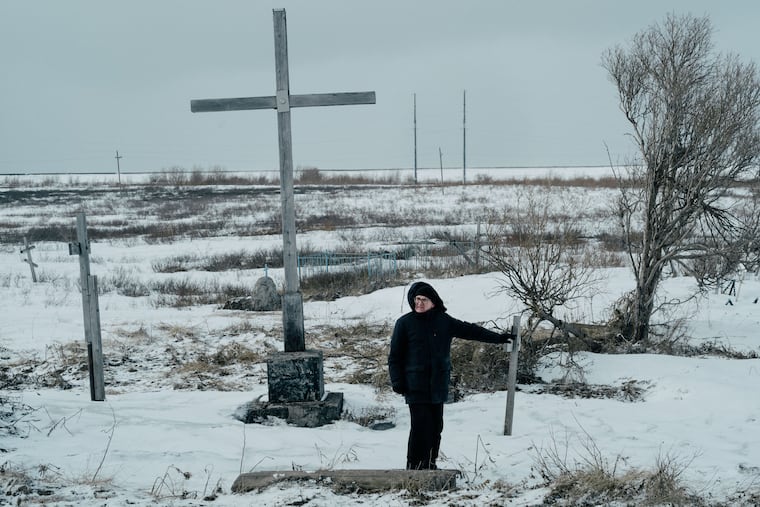
This summer, the authorities removed a memorial plaque to victims of the Gulag in Yur-Shor, an Arctic village a half-hour drive from Smiryaka’s apartment. The plaque was next to a cemetery where prisoners who worked in a mine were buried from 1944 until the mid-1950s, their graves marked by wooden stakes in the tundra.
The prisoners, many of them political dissidents, were from across Eastern Europe. Some participated in an uprising in 1953, months after Stalin’s death, demanding better conditions and a review of their cases. The camp administration killed dozens in response.
Fifty years later, a historian, Alexander V. Kolmakov, and other researchers used lists from the state archives to determine who had been buried in the cemetery and install name plates on every cross jutting through the overgrowth.
Kolmakov arrived in Vorkuta, near Yur-Shor, in 1968 to work as a geologist. After encountering what seemed to be unmarked graves, he began asking people what had happened. No one was willing to talk, he said. It would take him 20 years to understand the extent of the nightmare.
In 2010, a memorial was erected. It bore mostly the names of Ukrainians, some of whom had been accused of promoting self-determination for Ukraine. Photographs of an installation ceremony showed attendees wrapped in Ukrainian and Russian flags.
Sixteen years later, the presence of Ukrainian names was enough for a Vorkuta council member — a veteran of the war in Ukraine — to demand that the memorial be dismantled.
“We must all remember what happened to prevent it from happening again,” the council member, Grigoriy Dyshlik, said in a news release. “However, the burial site itself need only be marked on a map. As for the memorial sign, it should be removed — there is no reason for it to remain in our city.”
Kolmakov braved an intermittent blizzard to show me the camps, graveyards, and settlements surrounding Vorkuta. With us was Georgy Mamulashvili; his Georgian father labored in the Gulag for 15 years after being denounced by a competitive classmate, and his Ukrainian mother served 10 years as punishment for being forced to work as a housemaid for German occupation officials during World War II. Non-Russians were disproportionately sent to the Gulag by a regime determined to suppress their aspirations for autonomy.
Kolmakov took pains to say that actual war criminals were incarcerated after the war. He showed me a cemetery where mostly Hungarian and German war criminals were buried.
But he also showed me books, printed in the early 1990s, that listed Stalin-era government quotas for every region detailing how many “enemies of the people” should be shot or sentenced to hard labor. Kolmakov lamented the ban on the organization Memorial and the blocking of civic initiatives in Vorkuta to construct a museum focused on Gulag memory.
“Today in our society, the word ‘Memorial’ has become a curse word,” he said.
“Society has become divided and increasingly embittered,” he added. “History teaches us nothing. This is my country’s cross: beat your own, so that others will fear you.”
Others reflected the new government line on the Stalin era. In Zapolyarny, I met Larisa Sundaryova, whose father was sent to Vorkuta for 25 years of hard labor as punishment for being captured during the war, which the Soviet Union considered treason.
Sundaryova blamed the scale of the repression not on Stalin himself, but on the fact that many people denounced their neighbors during that time.
“Would he have achieved those results if he hadn’t ruled with an iron hand?” she asked.
An exception to the efforts to erase Stalin-era memory can be found in the Yamal region neighboring Vorkuta.
There, the authorities recently renovated a Gulag outpost called Camp Glukhariny. Inmates at the remote camp labored under punishing conditions on the never-completed Trans-Polar Railroad Project 501/503.
Some of the camps established to build the railroad continue to exist today as harsh prisons like Penal Colony 3, where Western intelligence agencies say Russian opposition politician Alexei Navalny was killed.
The open-air museum at Camp Glukhariny shows the prisoners’ harsh lives. But it stops there. None of the informational signs provide wider context about the Gulag or note that many of those held there were political prisoners.
In Yamal’s regional capital, Salekhard, I met a historian, German Bardin. He argued that Stalin needed prison labor to develop the Soviet Union, whatever the conditions the inmates would have to face.
“Why focus on the fact that slaves built the pyramids?” he asked me rhetorically. “How are the pyramids perceived by us today? As the Seventh Wonder of the World.”
This article originally appeared in the New York Times.