U.S. signs nuclear deal with Saudi Arabia that gives it path to enriching fuel
The agreement with a kingdom signaling it wants a nuclear weapon has sparked alarm among nonproliferation experts. Congress has 90 days to act.
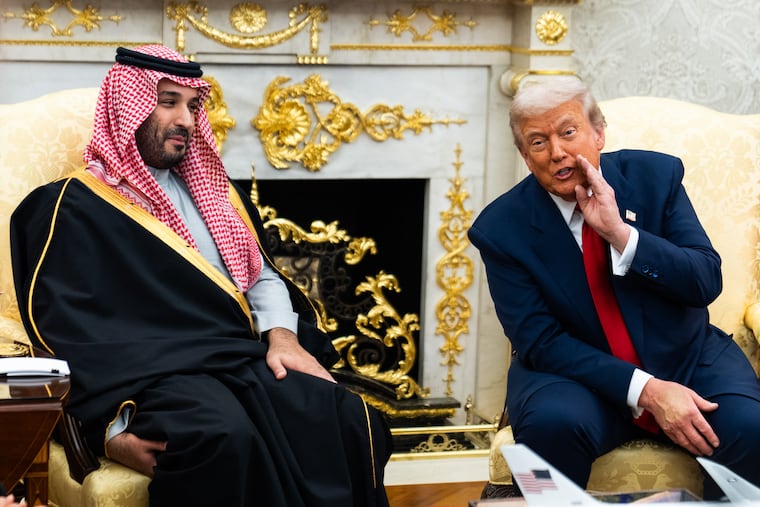
The Trump administration on Wednesday signed an agreement with Saudi Arabia that gives that country a pathway to enrich nuclear fuel and commits it to using U.S. firms to supply its reactors.
The agreement, which the Energy Department announced had been signed, is certain to spark heated debate in Congress, where many lawmakers have long expressed concern that exporting enrichment capabilities will lead to a proliferation of nuclear arms.
Saudi Crown Prince Mohammed bin Salman has spoken openly about working to develop nuclear weapons if Iran is not stopped from getting them.
While the Trump administration offered little information about the agreement’s contents, three people familiar with it shared details with the Washington Post. The people spoke on the condition of anonymity because they were not authorized to discuss the agreement publicly.
The people familiar with the new agreement say it is designed with safeguards to keep the Saudis from enriching nuclear fuel to weapons-grade level. But they also acknowledge it includes a waiver that exempts the Saudis from the aggressive international inspections required in nuclear reactor deals with other countries, including the United Arab Emirates. Instead, sensitive inspections would be executed by American teams under terms spelled out in the agreement, which was initially worked out when the crown prince visited Washington in November.
“These agreements reflect our two nations’ shared commitment to strengthening U.S.-Saudi commercial relations, delivering prosperity at home and security to our allies abroad,” Energy Secretary Chris Wright said in a statement. “Rest assured, these agreements uphold the highest standards of nuclear safety and nonproliferation, while relying on the world’s best nuclear technology and scientists, designed right here in the United States.”
On Wednesday, Wright and his Saudi counterpart signed what is known as a 123 agreement, which lays out conditions for nuclear energy cooperation and includes stipulations aimed at preventing the spread of nuclear weapons.
Unlike with this agreement, other recent deals between the U.S. and countries that are not already enriching their own fuel have precluded or discouraged them from doing so.
Because the deal does not include conventional international inspections, President Donald Trump had to sign a separate national security waiver for it to go forward, according to the individuals familiar with it. Now that the agreement has been signed, the details will be sent to Congress, which has 90 days to act on it.
Even if Congress votes against implementing the deal, the president could veto that disapproval, and it is unlikely that opponents would have enough votes to block the deal from going forward.
The Wall Street Journal first reported the details of the agreement.
Under the deal, the two countries agree to study for two years whether enrichment on Saudi soil is feasible and necessary. There is enough nuclear fuel manufactured in other countries to power future Saudi reactors. But nuclear energy proponents argue the world’s fuel supply will quickly run out if plans by the Trump administration and other governments to vastly expand nuclear power production around the globe materialize.
They say the deal with the Saudis gives the U.S. an opportunity to expand the enrichment network on its own terms, limiting the associated weapons proliferation risks. The deal stipulates that any enrichment on Saudi soil would be controlled by U.S. companies using technology that is not shared with the Saudis. The aim is to allow Saudi Arabia to achieve its goal of developing a nuclear power economy without giving the kingdom access to tools it could use to develop a nuclear weapon.
Nonproliferation experts have long warned against such a deal, starting back when the Biden administration raised this possibility as part of efforts to establish diplomatic relations between Saudi Arabia and Israel. They continued to speak out as the Trump administration signaled it was heading down the same road, arguing that any safeguards the U.S. establishes will not hold.
“A bad U.S. nuclear deal with Saudi Arabia is coming for congressional review — inexplicably, carried over from the Biden administration,” wrote Andrea Stricker, a nonproliferation scholar at the Foundation for Defense of Democracies, a national security think tank, in a post on X. “Congress should block it. If it does not, one hopes the policy will be reversed by a subsequent administration before too much damage is done in terms of watering down safeguards, setting negative precedents for other states, and failing to contain the spread of enrichment and reprocessing — which we just put back in the box in Iran via force.”
There are currently 14 nations enriching uranium, according to the think tank, nine of which have nuclear weapons.
The agreement is sparking alarm in Israel, where officials have long sought to keep neighboring nations from enriching nuclear fuel. Unlike the Biden administration’s proposed nuclear energy pact with Saudi Arabia, which U.S. officials had predicated on the Persian Gulf state recognizing Israel’s right to exist, there is no such stipulation in the arrangement Trump negotiated.
Naftali Bennett, who had served as Israeli’s prime minister and now chairs the Together party, said in a statement that the deal “joins a series of diplomatic failures in which Israel is losing influence over its own fate.”
Bennett, who is challenging Israeli Prime Minister Benjamin Netanyahu in the upcoming elections, called the deal “a severe strategic failure that jeopardizes our security” by threatening to trigger a regional “nuclear arms race and a dangerous loss of control.”
Israel Ziv, a former head of the Israel Defense Forces Operations Division, wrote in the daily newspaper Maariv that the agreement “is the final diplomatic nail in the coffin for the future of regional normalization.”
Netanyahu’s office did not respond to a request for comment on Wednesday.
Even analysts who concede that the expansion of enrichment to Saudi Arabia and other countries is inevitable — as countries pursue nuclear power amid fast-rising global energy demand — question the structure of the agreement.
Richard Nephew, who advised Presidents Joe Biden and Barack Obama on the Middle East, said in an interview that the sidelining of international inspectors would set a worrisome precedent. He said that while U.S. inspectors are capable of robust review of nuclear activities, adversaries of the U.S. are unlikely to trust their findings and may choose to abandon inspections by the International Atomic Energy Agency.
“The point is not that Americans can’t do a great job at inspections,” he said. “The point is if you were Iran, how much confidence would you have in American inspections of Saudi operations? How would we feel if the Iranians said, ‘Don’t worry. Russians will inspect us.’ We would not accept that.”
“What if the Russians told us not to worry about nuclear facilities in Cuba because they were inspecting them?” he said. “All of this just doesn’t work in a geopolitical environment with as much mistrust and uncertainty as ours.”
One of the biggest beneficiaries of the deal is the legacy U.S. nuclear firm Westinghouse, which builds the large light-water reactors Saudi Arabia is seeking. While officials familiar with the agreement said it does not specifically name the company, the deal’s provisions requiring that U.S. firms are contracted for the nuclear work effectively steer the Saudis to the firm and its AP1000 reactors, each of which is capable of powering hundreds of thousands of homes.
There are also supply chain provisions that aim to give other U.S. firms an advantage, including those mining uranium and building components used in reactor construction.
But the nuclear supply chain in the U.S. has severely atrophied over the years, as utilities stopped building plants following project cost overruns and construction delays that cost ratepayers tens of billions of dollars.
The agreement states a strong preference for U.S. suppliers at all stages in construction and development of nuclear plants, according to the individuals familiar with it, but does not prohibit the Saudis from seeking materials, parts and expertise elsewhere when needed.
Members of Congress are already criticizing the framework. Rep. Brad Sherman (D., Calif.) noted during a House Foreign Affairs Committee hearing Wednesday that Iran’s nuclear program, which the White House says it is now being leveraged by Iranian leaders to build a weapon, is rooted in U.S. technology given to that country when it was still run by the shah.
“We have no idea who is going to be running Saudi Arabia 10 years from now,” Sherman said. “We are bombing Iran because they insist upon enriching and reprocessing. We are entering into an agreement with Saudi Arabia, giving them the green light to reprocess and to enrich, and the only difference I see here is that Westinghouse stands to make an awful lot of money on this deal, whereas the Iranians were not enriching American companies.”
Sherman pointed out that when Secretary of State Marco Rubio served in the Senate, he joined Sherman in co-sponsoring the “No Nuclear Weapons for Saudi Arabia Act,” which would have required that Congress affirmatively approve any deal with the Saudis before it could move forward.
In a gaggle with reporters Wednesday during a trip to the Philippines, Rubio declined to answer questions about the deal in detail, saying the U.S. would not sign any agreement that risks proliferation.