Trump keeps making threats. Washington and the world have stopped flinching.
Political leaders at home and abroad have learned that the president's bombastic style doesn't always include follow-through.
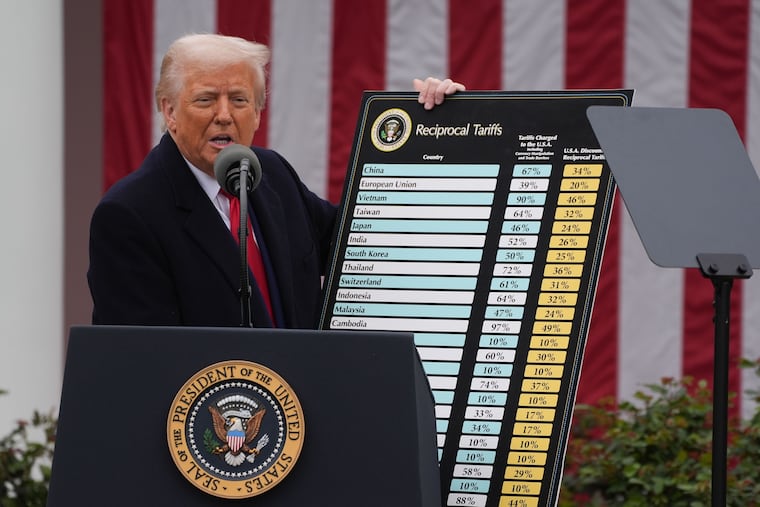
LONDON — When President Donald Trump strode into the Rose Garden in April 2025 brandishing a poster board of tariff hikes, the world leaped as if a fire alarm had gone off. Markets shed trillions of dollars, envoys rushed to Washington, and more than 75 governments scrambled to negotiate, some scrapping carefully prepped countermeasures in a rush to cut deals.
Sixteen months later, the flabbergasting threats keep piling up — to weaponize trade, annex Canada, seize Greenland, abandon NATO, annihilate Iran — but the alarm bells have gone quiet. World leaders are slower to rattle as they’ve seen the president increasingly fenced in by courts, rebuffed by Congress, and strung along by Tehran — his ultimatums evaporating and poll numbers sinking.
When Trump announced a fresh barrage of tariffs last month, this time based on accusations of child labor violations to skirt limits imposed by the Supreme Court, the world didn’t shriek — it shrugged. France’s central bank governor predicted little impact. Britain proclaimed its exporters largely unaffected. Mexico’s economy minister waved it off as one tariff simply replacing another.
The financial markets, inured to the bluster, hardly moved.
As Trump nears the midpoint of his second term, officials and analysts say, one of his signature powers — to bluster on social media, shock, spark panic, and convert that panic (“thank you for your attention to this matter”) into the outcomes that he wants, has begun to fade. The bully pulpit of the presidency remains, but the audience is no longer quaking in the pews.
“We are getting used to these daily announcements,” said Brando Benifei, an Italian member of the European Parliament who chairs its delegation for relations with the United States. “We don’t take them so seriously anymore.”
At home, Trump continues to dominate the national conversation and drive the policy agenda. Still, the president was unable to muscle the Republican-controlled Senate into leaving the Epstein files under seal or passing his signature Save America Act. This week, he had to make concessions to get his nomination of Todd Blanche as attorney general back on track.
Abroad, most consequently, Iran refuses to bend under American bombs and reopen the Strait of Hormuz, and Russian President Vladimir Putin persists in his war in Ukraine. Europe met Trump’s recently renewed demands for Greenland with a collective sigh, and trading partners have shrugged off the latest tariffs.
For a world weary of the United States’ capacity to disrupt, the bombast is baked in, the threats are frequently bluffs, and the president who relishes shock and awe, in the end, often backs down.
The stock trader’s refrain of “TACO” — Trump Always Chickens Out — has begun to take hold in more world capitals, said Jeremy Shapiro, director of the U.S. program at the European Council on Foreign Relations think tank.
“I’ve been a little surprised at how much his bluster has worked until now,” Shapiro said of the bravado that rattled the world at the start of Trump’s second term. It was effective, he said, because it drew on the “awesome power and deep, long-stored-up diplomatic capital of the United States” — reserves, he said, that Trump has “finally started to blow through.”
Officials “are starting to notice that he’s kind of a bully, and is quite easy to scare,” Shapiro said.
Last year’s “Liberation Day” tariffs were hollowed out within days by carve-outs and delays. The steep levies he threatened against European allies over Greenland were withdrawn in Davos, Switzerland, in January for a vague “framework” that Denmark never accepted and has yielded no major change.
China met his threat of 100% tariffs by refusing to blink, then used its chokehold on rare-earth minerals and a halt on U.S. soybean purchases to force Washington into a climbdown — a lesson in how standing tough often causes Trump to bend that other governments have also learned.
Brazil’s president, Luiz Inácio Lula da Silva, ignored a 50% tariff designed to derail the prosecution of former president Jair Bolsonaro, who was convicted of charges related to fomenting an armed coup and sentenced to 27 years anyway.
Nowhere is the erosion of Trump’s bluster-power starker than in Iran, where the United States and Israeli initiated a bombing campaign that killed the country’s supreme leader and other top officials but left the Islamic regime intact and with a stranglehold on the Strait of Hormuz, a vital conduit for global energy supplies and other cargo.
Trump issued a cascade of ultimatums demanding that Tehran reopen the strait, notably threatening to annihilate Iranian “civilization” if it refused. The strait stayed shut. Iran did not fold, even under existential threat, and Trump quietly shifted his stated goals on regime change and on Iran’s stockpile of enriched uranium.
“Between threats, then bombing, then backing off, what he’s radiating to the Iranians is that he’s desperate,” said Ronald E. Neumann, a career Foreign Service officer and U.S. ambassador to Afghanistan, Bahrain, and Algeria under Presidents Bill Clinton and George W. Bush. “As experienced bargainers, that means you don’t have to lower the price.” Neumann also put it less diplomatically: “The way Trump bargains,” he said, “I wouldn’t give him money to go to the carpet bazaar.”
Trump’s browbeating also failed to pull European countries into his Iran campaign. He threatened Spain with a total trade embargo after it refused assistance, leaned on Britain, France, and Germany to reimpose U.N. sanctions, and hinted he might not honor America’s NATO obligations. But those allies refused to get more deeply involved the war — and some countries, namely Spain and Italy, have closed their bases or airspace to it.
When Trump threatened to cut off trade with Spain, said one EU diplomat, officials seemed more inclined to dismiss the comments as rhetorical bluster, with many having learned from experience that his outburst would fizzle if ignored. But this diplomat, who spoke on the condition of anonymity to discuss delicate relations, conceded that Trump’s unpredictability made such calculations difficult.
“It can be tricky,” the diplomat said, citing Trump’s military operations against Iran. “He doesn’t always chicken out.”
To be sure, Trump has shown he is willing pull the trigger.
To the surprise of his America First base that expected retrenchment, not adventurism, he has deployed the U.S. military more aggressively abroad than any recent president — seizing Venezuela’s Nicolás Maduro in a January raid by Special Operations forces, bombing Tehran a month later, and ordering dozens of lethal strikes on alleged drug boats across the Caribbean and Pacific.
At home, he sent National Guard troops on patrol in Washington, D.C., and his immigration crackdown has thrown American cities into turmoil, with masked federal agents sweeping workplaces and courthouses — raids that sometimes turned deadly and ignited protests.
But even the willingness to use force has not bought the deference it once did. Increasingly, officials and politicians at home and abroad are willing to challenge Trump’s threats — or ignore them.
“Europe is noticeably less prone to panic,” said Mujtaba Rahman, managing director for Europe at the Eurasia Group consultancy. “European governments are increasingly distinguishing between Trump’s rhetoric … and the policies that ultimately emerge.”
The pattern reaches into the Gulf, where officials have grown inured to Trump’s style of deal making, analysts said.
Last month, Washington and Riyadh announced an agreement on Saudi Arabia’s civilian nuclear program only for Trump to post later on Truth Social that the deal was contingent on Saudi Arabia joining the Abraham Accords.
Saudi officials found the claim surprising and annoying given that they had already trumpeted the agreement across their own channels, said Andrew Leber, a Middle East scholar at the Carnegie Endowment for International Peace, the Washington-based policy institute.
“At this point, they have dealt enough with Trump deals to know that such exasperating and inconsistent moves have become the norm,” Leber said.
For much of Trump’s first year back, European capitals ran the same strategy of flattery and appeasement they believed had contained him before. European Commission President Ursula von der Leyen flew to Trump’s Scottish golf resort to settle a trade fight on his terms. Britain invited him for an unprecedented second state visit.
Leaders now are still willing to flatter Trump, especially in private, but they are less willing to offer the concessions he wants, according to a European diplomat who has been involved directly in talks with the administration.
“Behind closed doors they are still putting it on thick because they know it works,” said the diplomat, who spoke on the condition of anonymity to discuss sensitive interactions. “This is a president who can significantly soften his position in the course of a single meeting. But that doesn’t mean you give in. That is true more than ever.”
Greenland was a turning point, the diplomat said, because Trump’s threats evaporated against united European opposition. China, too, showed that pushing back could bend the president, as did Brazil, whereas Europe’s surrender to Trump’s initial trade barrage merely led to further demands from him.
“I think people are saying, well, we don’t want to provoke him unnecessarily, but we can’t really make him happy,” said Neumann, the former ambassador.
Learning to mute Trump’s threats won’t necessarily make the rest of his term easier to navigate, analysts said. Doing so could even make things less predictable if Republicans lose one or both of their majorities in Congress in the midterm elections and Trump turns to more unilateral executive actions.
“It could be super dangerous,” Shapiro said. “Trump is not somebody who will go quietly into the night. He will rage about his loss of capacity and he will look for other ways to take risks with American power.”