Long-awaited pedestrian swing bridge across Schuylkill opens. Here’s what you need to know.
The $28 million bridge officially opens Friday to thousands of runners, cyclists, and walkers using the Schuylkill River Trail.
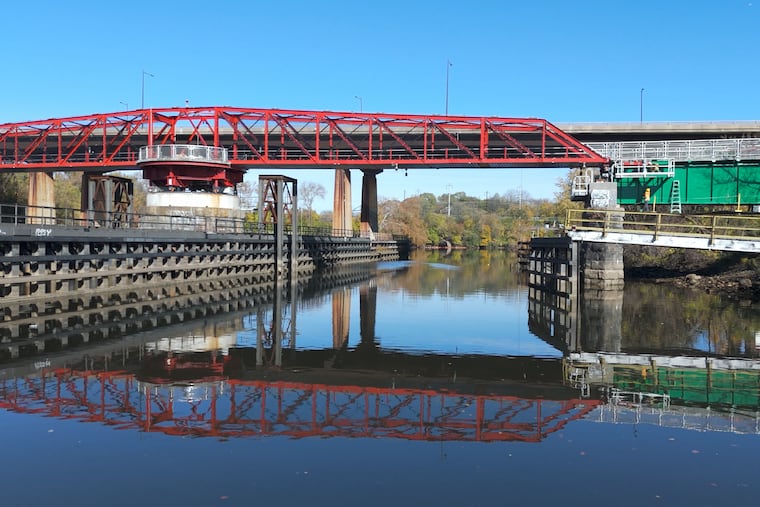
A red steel bridge swung over the Schuylkill in one of its final tests before opening to the public.
Its 225-foot span and 60,000 pounds of mechanical drive equipment pivoted into place with precision, joining the east and west sides of the river.
“It is kind of like a Swiss watch,” Tyler Barile, assistant chief construction engineer for the Philadelphia Streets Department, observed during a test of the new bridge Wednesday. “All those pieces have come from all over the country to fit together with tolerances to thousandths of an inch.”
The $28 million bridge officially opens Friday to thousands of runners, cyclists, and walkers using the Schuylkill River Trail. They will be able to cross unimpeded from Center City through South Philadelphia to Grays Ferry. They will come out just above Bartram’s Garden.
Officials call it a major engineering achievement for the Schuylkill River Trail in Philadelphia.
Connecting historic landmarks
The bridge was built through a partnership between the nonprofit Schuylkill River Development Corp. (SRDC) and the city. SRDC works with the city on the Schuylkill corridor from the Fairmount Dam to the Delaware River, branded as Schuylkill Banks, which is part of the much larger Schuylkill River Trail.
“The bridge fills an important gap that connects not just the east and west river banks,” said Heather Saeger, interim CEO of SRDC, “but it also connects Bartram’s Garden to Fairmount Waterworks, both National Historic Landmarks.”
The crossing links approximately 1.5 miles of trail to the south with three miles to the north, creating about 4.7 continuous miles along Schuylkill Banks with the bridge included.
Beyond Schuylkill Banks, the opening extends unbroken riverfront trail travel to over seven miles north to Ridge Avenue in Manayunk, where plans are underway for a connector to the rest of the Schuylkill River Trail that now extends to Reading.
Saeger emphasized that adding the swing bridge alongside the Schuylkill Banks boardwalk and cable-stayed bridge that opened in 2025 is “hugely important for completing that vision, building momentum for future trail sections.”
» READ MORE: New $48M pedestrian bridge connects Schuylkill Banks in Center City to Grays Ferry
Past trail expansions have dramatically accelerated use. Average weekly trips by users on Schuylkill Banks grew from 8,000 during its 2000 opening to 37,000 now, at Walnut Street, after the cable-stayed bridge opened, Saeger said.
In fact, Schuylkill Banks is by far the most heavily used trail segment in the region where trail counters are installed, according to data from the Delaware Valley Regional Planning Commission.
In the year to date, counters have logged 431,159 cyclist and 1.4 million pedestrian trips on the segment.
The new crossing also serves as a critical stepping stone for future southern extensions toward Passyunk Avenue and, ultimately, Fort Mifflin. It unlocks a dedicated commuter route between Southwest and South Philadelphia.
The bridge will remain in place across the river for trail users most of the time, swinging open only occasionally to let marine traffic pass. The city will get notice far in advance through the U.S. Coast Guard and can schedule the closing of the trail.
In all, it takes about three minutes from start to finish for the gates on the pedestrian walkway to close and the bridge to open or close.
Why a swing bridge?
The idea for using a swing bridge to cross the Schuylkill dates to 2009, said Chariss McAfee of Charles Loomis Chariss McAfee Architects. The firm volunteered with the nonprofit Community Design Collaborative’s Infill Philadelphia initiative, which explores development opportunities through design.
At the time, the group was studying connections between Wharton Street in South Philadelphia and Bartram’s Garden.
Separately, the SRDC and city officials were considering building a pedestrian bridge over the existing swing bridge at the same location. That bridge was adjacent to the traditional Grays Ferry Avenue bridge, which has a pedestrian walkway but is not connected to the trail on both sides.
McAfee and the Infill Philadelphia group believed that building over the infrastructure of the old swing bridge would require a new bridge to be very high with steep ramps.
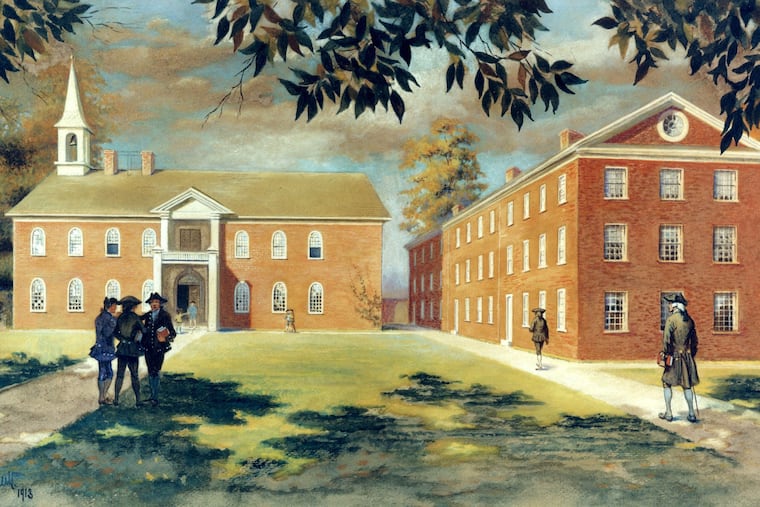
The swing bridge was built in 1902. Conrail acquired it in 1976 and removed it from service in 1984.
The Infill Philadelphia team proposed rehabilitating it.
“We suggested that they really consider reusing the swing bridge,” McAfee said, “because it would put the people crossing it, the bikers and the pedestrians, closer to the water.”
That concept drew support.
“It’s going to be wonderful to actually cross and come over on the other side pretty much at the bank level,” McAfee said this week, “and not have to come down another massive ramp.”
Built in Coatesville
The city adopted the concept of a bank-level swing bridge, but structural realities required building a new truss atop the historic stone piers.
It took about eight years from planning and funding through to construction and installation. The bulk of the funding came in 2015 through a federal grant.
The swing bridge work involved construction that had to navigate around I-76, active CSX rail yards and tracks, and private commercial landowners along the riverfront. And it included building over a tidal riverfront.
Removing the old bridge and assembling a new bridge posed significant challenges, said Barile, the city engineer. The old truss was frozen open, and removing it risked destabilizing it. Because it rested on a pivot, workers had to cut a little off one side, then a little off the other side repeatedly to keep it balanced.
The new bridge had to be built and assembled to rest on the original stone-and-masonry piers and abutments already anchored in bedrock.
A center pivot balances the new bridge with so little friction that workers were able to spin it by hand during assembly.
Motors came from California, electrical controls from Chicago, various machinery from Miami, and gearboxes from Niagara Falls. The main truss was fabricated in Coatesville.
South Jersey-based AP Construction is the general contractor, and Philly-based Urban Engineers provides construction management oversight.
“You’re not just ordering a truss online, and it gets you a two-day shipping,” Barile said.