A Penn student journalist is part of a lawsuit against the White House’s ‘ban on free press’
Ethan Young, the editor-in-chief of the Daily Pennsylvanian, is one of six people who sued President Donald Trump over banning of journalists from the White House.
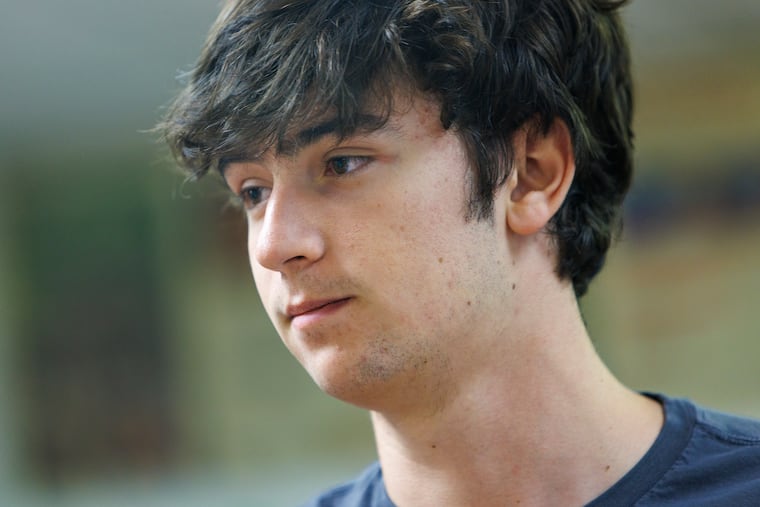
A University of Pennsylvania senior and student journalist joined a lawsuit accusing President Donald Trump of violating the First Amendment by expelling reporters from the White House as part of a “ban on free press.”
Ethan Young, a history and political science major and the editor-in-chief of the Daily Pennsylvanian, is one of the six people who sued Trump and other officials over what the complaint calls a “policy” of punishing members of the White House press corps by revoking journalists’ credentials.
The 21-year-old from Philadelphia is participating in the lawsuit in his own capacity and not as a representative of the Daily Pennsylvanian.
“I see myself as a very small part of a larger consequential moment,” he said.
(Young interned at The Inquirer over the summer as part of a program of the Pennsylvania Legislative Correspondents’ Association.)
He joined the suit because he often incorporated reporting of the White House press corps into his work in the student newspaper. As a student in Philadelphia, Young said in a declaration accompanying the lawsuit, he can’t attend White House press briefings and needs reliable information about the administration for the stories he writes and edits.
The complaint was filed Monday in a New York federal court, and it asks a judge to find Trump’s policy unconstitutional because “it imposes restrictions on a limited public forum that are viewpoint based and unreasonable.”
In addition to Trump, the suit names White House chief of staff Susan Wiles, assistant to the president for communications Steven Cheung, and Secret Service Director Sean Curran.
Young is a plaintiff alongside a human-rights advocate, a Pulitzer Prize-winning historian, two independent journalists, and New York City high school teacher.
The six together illustrate “the different ways the policy impacts the American public,” Young said.
The suit describes the history of the White House press corps, dating back to the 1881 origin of the press pool and President Theodore Roosevelt’s 1902 decision to dedicate a room in the West Wing for the press.
The policy began right after Trump’s second term began, according to the complaint. In February 2025, the White House banned the Associated Press from the press pool because it continued to use the term “Gulf of Mexico” after Trump renamed the body of water “Gulf of America.”
Last month, the White House revoked the credentials of CNN, MS NOW, and Politico. On his Truth Social platform, Trump said the ban was in response to “FAKE NEWS,” the suit notes.
Days after, the suit says, Trump posted on Truth Social that “the White House is not instituting an assault on the Free Press … It is instituting an assault on the FAKE NEWS.”
A federal judge earlier this month found the ban was likely unconstitutional.
In court filings in lawsuits related to journalists’ access to the White House, the Trump administration repeatedly described its action as part of a “policy,” the suit says.
The White House’s policy deprives the public of independent reporting, the complaint says, and it impacts the work of reporters who weren’t banned because “every journalist who reports from the White House must now account for the possibility that a critical or ill-advised word about the president may result in their access being summarily restricted or revoked.”
Lawyers from the Knight First Amendment Institute at Columbia University and the Media Freedom and Information Access Clinic at Yale Law School filed the complaint on behalf of the plaintiffs.
“The White House cannot decide what information Americans receive by punishing critical reporting,” Katie Fallow, deputy litigation director at the Knight First Amendment Institute, said in a statement.
A White House official said in a statement that no person can demand access to the Oval Office.
“Media that peddle misinformation and defamation are completely capable of reporting their manufactured stories from directly outside,” the official said.
Young said he is honored to be part of the lawsuit, and his family has been supportive of his choice to sue the president. The people around him saw his passion for journalism and the amount of time he has spent at his college newspaper.
“As someone who wants to be a journalist,” Young said. “I see upholding the First Amendment as synonymous with pursuing that profession.”