City Council grills Drexel representatives for closing Academy of Natural Sciences museum
During several hours of testimony, City Council members were focused on what it would take to reopen the museum to the public.
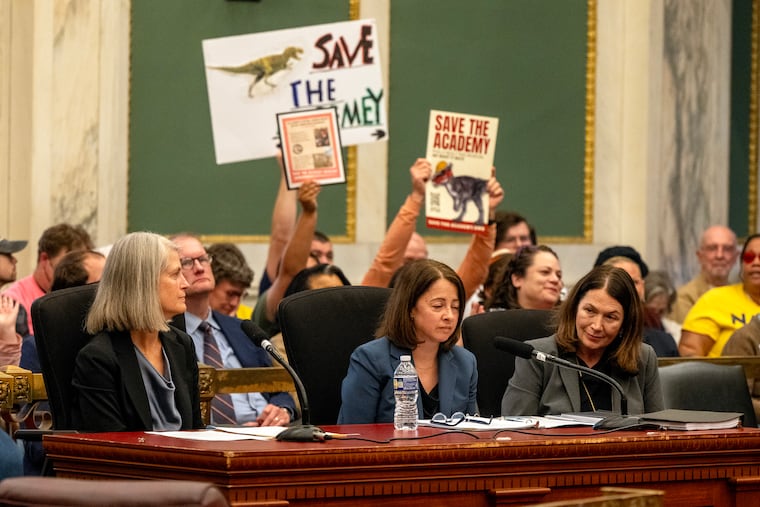
Philadelphia City Council members on Monday grilled representatives of Drexel University over why the school closed the Academy of Natural Sciences museum without first seeking potential support from them and the philanthropic community to save it.
“Why is this museum not as important to you as it is to members of the general Philadelphia public?” asked Councilmember Quetcy Lozada during an hours-long afternoon session that the Council’s legislative committee called to investigate the museum’s closure.
The hearing marked the first time that a legislative body was able to ask questions about the closure that has garnered international attention and criticism since Sept. 1, when Drexel and the Academy announced that the museum would no longer be open to the public after nearly two centuries in operation.
» READ MORE: Drexel University and the Academy of Natural
More than 120 people filled Council chambers, waving “Save the Academy” signs and booing repeatedly when a Drexel official offered testimony on its steps that led to the closure.
“The current operating model was quietly devouring the Academy from within,” said Melissa Richman, Drexel’s executive director of operations, who delivered a statement on behalf of the university. “Over these last 15 years, Drexel has provided the Academy with an infusion of over $49 million in direct cash support to cover the Academy’s recurring operating deficits, in addition to tens of millions of dollars in the form of in-kind administrative support to sustain the Academy’s work.”
She said given Drexel’s own financial challenges — the university has been working to erase a deficit — Drexel can’t afford the $5 million to $6 million a year in support to the Academy.
» READ MORE: William Penn Foundation offers funding to keep Academy of Natural Sciences museum open
“To put the Academy on a sustainable financial path, Drexel is prepared to do everything within our financial means, including bringing together civic leaders, philanthropic partners, and other stakeholders to help secure the Academy’s future,” Richman said. “We welcome any viable, long-term solution, including one that would allow the Academy to remain in its current Parkway location, provided its substantial capital needs are addressed and a sustainable operating model is established.”
The hearing comes amid talks between Drexel and the Academy to renegotiate their affiliation agreement — discussions that have not as-yet yielded an agreement. A source close to the negotiations said no further talks are currently scheduled.
Drexel president Antonio Merlo did not attend the hearing, which drew repeated criticism from Council members, who called his absence “disrespectful.” Richman said Merlo had to be on campus for a site visit by the Middle States Commission on Higher Education, which is undergoing its regular reaccreditation process that happens every five years.
Council members were also critical of Mayor Cherelle L. Parker’s administration for not sending a representative to the hearing. The city’s representative on the Academy issue, Deputy Mayor Trish Wellenbach, did not show up at the hearing, sending a statement instead saying she was not the “appropriate” person to testify, as she could not speak on behalf of Drexel or the Academy.
» READ MORE: The Academy of Natural Sciences museum is closing, but all eyes are on its specimens — all 19 million of them
Councilmember Jeffery Young Jr. tore up Wellenbach’s statement. He said the body would be issuing subpoenas to compel certain people to testify at a future hearing, now scheduled for Nov. 16.
It is out of the ordinary for the administration to not send a representative to testify in a high profile hearing if Council sought it, and it would be highly unusual for Council to issue a subpoena for testimony, especially from a member of the mayor’s administration. While Council has the power to compel testimony, it rarely exercises that power.
During the testimony, Council focused on what it would take to keep the museum, which was closed to the public Sept. 27, open. About 50 people were scheduled to speak.
The Academy’s public programs last year cost $7.7 million but brought in only $3 million in revenue, Richman told Council.
“So if there was a commitment from both the city as well as the private sector to offset that $4.4 million that you lose annually, do you think there would be an appetite to open the museum back up and keep it in the same location?” Committee Chair Isaiah Thomas asked.
“I think if there is an opportunity for financial resources that created both a financially sustainable model for the Academy and allowed us to address some of the capital expenditures that are required for that building, that would certainly be a possibility,” Richman answered.
The university has previously said the building needed about $150 million in deferred maintenance.
“That was the best answer today,” Thomas said.
Richman said the decision to close the museum came after a “rigorous, two-year strategic study of the Academy underwritten by the Pew Center for Arts & Heritage. Informed by Academy leadership and multiple external consultants and subject-matter experts, the study comprehensively assessed the Academy’s physical building needs, the care the collections require, research capacity, and the economics of operating the museum.”
The study “explicitly” recommended closing the Academy museum, the Drexel statement read by Richman said.
Academy board president Suzanne Biemiller said during Monday’s hearing that the Academy would like to see the commissioning of a feasibility study.
In an effort to keep the doors open, the William Penn Foundation has offered to cover Drexel’s subsidy of the museum for a year while a path toward a long-term solution could be found. Drexel has neither accepted nor rejected the offer, which was made more than a month ago.
“The foundation has not received a response to our offer to help keep the museum open while longer-term plans are evaluated and additional parties are engaged to identify potential solutions,” a William Penn spokesperson said Monday before the hearing. “We remain open to conversations about how we can be helpful.”
Drexel is financially responsible for the Academy, according to the September 2011 affiliation agreement between the two institutions, “and shall cause sufficient funding to be made available to meet any operating deficits, liquidity needs, and budgeted capital improvements … that may be incurred.”
The hearing was preceded with a news conference and demonstration outside of City Hall by the Save the Academy Coalition to advocate for an “independent interim commission to safeguard the academy and secure its next 200 years.”
The demonstration was attended by about 120 supporters holding signs like “We Need Science” and “Save the Academy.”
“We hope [this] marks the beginning of both accountability and a brighter future for this institution,” coalition organizer Isa Betancourt told the crowd.
Staff writer Anna Orso contributed to this article.