This wealthy Victorian family left behind a pet cemetery in Northeast Philly. Meet the pets buried there.
The Ryerss family's love for animals transcended death. They donated swaths of money to animal welfare causes, set aside funds for their care, and buried the dead in a pet cemetery.
We love our pets to death. But some love their pets in death.
The latter was the case for the Ryersses, the prominent Victorian-era family and namesake of the Ryerss Museum and Library, a trove of worldly oddities tucked away in the Fox Chase neighborhood.
In addition to being railroad and shipping tycoons, prolific travelers, and eclectic collectors, the Ryersses fiercely protected furry friends, decried vivisection, and helped found the Pennsylvania Society for the Prevention of Cruelty to Animals.
“They loved all animals,” said Martha Moffat, the museum’s site manager. “They were early animal rights advocates.”
That love transcended their pets’, and their own, mortality. The Ryerss summer estate, Burholme, features a pet cemetery on the mansion’s west side. Pet cemeteries and pet portraiture grew more common during this period, as animals started to be seen as loving companions not just workers. The Ryersses also donated large sums of money to animal welfare causes and willed up to $2,000 a year to care for any pets alive after their deaths, according to the museum’s displays.
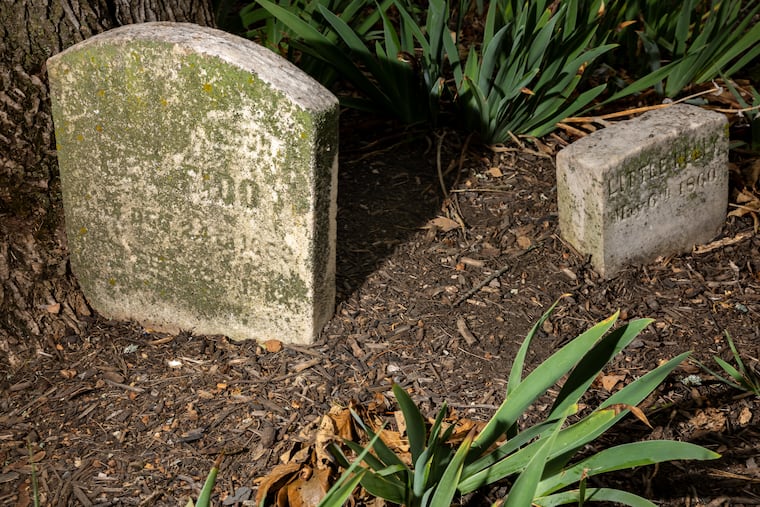
Nine marble tombstones remain clustered around the grand tree outside the mansion. More than a century spent in the elements have made some of the inscriptions illegible. Only names — Jenny and N.R. — remain on two of the graves. At some point, there was at least one other tombstone on the property, Moffat said.
Little is known about the animals buried here and records are scarce. No Ryerss family dairies were left behind to give insight into these pets or their personalities, according to Moffat, but we presume they were all — or mostly — “good boys and girls!”
Pet Fido & Pet Fanny
Fido (d. 1882) and Fanny (d. 1878) were born on Christmas Eve in 1863, a Thursday in the midst of the Civil War, according to their tombstones.
Fido and Fanny, both Capricorns, lived to be 18 and 14, respectively — above average ages. They must have been disciplined and ambitious, like all Earth astrological signs.
Fido and Fanny are featured in an oil painting by the revered Germantown artist Newbold H. Trotter. Trotter painted other Ryerss family pets, including a horse named Old Grey and a tricolored trio of rabbits, which are on display in the second-floor library.
In Trotter’s 1872 rendition, Fido appears to be a greyhound, or perhaps just a gray hound, wearing a red collar, sitting alongside Fanny, a golden long-snouted hound with a green collar.
At least one other grave was for a dog: Dalmatian Ponto. Ponto — a brown-spotted dog, whose collar read “Pont” — was immortalized in an 1884 painting. A year later, Ponto died at age 9.
A “Fido” was also photographed on the porch of Burholme … in a photo dated 1895 — more than a decade after “Fido” died, according to the tombstone.
A ghost?!
Or maybe the Ryersses “really liked the name,” Moffat said. (Moffat had no reports of paranormal pet activity.)
Little Nelly
It appears the Ryerss family also liked the name Nelly.
Little Nelly’s gravestone includes only one date: May 6, 1860. It’s unknown if that’s a birth or death date.
An undated and unattributed 19th-century oil painting shows Nelly as a black and tan pointy-eared dog with a red collar. Nelly looks with intensity off of the canvas, maybe scoping out for squirrels.
But another painting, from 1884 by J.N. Hess, depicts “Nellie” as a dark brown mare, standing in a field with three Dalmatians.
Old Grey
The Ryersses likely had many horses on their land. Matriarch Anne Waln-Ryerss, a “petite, feisty, but kindhearted lady,” bequeathed and trusted $70,000 to establish a hospital for ill, aged, and injured animals after she died. The Ryerss Farm for Aged Equines in Pottstown is now the oldest horse retirement farm and rescue in the country, according to its website.
One of those equines was Old Grey, a white-and-gray flecked horse painted by Trotter in 1873.
Old Grey’s resting place was once marked by a tombstone somewhere on the Ryerss property.
But decades ago, the slab was stolen, Moffat said.
The culprit was never caught.
The Ryerss Museum and Library, at 7370 Central Ave., Philadelphia, Pa. 19111, is open Fridays through Sundays from 1 p.m. to 4 p.m. Admission is free.