Fed up, these Philly neighbors banded together to map illegal dump sites block by block
They want a comprehensive, transparent map of illegal dump sites across city streets, vacant lots, and parks as a step toward being able to address them comprehensively.
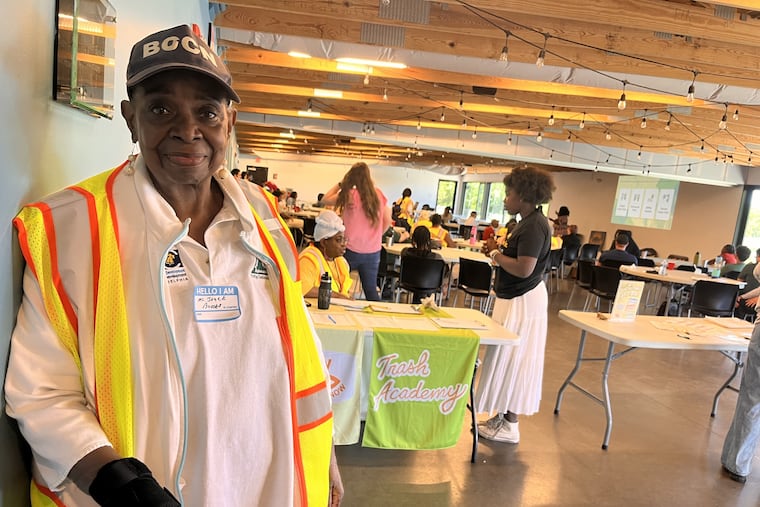
Joyce Brooks is dismayed by the contractors who illegally dump behind a shopping center at 15th and Wingohocking Streets.
But it’s the neighbors who dump there who sadden her most, she said. Some bring children with them to toss waste in a dump that has lasted 20 years, despite being cleaned out over and over again.
“That’s a legacy. Passing it from adults to children to their children,” said Brooks, who leads the Block Captains Committee of Nicetown, a neighborhood grassroots group.
Brooks was one of about 75 Philadelphia residents representing neighborhood groups and nonprofits who gathered Thursday at the Discover Center in Fairmount Park to map by hand illegal legacy dumps scattered throughout the city.
The groups want a comprehensive, transparent map of illegal dump sites across city streets, vacant lots, and parks as a step toward being able to address them comprehensively.
The event was organized by Clean Philadelphia NOW, a collaborative with multiple neighborhood organizations and nonprofits. It pulled together community groups and residents from 11 neighborhoods.
“I just want to encourage us as a people to stop this,” Brooks said, “not just in Nicetown but all over this city of Philadelphia. … I believe there’s hope.”
Legacy dumps are one of the biggest issues affecting the quality of life in Philadelphia, said those at the event, and they want to find solutions.
In April, The Inquirer identified one of the largest illegal dumps in the city. The dump spans more than a block down a slope off Pennway Street in Northeast Philly and finally comes to a dirty halt just feet from a clear creek.
» READ MORE: This is one of Philly’s biggest illegal dumps. Cleaning it up is a logistical nightmare.
The root cause
Shari Hersh, a codirector of Trash Academy, one of the groups collaborating under Clean Philadelphia NOW, said the goal is not only to clean sites but also to replace outdated waste management systems with sustainable, long-term solutions.
The Clean Philadelphia NOW initiative began mapping sites in fall 2024, initially documenting 48 dump sites in the Fairhill and Harrowgate neighborhoods. It hosts the map on its website.
While the city has heavily invested in abatement, Hersh argues that the approach falls short of addressing the root causes of the persistent “clean-dump-clean cycle.”
Hersh said community cleanups are not a solution.
She said some illegal dump sites, such as one at Ninth and Ontario Streets in North Philadelphia, have been actively dumped on multiple times a week since 2005. Simply cleaning them out does not stop dumping.
“It can’t just be the neighbors who have the time to work on it,” Hersh said. “It has to be that we have a successful waste management system in the city of Philadelphia.”
She believes dumping is fueled by several factors.
“There are a lot of reasons why there’s dumping, and there are a lot of people doing it because, to some degree, it’s normalized in Philly,” said Hersh, who lives in Fairmount. “They think, ‘It’s always been dumped there, so we’re just going to keep using it as a dump.’ And some people don’t even know it’s wrong.”
Hersh said collaborators would like to see municipal curbside composting to manage the food odors from residents putting trash out on non-collection days.
And they would like to see cost-effective voucher programs for construction and demolition waste.
“We don’t just want to manage illegal dumping,” Hersh said. “We want to end it.”
She said she did not have a final tally yet on the number of legacy dump sites but estimated the group’s current total could be around 100.
On Thursday, event attendees hand-pinned dumping sites to a physical map. Clean Philadelphia NOW volunteers will vet the sites against an online map to get a true count.
Hersh expects the list of illegal dumping locations could swell to 200 as they keep adding more through the end of the year.
A sense of pride
Dallas Herbert Sr. of the 215 People’s Alliance said he hopes the collaboration can help “create a sense of pride in the community.”
Construction waste is a big issue, he said. It worsens as homes are razed and new ones built. He calls it an “unintended consequence” of the city’s attempt to create more housing. People unload the contents of old homes at the sites. Some contractors dump debris there.
Herbert said contractors should have to show proof to the city that they dispose of waste correctly, and the city should “hold them to account.” He said much construction waste can be recycled.
Most of those in attendance at Thursday’s event credited the city‘s focus on litter under Mayor Cherelle L. Parker. But they would like to see more done.
A dumping voucher
Rosemary Duarte, director of neighborhood impact services for the nonprofit North10 Philadelphia, believes there are solutions. The group works to improve the Hunting Park and East Tioga neighborhoods.
She said one dump in her neighborhood gets cleaned by the city each Tuesday and is monitored by video cameras. Still, contractors and others sneak in at night.
North10 Philadelphia has a grant from the William Penn Foundation to give residents $120 vouchers for bulk-item trash taken to Burns Services in an effort to curb dumping. Burns has a 13-acre Hunting Park complex where demolition debris is sorted for resale to steel mills, building-materials makers, plastics plants, and other re-users.
So far this year, North10 Philadelphia has given out $10,000 worth of vouchers, Duarte said.
The group reaches illegal dumpers by posting signs at legacy locations that read “Please don’t dump here” and telling them how to reach out for vouchers.