How thousands of heavy-duty recycling carts made in Hunting Park ended up on construction sites around the U.S.
Philadelphia’s Burns Services invented the TommyCart as a better way to sort, save, and sell recyclable materials from construction sites.
The TommyCart, a durable, bar-coded, welded-steel recycling wagon made in Philadelphia, is popping up at U.S. construction sites from the Wanamaker Building’s apartment conversion in Center City to the Tennessee Titans’ new stadium in Nashville.
The carts, specialized for recycling, were developed by Richard S. Burns & Co. at its 13-acre Hunting Park complex where demolition debris is sorted for resale to steel mills, building-materials makers, plastics plants, and other reusers.
“We were struggling with increasing the quality of recycling material going out the door, and from the increased quantity of material coming in the door,” said Allen T. Burns, who runs the company, now known as Burns Services.
His father, company founder Richard S. Burns, tried automatic sorters but found they chewed up and wasted more than half the material.
So the family-led team invented and patented a heavy-duty cart, more nimble than the heavy dumpsters used to collect industrial waste. With the carts, they could more easily weigh, measure, and handle materials at crowded building sites. The process was efficient enough to resume hand-sorting and recover far more material to resell.
Burns ships several thousand TommyCarts back and forth from his Hunting Park complex to regional building sites and has leased thousands more to construction recyclers in Washington, D.C., Pittsburgh, Chicago, and Tennessee.
Using the TommyCarts, the company can sell about 80% of the recyclables it collects for reuse.
Burns rolled out its first TommyCarts in 2015. The firm collected a string of patents, began selling the carts to other recyclers in 2023, and won a key industry certification last year. The goal is to produce up to 3,000 TommyCarts in 2027, double this year’s output and triple last year’s.
How the company grew
Burns Services has made an average of 500 carts a year since 2015, mostly for its own use at the company’s 13-acre Hunting Park complex. Truckloads and TommyCart-loads of debris — 500 trailers’ worth on a typical day — arrive at the yard, where the materials are sorted and sold.
“We have six welders, and we can make 15 carts a day. We need to get close to 50 a day to keep up with demand. So we are getting into full robotic welding,” Burns said.
The carts are named for Burns’ business developer, Tommy Garlick, who is listed as co-inventor on some of Burns’ nine patents.
“We have rebuilt our maintenance shop, renovated our welding shop, sandblaster, and paint shop to make room for the automation,” Burns said.
His father, born in an upstate prison, started the company after his Marine Corps service, a semi-pro football career, and a stint at a steel company.
At the time, recycling was a response to the rising cost of landfills.
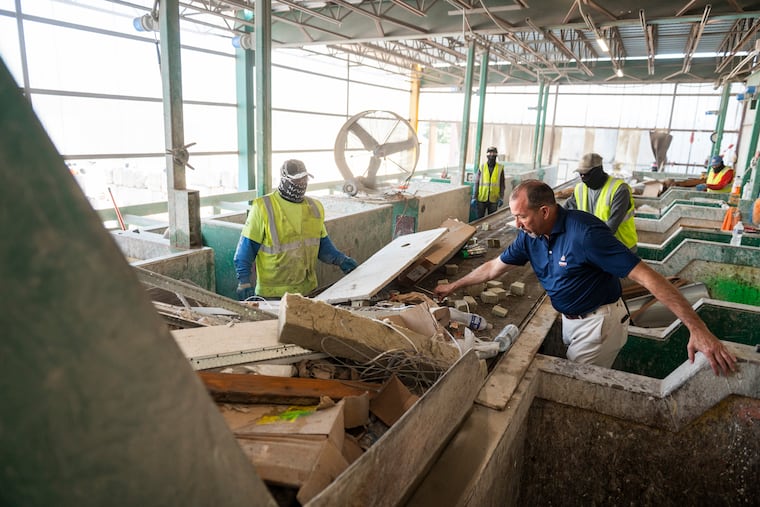
“Dad’s philosophy is that waste is a commodity you haven’t found a market for,” Burns said on a hot June day over the clash of falling debris, sprayed by industrial misters, from the conveyor belt-driven sorting line above two lines of TommyCarts.
This is no clean-room factory, as where pharmaceuticals or computer chips are made. Carts are assembled in the Burns welding shop, with rectangular grips for forklifts, wheel mountings, and a brake attached below.
Outside, sorting-line workers stand wrapped, booted, visibility-vested, and goggled like travelers in a sandstorm — though Burns worked gloveless as he lent a hand, flicking wallboard, steel trim, and plastic liners from truck-fed conveyor belts to the TommyCarts waiting below.
Pre-TommyCart efforts at automated sorting mangled and smeared the loads, so less than a third of the material could be recycled. Next-generation TommyCarts, numbered and coded, are easy to move in confined areas, simple to weigh before and after sorting, and less damaging.
Fire can be a menace in a scrapyard — more so recently, with rapidly growing incidence of hot lithium-ion fires from improperly discarded tool and appliance batteries. The EMR scrapyard, Burns’ go-to buyer for iron and steel near Camden’s Beckett Street metal-shipping port terminal, was closed after its latest fire in May, forcing area yards like Burns to find new buyers.
Burns also had fires traced to batteries this summer, noted John Thomas, Hammonton-based president of the Construction & Demolition Recycling Association, which named Burns “Recycler of the Year” for 2025.
Honky-tonk cleanup
In 2023, a Nashville builder gutting a 30,000-square-foot site for country star Morgan Wallen’s new bar had a problem: Trucks couldn’t squeeze onto the site in the city’s crowded Lower Broadway honky-tonk strip and had to be hand-loaded from a distance — at prohibitive cost.
Lincoln Young, a demolition-debris contractor who runs Rockwood Sustainable Solutions in Tennessee, reached out to Burns in Philadelphia. “He has a patented system, a proven process,” for rolling TommyCarts into the building and back to the trucks, Young said, so the material can be easily weighed, sorted, and sold.
Rockwood leased carts for the job and became Burns’ first outside TommyCart user.
“The beautiful thing, these carts would cost me maybe $1,200 to make, but leasing them I have no capital cost. I can scale more or less of them when I need them,” Young said. “General contractors around the country are now calling for TommyCarts in their contract specs. We have hundreds of TommyCarts now at the new Titans stadium.”
Burns says verifiable measurement is the key to paid recycling. The conveyor system reads the bar codes and records the gross weights to calculate payment.
“This is not the cheapest way of doing it,” Burns said. “We have competitors who charge less per container. But this way you have accountability. You can get industry certifications.”
The carts are welded — 20 feet of weld per cart — joining plates of 3/16-inch steel supplied by distributor Joseph Fazzio in Glassboro from U.S. and foreign mills.
Burns also has tried automated painting systems for the sandblasted metal surfaces, so carts can go a decade without repainting. A $50,000 automated-spraying rig can pay for itself in two years by using less paint, he said.
“Automation itself is not the issue. Like any tool, it is how it is used,” said Anton Ruesing, director of the Finishing Trades Institute for the IUPAT painters’ labor union. “Tools that reduce repetitive motion injury, improve safety, increase productivity, or even lower costs can enhance both the worker’s and the contractor’s experience” — as long as the worker remains in control and helps plan the job.
The company’s Philadelphia location helps recruit reliable labor, Burns said. He’s hired industry veterans, immigrants, former prisoners, and family members of employees. Some workers have been targeted by Immigration and Customs Enforcement, incurring legal bills even though they are in the U.S. legally, Burns said.
Work in the yard starts at $16.50 an hour plus benefits, rising to $38 an hour. Overtime starts with the federally mandated time-and-a-half over 40 hours a week, rising to 1.8 times base pay after 60 hours. Sorters can earn more than $50,000 a year, plus benefits.
Burns’ sons work there, too. “Me and my brothers, we dropped out of high school and worked for my dad,” he said.
Burns says he learned more in decades of long work, weeks next to his father in the workshops, and from the lawyers, accountants, architects, engineers, and other professionals that help deal with clients and suppliers.
“I worked elbow-to-elbow with my father,” he said.
Burns says automation makes work smarter but doesn’t eliminate the need for people, who come up with in-house solutions to tough problems.
That’s why, as construction companies are experimenting with artificial-intelligence systems, Burns has built a staff of four full-time software programmers.
“Off-the-shelf systems don’t do what we need,” Burns said.