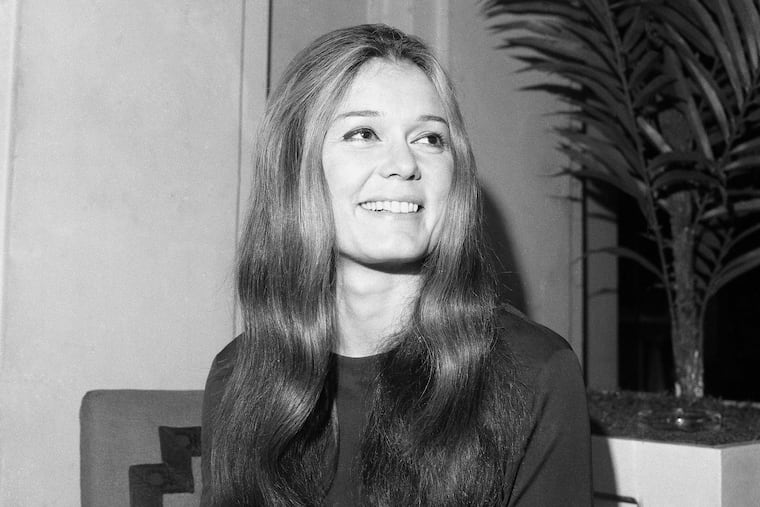
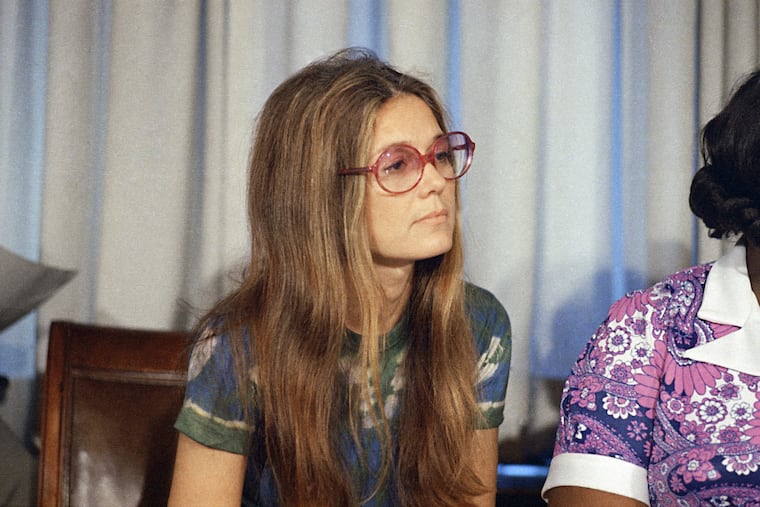
Annie Dillard, Pulitzer-winning author of ‘Pilgrim at Tinker Creek,’ dies at 81
She was viewed as a bard of the environment, a 20th century Henry David Thoreau.
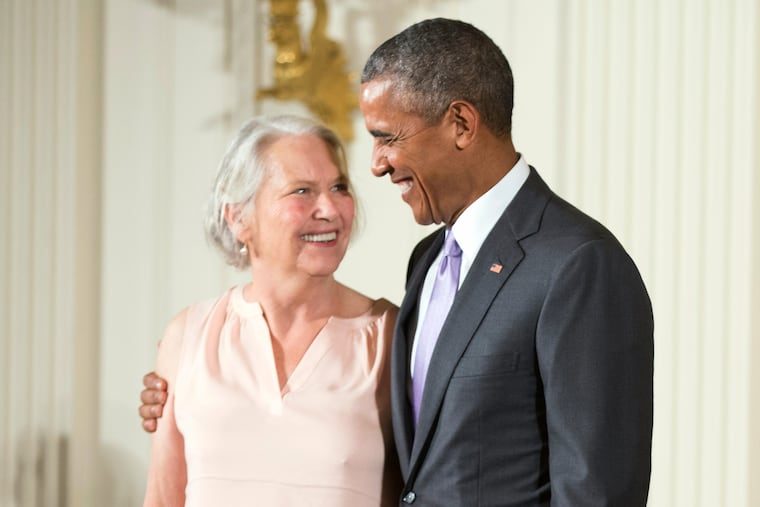
Still in her 20s and possessed of a curious eye and sensitive spirit, Annie Dillard set out beneath the trees along Tinker Creek in southwestern Virginia and emerged with a best-selling book that made her one of the most honored and beloved writers of her time.
Pilgrim at Tinker Creek, published in 1974, won the Pulitzer Prize and made Ms. Dillard something more than a literary celebrity: She was viewed as a bard of the environment, a 20th century Henry David Thoreau, a youthful sibyl of the wildwoods, a visionary whose shimmering prose offered glimpses of the eternal.
Ms. Dillard, who went on to write well-received novels, memoirs, essays, and poems, and was awarded the National Humanities Medal in 2015, died Tuesday at her home in Wellfleet, Mass. She was 81. Her death was confirmed by writer Maggie Nelson, her literary executor.
Pilgrim at Tinker Creek seemed to be an almost perfect embodiment of its times: an eager embrace of the natural world, a work of mystical, even sensuous prose, and the spiritual autobiography of a questing soul.
“I am no scientist but a poet and a walker with a background in theology and a penchant for quirky facts,” Ms. Dillard wrote. “I walk out; I see some event that would otherwise be utterly missed and lost, or something sees me, some enormous power that brushes me with its clean wing, and I resound like a beaten bell.”
Her model was Thoreau, who chronicled a year spent in a cabin in his 19th century literary classic Walden, which became a lodestar for students and nature lovers of the 1960s. Ms. Dillard similarly wrote about a single year — winter to winter — at Tinker Creek, giving the impression that she was isolated deep in the Blue Ridge Mountains of southwestern Virginia.
In reality, Tinker Creek flowed through the suburbs of Roanoke, where Ms. Dillard lived at the time with her first husband. When she recorded her musings on nature, she was seldom out of range of houses, highways, and other fixtures of modern life.
“I didn’t say, ‘I walked by the suburban brick houses,’” she told the Atlantic in 2015. “I didn’t obscure anything, I just left it out.”
Yet her descriptions of the stones, trees, insects, and slippery creatures she found there — and her responses to them — suggested a pristine state leading to meditation, even prayer.
“A reader’s heart must go out to a young writer with a sense of wonder so fearless and unbridled,” novelist Eudora Welty wrote in the New York Times. “There is an ambition about her book that I like, one that is deeper than the ambition to declare wonder aloud. It is the ambition to feel.”
Ms. Dillard openly invoked a sense of the divine as she explored the world above her head and beneath her feet, but her depiction of nature went far deeper than sunshine and birdsong.
“Evolution loves death more than it loves you or me,” she wrote in Pilgrim.
In one of the book’s most celebrated passages, Ms. Dillard described the death of a Tinker Creek frog, attacked by a giant water bug:
“As I looked at him, he slowly crumpled and began to sag. The spirit vanished from his eyes as if snuffed. His skin emptied and drooped; his very skull seemed to collapse and settle like a kicked tent … I gaped bewildered, appalled. An oval shadow hung in the water behind the drained frog; then the shadow glided away. The frog skin bag started to sink.”
Earlier writers, including Aldo Leopold, Rachel Carson, and Henry Beston, had described the workings of nature with perception and skill, but Ms. Dillard brought a new sensibility to the art.
She evoked the ecstasy of saints as she described her search “through the peach orchards of summer, in the forests of fall” for a tree burning with light. When she found such a tree, she described it almost as a moment of seduction: “It was less like seeing than like being for the first time seen, knocked breathless by a powerful glance.”
Soon after winning the Pulitzer for nonfiction in 1975, Ms. Dillard moved from Virginia to an island in Puget Sound in Washington state. She published another slender meditation on nature and faith, Holy the Firm, in 1977. Two years later, she settled in Middletown, Conn., where she lived for many years while teaching at Wesleyan University.
In the 1980s, she published Teaching a Stone to Talk, a collection of essays built around travel and science; Living by Fiction, a work of literary criticism; and Encounters With Chinese Writers, based in part on a visit to China with a cultural exchange program.
Her acclaimed 1987 memoir, An American Childhood, described her Pittsburgh childhood, her intellectual and spiritual growth, her curiosity about the natural world, and her sometimes-strained relations with her socially prominent but idiosyncratic parents. Her father once quit his job to pilot a boat downriver to New Orleans to visit Dixieland jazz clubs. Her mother had a wicked gift for practical jokes, sometimes answering wrong numbers by handing the telephone to another person and giving the instruction, “Here, take this, your name is Cecile.”
“Our family was on the lunatic fringe,” Ms. Dillard once said.
From the time Pilgrim was published, her books were never out of print and were often collected in omnibus volumes. Other nonfiction writers of the 1970s and 1980s, including Tom Wolfe, Joan Didion, and Hunter S. Thompson, became renowned for their extravagant prose or personal styles, but their work relied primarily on the outward-looking conventions of journalism.
Ms. Dillard’s vision, by contrast, was more internal. Like Wolfe and other writers first known for their nonfiction, she began to experiment with fiction and in 1992 published her first novel, The Living, a multigenerational saga about the 19th century settlement of the Northwest.
She published a collection of essays, For the Time Being, in 1999. Another novel, The Maytrees, about the marital struggles of a couple on Cape Cod, appeared in 2007. Ms. Dillard then turned to painting and, except for a 2016 book of reprinted essays, fell silent as a writer.
“One of the few things I know about writing,” she wrote in her 1989 book The Writing Life, “is this: spend it all, shoot it, play it, lose it, all, right away, every time. Do not hoard what seems good for a later place in the book, or for another book; give it, give it all, give it now. The impulse to save something good for a better place is the signal to spend it now.”
Affluent upbringing
The oldest of three daughters, she was born Meta Ann Doak in Pittsburgh on April 30, 1945. A great-great-grandfather had founded the bathroom-products company American Standard, and she grew up in affluent circumstances.
She attended private schools, played baseball, and developed an early fascination with natural history. She also became a dedicated reader, documenting the thousands of books she read since 1964.
An admitted rebel as a teenager, she was suspended from school for smoking. (She was a heavy smoker throughout her life, even when communing with nature.)
Partly to “smooth off her rough edges,” her parents sent her to what is now Hollins University, a women’s college in southwestern Virginia. After her second year, she married her creative writing professor, poet Richard Dillard.
After graduating in 1967, she received a master’s degree in English from Hollins in 1968, then stayed for several years in Roanoke, reading about nature and theology and exploring the nearby mountains and streams. She composed much of Pilgrim at Tinker Creek in the Hollins library.
At first, Ms. Dillard wrote poetry, publishing her first collection, Tickets for a Prayer Wheel, in 1974, just before Pilgrim.
“My poetry, unfortunately, is no good,” she told the Washington Post in 1987. “There’s nothing in the language that poetry can do that prose can’t do much better — discursive writing, reasoning, information as symbol, narrative — all those things that poetry has forbidden itself.”
Her first marriage ended in divorce, as did her second, to anthropologist Gary Clevidence. In 1988, she married Robert D. Richardson, the author of biographies of Thoreau and Ralph Waldo Emerson. He died in 2020.
Survivors include a child from her second marriage, Cody-Rose Clevidence; four stepdaughters, Carin and Shelly Clevidence, and Anne and Lissa Richardson; and two sisters.
In later years, Ms. Dillard told interviewers she could not write any better than she had when she was younger. She spent her time painting and reading at her homes in Massachusetts and Key West, Fla.
“Why are we reading,” she observed in The Writing Life, “if not in hope that the writer will magnify and dramatize our days, will illuminate and inspire us with wisdom, courage and the possibility of meaningfulness, and will press upon our minds the deepest mysteries, so we may feel again their majesty and power?”