The Catto Baseball League has found success. Now, it wants to spark even more opportunities
The success of the Octavius Catto League, which wrapped up its second season of baseball, has led to the city launching tennis and soccer programs in the same sections of North and West Philly.
Julian Montgomery corralled his rowdy players into a circle by the dugout at the end of a youth baseball game at Lee Cultural Center in West Philadelphia.
“You guys started off a little bit slow, right, that’s just fine, but you guys turned it around, you guys finished strong,” Montgomery told his players. “Ultimately everybody’s a winner today, but I think you guys might’ve won that game.”
On the field, Montgomery looked like a natural, pitching the ball to his young players, but less than two months earlier, he hadn’t so much as even played baseball, let alone coached.
Montgomery and 19 other coaches took part in an entry-level, city-funded baseball league focused on introducing the sport to areas in North and West Philadelphia.
The Octavius Catto League, named for the 19th-century civil rights leader and baseball player, taught more than 150 young kids to play quickball, a variant of baseball, and has since served as the model for how other upstart sports leagues can operate through the Department of Parks and Recreation.
Parks and Recreation has provided the league with not only training, but also equipment and infrastructure provided by nonprofit and private partners.
The city partnered with the Philadelphia Youth Sports Collaborative (PYSC), a nonprofit consortium of youth sports organizations, other nonprofits, and the Philadelphia Phillies to expand the league to ten sites in its second year. The league’s model — which relies on training rec leaders to coach new sports — has already been replicated in tennis in partnership with the U.S. Tennis Association and soccer with the U.S. Soccer Foundation.
“We’re trying to support [Parks and Recreation] in building a sustainable model for safe, entry-level user programming at rec centers across the city,” said Josh Throckmorton, the program development director at PYSC. “We’re targeting these pockets of the city where there just hasn’t been a ton of programming for use at their local rec center.”
» READ MORE: Tyrese Maxey loves giving back. It comes from his family.
Philadelphia’s youth sports landscape reflects the same racial and economic inequalities that define the city’s geography. A 2025 PYSC and Temple University study of public sports facilities found neighborhoods with more white residents had more fields, amenities that were in better shape, and more youth sports programs than other areas.
The disparities are especially pronounced in baseball. The Phillies’ RBI program, among the area’s largest, mostly serves Philadelphia’s predominantly white, middle-class neighborhoods in the Northeast. From 2012 to 2025, Parks and Recreation saw 31 of 51 community baseball teams in its league cease to exist or provide baseball at the same level they once did, said Mike Barsotti, the director of youth sports for Parks and Recreation.
The Catto League, in contrast, operates in areas that don’t have much robust programming already. Three of the sites are in Fairmount, Francisville and Brewerytown; four in West Philadelphia; and one each in Yorktown, Germantown and Oxford Circle. The league operates on a pay-what-you-can model with an encouraged donation of $40 per family — though two rec centers found local sponsors to cover the entire cost, Throckmorton said — whereas other youth baseball programs can often cost hundreds of dollars.
The league intentionally focused on young kids. Research shows early childhood is an optimal starting age to keep children playing sports into their teens.
“Our goal here is to catch those 6- to 9-year-olds, those kids before they’re ready for Little League, give them those core skills in an accessible way, in their neighborhood, focused on their development, and have them be ready to take that next step,” Barsotti said.
Expanding access to youth baseball could have effects reaching beyond the sport. Community coaches who work in poorer areas of the city say their work has the potential to save lives by keeping kids out of trouble. The 2025 study of sports facilities and youth programs found lower crime rates in the blocks surrounding them. The city, for its part, has invested dollars in youth sports programs as violence prevention measures through the mayor and district attorney’s offices.
“I think sports is one of the main things that used to keep our streets safe and we just got away from it for a long time,” said Louis McCrea, a dad watching his son practice in Brewerytown. “Kids go to school for eight hours a day, the teachers tell them to sit down all day, and these kids have nowhere to express their energy.”
But among the challenges facing community teams are lack of quality coaches and the difficulty of reaching kids who have never played an organized sport. Those two issues are what the Catto League, and its spinoffs, are trying to solve.
“We need people who are willing to take the time to ensure that kids have a great experience playing this game,” Barsotti said.
Teaching the teachers
The whirring of loud fans consumed the basketball gym at Gustine Recreation Center on an unusually warm March day as rec leaders gathered to learn baseball for the first time.
Sitting on red bleachers, the adults listened attentively to Throckmorton, who stood by an illustrated flipchart as he gave a brief lecture on the development of children’s brains as they age.
“We’re setting expectations for what the kids will be able to do,” Throckmorton said to the group.
Throckmorton asked the coaches, armed with pens and sticky notes, to write down ways that they might act differently toward the kids they coach based on the information they were learning. He said young children look to adults for cues on how to interpret the world around them. In response, a coach wrote on their sticky note that they would try to be more patient with their players.
The Catto League faced the challenge of training 20 rec leaders, the vast majority of whom never played or coached baseball, to be able to teach it at their rec centers.
Community baseball coaches in North Philadelphia have cited a lack of quality coaches as one of the main challenges in running their programs. The path toward becoming one is not easy: On top of the time commitment, coaches may need to secure background checks, buy insurance, market their programs, and manage registration, among other administrative tasks.
By training existing rec staff in new sports, the Catto League represents one part of the city’s approach in bolstering the pipeline of future coaches. Parks and Recreation is also training youth to become coaches through its summer and after-school career readiness program in the hopes they pursue careers with the department, and PYSC partnered with the city and AmeriCorps’ Coach Across America to teach a cohort of a dozen coaches trauma-informed youth development practices through working at recreation centers last year.
» READ MORE: Bringing his paintings to Philly felt like ‘serendipity’ for this former pro basketball player
The Catto League’s coach training was modeled to teach the adults in the same way they would teach the kids. Coaches were given kid-friendly analogies — to field a ground ball, extend the hand like Spiderman — played through drills and scrimmages, and received positive reinforcement, including prize stickers when they did something right.
“It was awesome to see because many of them became kids,” said Shannon Gunby, the executive director and founder of the On Deck Circle, which partnered with the Catto League. “One of the coaches said, ‘This was fun.’ And he walked out of here with a big smile on his face.”
The future of the league
The Catto League will be back next year, though its structure will look different.
Parks and Recreation will run the league as PYSC’s contract with the city has ended, Throckmorton said. The department will try to support the Tustin and Athletic recreational centers — which had comparatively larger participation this year — in developing their own in-house recreational leagues. The cost of this year’s program to the city was just shy of $37,000, Throckmorton said.
As far as the Catto League’s offshoots, the city has received more than 300 signups for One Philly Soccer Club, which has brought entry-level programming to more than 20 rec centers this fall, Throckmorton said.
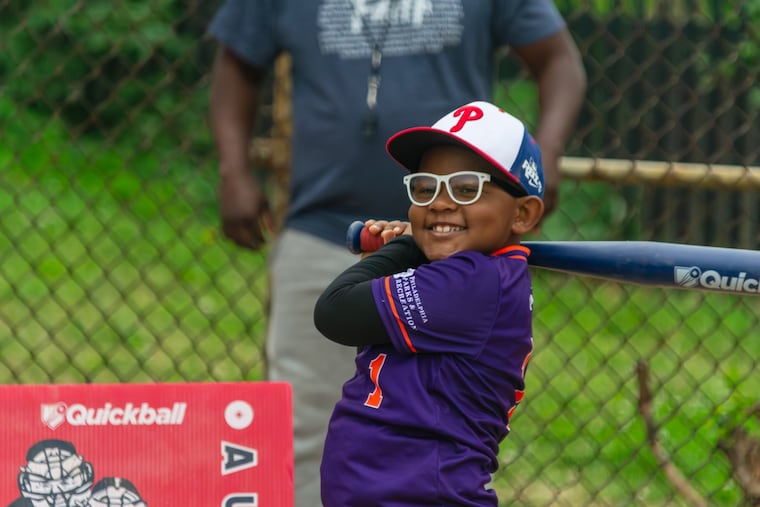
Back at Lee Cultural Center, Dominique Sampson watched her son Dallas step up to the plate. She said playing in the Catto League has been life-changing for the 6-year-old, as he’s made friends and learned to be comfortable and trusting with his teammates.
“He’s psyched up and ready to play baseball,” Sampson said. “So now I have to find something else for him to do after this.”
With his eyes on the ball, in his signature white sports glasses, Dallas sent a grounder to third base and made his way safely to first, earning thunderous applause from parents in both dugouts.

Temple University’s Logan Center for Urban Investigative Reporting and the Claire Smith Center for Sports Media, in partnership with the Philadelphia Inquirer, have launched a series examining the state of North Philadelphia’s recreational facilities and youth sports programs and whether investing in them should be a cornerstone anti-violence strategy for City Hall.
We’ll visit parks, pools, and playing fields north of Girard Avenue to document the conditions of facilities and compare them to others throughout the city. We’ll also outline the challenges leaders face in maintaining activities for young people in the city’s poorest neighborhoods most impacted by gun violence.