A stint in Lehigh Valley allowed Andrew Painter to work ‘freely’ on mechanics and his mind. Here’s what he learned.
Painter's monthlong hiatus to Allentown appears to have helped.
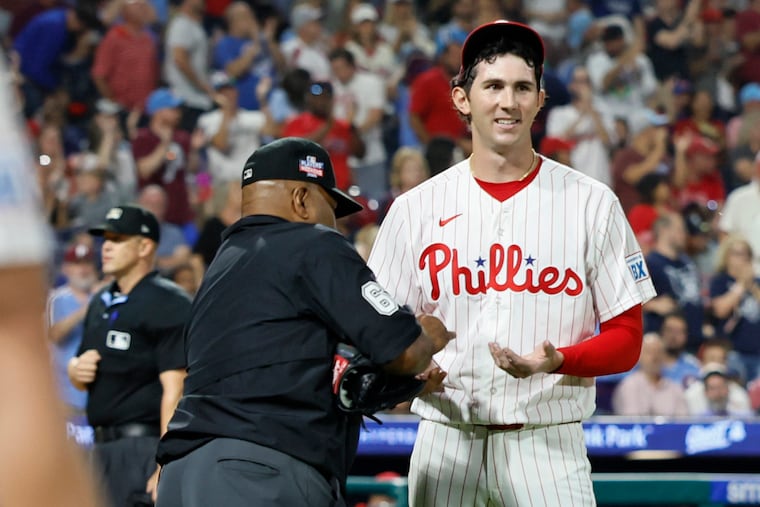
When Andrew Painter was optioned to triple-A Lehigh Valley in June, he received something he sorely needed: space. Seventy-seven miles north of Citizens Bank Park, far from the scrutiny of Philadelphia, the right-handed pitcher was able to work and think.
He could try grips, mechanical tweaks. In three straight games with the Iron Pigs, he threw three different changeups. This is not the type of thing Painter would be able to do in the big leagues, especially not in the midst of a playoff push.
But in triple A, it was encouraged.
» READ MORE: Andrew Painter has best start of his career as Phillies cruise past the Cardinals: ‘The ceiling is so high for him’
“You’re able to go down there, and games don’t really mean much,” Painter said. “Obviously you’re playing to win, but it’s about development. There’s obviously a lot less stress, and you’re able to kind of freely work on things.”
“Freely” is an apt description. Before Painter was sent down on June 18, he looked anything but free. The 23-year-old labored through each start. He struggled with command. His fastball lacked its signature rise.
By June 17, his ERA had ballooned to 7.06 ERA.
The monthlong hiatus to Allentown appears to have helped. It allowed the highly touted rookie to take a hard look at what worked and what didn’t, and make changes without fear of failure.
The Phillies’ pitching coaches dove deep into his mechanics and unearthed some telling data points. Chief among them was the way Painter moved his lower half.
Before, he was standing more upright, almost as if his back leg was completely straight.
The coaches suggested that he hinge his back hip, and bend his back knee more. What might seem like a small tweak has produced notable results.
Now, Painter is driving more toward the plate, which has improved his command. He’s moving more efficiently, which has helped him sustain velocity deeper into games.
» READ MORE: Kyle Schwarber caps dramatic comeback with walk-off home run as Phillies sweep Cardinals
In the rookie’s outing on Saturday, his fastest pitch of the night — and of his young career — was his 100th. It clocked in at 99.6 mph.
“To me it feels like it’s less effort, and I think that kind of goes to … now when I’m in the sixth inning, there’s a little bit more energy,“ he said. ”Whereas before it was kind of [like] I was reaching for everything, and those were 94s, 95s.”
He added: “I think everything’s good when I’m just synced up, right? I feel like some guys try to throw it as hard as they can, and it ends up being slow, because they’re not in as powerful of a position.
“For me, the moves that we worked on with the lower half, kind of allows me to just be behind the ball a little more.”
Another suggestion from the Phillies pitching corps was to adjust his fastball grip. Painter widened his fingers slightly, and shifted them more diagonally, so they aren’t right on top of the seams.
“Because when I was throwing fastballs in the first half, the seams were almost taking it down, so it was killing vertical [break],” Painter said. “Whereas [my fastball] has always risen.”
The changes haven’t just been mechanical. Those who work with Painter believe he has a different energy about him, more of a self-assured confidence. Lehigh Valley pitching coach Phil Cundari said they’ve focused on staying present; to not dwell on an inning, or even a pitch.
Cundari is uniquely qualified to help with this. Before he joined the Phillies organization in 2023, he was a licensed psychotherapist and had his own clinical practice.
» READ MORE: Batting practice … in a hotel room? It’s part of the ‘routine’ for Luis Arraez, baseball’s most unique hitter
Harvey Dorfman, the legendary mental skills coach who helped transform Roy Halladay’s career, was one of Cundari’s mentors. Halladay was introduced to Dorfman in 2001, in the midst of his lowest point in professional baseball.
Halladay had been demoted to the minor leagues after posting a 10.64 ERA through 67⅔ innings in 2000. He was at single-A Dunedin in the Blue Jays organization when Halladay’s wife, Brandi, bought him Dorfman’s book, The Mental ABC’s of Pitching.
That, coupled with some mechanical tweaks, guided Halladay back to the big leagues and onto a path toward the Hall of Fame. No one knows what path Painter will take, but he finds himself at a similar crossroads; humbled, at 23 years old.
From what Cundari can see, the rookie has responded well.
“The experience and the path that he’s had, both of those things are pretty challenging to try and overcome,” Cundari said. “But I think he’s done a great job. I think what you’re seeing right now is someone who’s much more in command. Not just of his stuff, but of his emotions, and who is in command, mentally.
“And you’re seeing a really confident young man up there. So, outings like [Saturday] night, hopefully we’re going to see more of those.”

The Phillies haven't won a playoff series since 2023, and their postseasons keep getting shorter and shorter. How can they fix it? Radio play-by-play announcer Scott Franzke joins Phillies Extra, The Inquirer's baseball podcast, to discuss Trea Turner's future, the managerial uncertainty, whether the Phillies can get "creative" to change the mix of the roster, and more. Watch here.
You can also subscribe to the podcast version of Phillies Extra on Spotify or Apple Podcasts.
Previous episodes: Larry Andersen | Matt Klentak | Jeff Francoeur | Luke Murton | Mike Hazen | Tony Gwynn Jr. | Kevin Stocker | Bobby Dickerson | Jim Bowden | John Middleton