Spreading the word on safety in workers' native tongue
ATLANTIC CITY - In her years working in union health and safety programs, Komilla John has learned one thing: Immigrant workers, unionized or not, "don't want to cause any problems," she said. "They are very afraid of losing their jobs. Normally, they are very ill-informed about their rights."
ATLANTIC CITY - In her years working in union health and safety programs, Komilla John has learned one thing:
Immigrant workers, unionized or not, "don't want to cause any problems," she said. "They are very afraid of losing their jobs. Normally, they are very ill-informed about their rights."
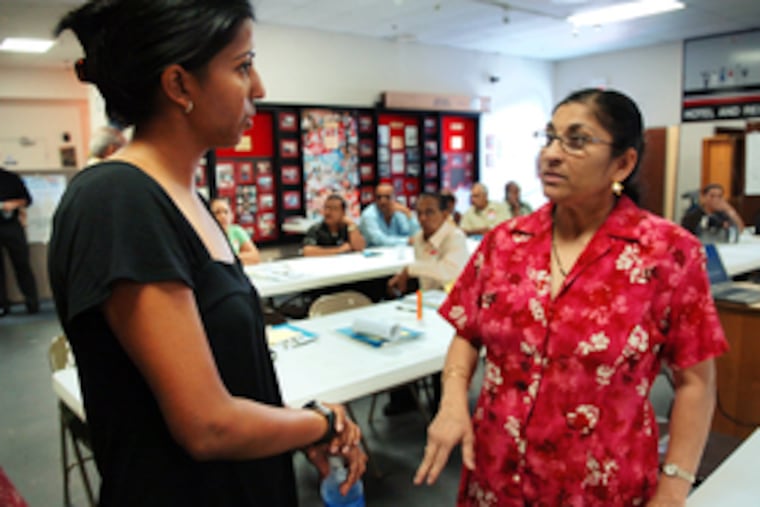
That's why John was in an Atlantic City union hall Monday, lecturing 20 Indian hotel housekeepers in their native Hindi about cleaning chemicals, spill hazards and electrical problems.
The session was part of an ongoing effort by the New Jersey Department of Labor and Workforce Development designed to reach workers in their native language.
"Most safety posters - you can find them in Spanish, but it's harder to find other languages," said John, coordinator of New Jersey State AFL-CIO Occupational Safety and Health Education Program, which developed the program with Rutgers University.
The two-day safety series was aimed at Indian workers because they make up about 10 percent of the union membership of Unite Here Local 54, which represents many casino hospitality employees.
Coming up is another series for Local 54's Chinese membership, which is growing. Earlier, John had facilitated a program for Haitian commercial-laundry workers in Newark.
In Atlantic City, the housekeepers, only taking a brief break to lunch on chicken curry and raita, watched slides of crowded closets and storage areas, the not-so-glamorous back areas of hotels.
Their job was to point out where they saw hazards. They sketched maps of their work areas, drawing safety hazards and listing problems.
Some Trump Taj Mahal Casino Resort housekeepers listed waste cans in hotel room bathrooms and bedrooms without liners. They said management no longer gave them liners in the cans.
"It is very dangerous," said one housekeeper. "We dump it in the main trash can, but condoms and maxi pads stick in the can. How about if you get sick? You don't know what made you sick."
This housekeeper proved John's point exactly. Even though she's a longtime employee, she was afraid to say her name. She said that management might not fire her outright, but they'd be less willing to overlook mistakes.
"I need to protect my peace of mind," she said.
Trump Taj Mahal spokeswoman Mary Moyer promised Monday that she would have a response yesterday, but did not return numerous phone calls seeking comment.
Jay Sodha, a multilingual business agent for Local 54, set up the sessions at the union hall. He speaks Hindi and Gujarati, the main language spoken by the housekeepers, although they also understand Hindi.
Most of them have been in the United States for more than a decade, and most have a decent command of English, but they said it was helpful to review safety measures in a familiar language.
Union shop steward Daksha Parikh, 52, said her fellow hotel housecleaners shouldn't be afraid to complain.
"Try to solve the problem with the management," she said. "Don't be scared."
Sodha understands that every worker might not be as brave as Parikh. But he wants them to be aware of safety issues so they'll call the union when there's a problem.
"I know how difficult it is to convince them that it is their right to be safe," he said. "And it's the employer's responsibility to make it safe."