2027 Kia Seltos: Better looks, same performance
A big price and size difference between Kia’s and Hyundai’s smallest SUVs ends up working to the advantage of the cheaper offering.
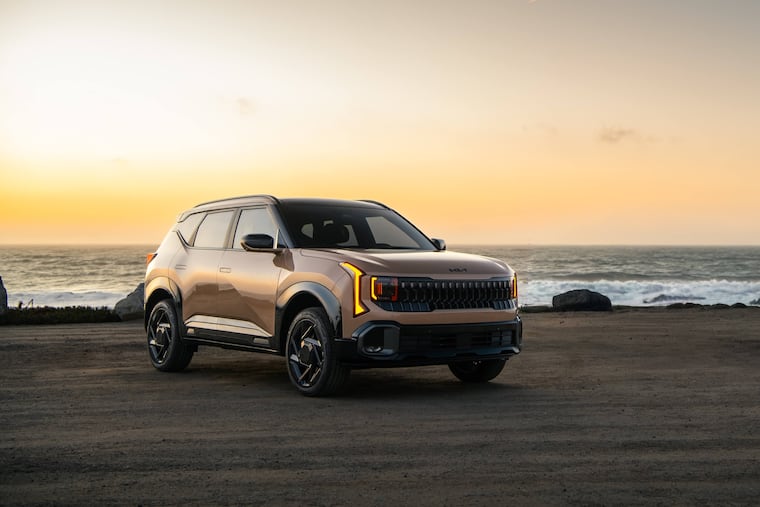
2027 Hyundai Venue SEL vs. 2027 Kia Seltos X-Line SX AWD: Bargain battle?
This week: Kia Seltos
Price: $37,250 as tested
What others are saying: “Highs: smooth and settled ride, great sound deadening, outstanding looks. Lows: Less haste, has put on a few pounds, not as athletic on the skidpad,” says Car and Driver.
What Kia is saying: The introductory video must say it all, as there’s no tagline there.
Reality: That 50% higher sticker price over the Venue pays only for looks and space.
Catching up: Last week we took the little Venue around and found that despite its under-$25,000 price, it could really put a smile on your face. Will the all-new Seltos do the same, with so much more extra money on the table?
What’s new: The whole thing. Gone is the little baby hatch that looked like a cross between a Mini Countryman and a Ford Flex and felt like a tin can, and in its place meet what looks like a miniature Kia Telluride.
The Seltos got some real testing, traveling to the Baltimore Aquarium and Washington, D.C.
Up to this point, I found the Seltos a lesser sibling to the now-defunct Soul, as noted in this review of a 2024 model. But that wasn’t really the case, as the 2024 tested cost $31,000. Will the Seltos’ growth spurt — and price spurt — satisfy?
Competition: Technically, it’s a whole different world from the Venue, judging from Consumer Reports’ picks for competition, including Buick Encore GX, Chevrolet Trailblazer, Ford Bronco Sport, Honda HR-V, Hyundai Kona, Mazda CX-30, Mitsubishi Eclipse Cross, Nissan Kicks, Subaru Crosstrek, Toyota Corolla Cross, and Volkswagen Taos.
Up to speed: “Less haste,” Car and Driver? That’s quite diplomatic of you. This thing is a dog. It’s takes 8.2 seconds to get to 60 mph in that publication’s testing, more than a second slower than the previous generation.
The power comes from Kia’s well-tested 1.6-liter turbocharged four-cylinder engine, which makes, wait a minute, 190 horsepower? Like more than half again the Venue’s 121?
The Seltos can also come with a less powerful engine that provides just 147 horses. I can’t imagine. (I checked again to make sure I actually had the turbo, and yes I did.)
I’m not sure how the Seltos feels doglike and yet bests the Venue by half a second? Oh the mysteries of life.
Shifty: Oh, aha, here’s one reason. I often say in reviews the transmission does what it should without complaint, so I’m kind of relieved to feel one that doesn’t do what it should and offers massive complaints. I’m not actually here zoning out and going blah blah blah blah week after week.
It’s an 8-speed transmission bested by a continuously variable job in the Venue. So we’ve now really landed in Bizarro world.
The Seltos was stubborn about shifting out of lower gears, and I found myself having to select manual mode to help the car not shoot the oil filler cap into the hood in a “Thar she blows!” moment (a la my disastrous 2004 Mazda MPV).
If Kia had offered an enjoyable manual mode, I might never have noticed this. I mean, there is a manual mode; it’s just not enjoyable in the least. The shifter is vague, and the ergonomics so poor that it actually made the one good shoulder I have left start to ache. Strong advantage Venue, continuously variable transmission and all.
On the road: Car and Driver called the handling “solid,” and I would greatly beg to differ. The handling was vague like the shifter, requiring the kinds of steering corrections I would expect in a 1984 Jeep Grand Wagoneer, not something that’s brand new and compact.
At least Grandpa’s wood-sided Gen X SUV would not have had the nerve to ask me if I needed a break every 20 miles. But technology has improved so much that this wandering beast will send a warning message, blaming YOU for its shortcomings. “Yes, I need a break,” I might have shouted more than once, “I need a break from this suspension!” I’m grandpa now, and I’m a little cranky. Most things hurt now, OK? Strong advantage, Venue.
Driver’s Seat: The Lovely Mrs. Passenger Seat and I did enjoy the front seats, which are cushy and supportive and feature Kia’s wild new headrest that really makes your head feel rested.
Controls keep those familiar with Kia operations feeling at home. Advantage, Seltos.
Friends and stuff: The rear seat has really nice legroom, headroom, and foot room. The rear seat sits up high and maximizes available space.
The seat adds a little bit of definition to the corners, but the middle isn’t subject to the usual balancing act to pay for it. Still, the floor hump and the console make that seat less welcoming.
Cargo space is 27.8/64.2 cubic feet. Strong advantage, Seltos.
In and out: A tie here, as both are easy getting in and out.
Play some tunes: The 12.3-inch touchscreen home button sets you up nicely, with large app icons lined up horizontally and easy to scroll through and pick. A setup button allows for quick changes of the equalizer, and other buttons alongside it underneath the screen offer similar conveniences.
Sound from the system is an A-. It memorably brought new life to one single song during testing, so here’s hoping more make their hidden chords sound better for other drivers. This is a tossup, but also a definite choice for buyers, the Hyundai offering an old-school setup and the Kia all new.
Keeping warm and cool: The Seltos gets Kia’s large screen stretching from the gauges all the way across to the infotainment. It also features screen-based HVAC controls in the middle. This time, though, they’re not hidden behind the steering wheel, as they are in the Telluride. Cheap plastic toggles on the front of the dashboard offer simple adjustments, a bit of belt and suspenders. This is a tossup, but again, the old and the new.
Fuel economy: The Seltos averaged 27 mpg in a highway-heavy mix of driving. A hybrid version is planned for the spring, so maybe that will ease the gas consumption. Venue for the savings.
Where it’s built: Gwangju, South Korea. 90% of parts are from Korea.
How it’s built: Consumer Reports predicts a 3 out of 5 for the Seltos reliability, another tossup category.
In the end: I figured this review would end up being unfair, with one car suddenly costing 50% more than the other. But I never imagined the cheap one would offer not just better value, but a much more enjoyable experience. Unless you’re in the back seat or cargo hold.
If you need to stay closer to Venue money, the Mazda 3, Toyota Corolla Hatchback and Prius, or Volkswagen Jetta would be the ones for me.
If we’re getting Seltos-level spendy, though, I’d direct you to the Mazda CX-30 Turbo for a great way to have fun in a small SUV. The Taos and the Crosstrek are also worth investigating.