Appraisals disappoint homeowners in tight market
Even in good times, home values are subjective, determined by appraisers hired to examine recent sales of comparable houses and find a number to reassure a lender that a borrower is a good risk.
Even in good times, home values are subjective, determined by appraisers hired to examine recent sales of comparable houses and find a number to reassure a lender that a borrower is a good risk.
These aren't good times, and lenders foundering in a sea of bad loans are not willing to take on any more.
Not only does that put more pressure on appraisers to prove value, it leaves homeowners with no clue how much their property is worth - or even if they can recoup the money they have spent on improvements.
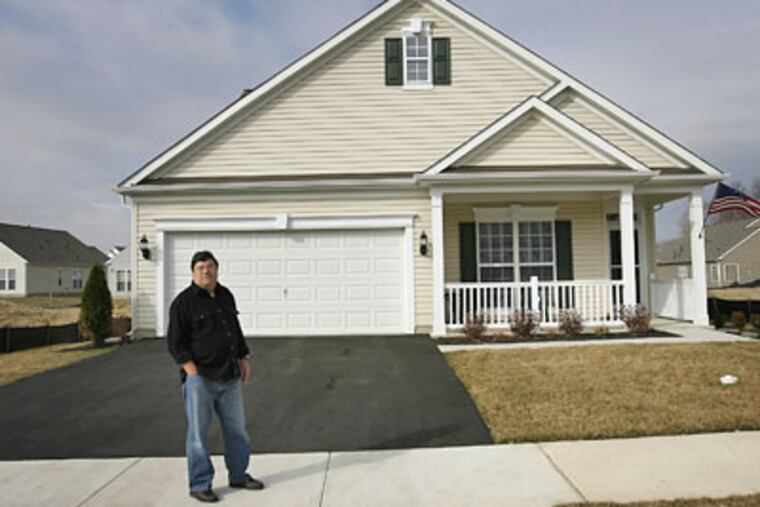
Dana Nasuti of Newark, Del., for one, wonders why the amount he spent on the 330-square-foot expansion of his second-floor loft to accommodate an office and space for his model trains was not reflected in the appraised value arrived at for his refinancing.
A publisher who moved from Cherry Hill, last year, Nasuti paid $357,000 for the newly constructed house. The appraisal done for the refinancing came in at $360,000.
"I about fell out of my chair," he said. "What happened to the $31,000 I put into this place over the past five months?"
Especially since an identical-model house across the street - lacking the additional square footage - just sold for $394,000, Nasuti said.
In Overbrook, Pauline Rosenberg believes the investment property she bought a year ago is worth much more than the $95,000 appraisal Wells Fargo & Co. considered in denying her application for a cash-out refinancing.
A comparable recent sale supplied by her real estate agent indicated the house should be valued at at least $100,000, Rosenberg said. She would like to see the appraisal report, but says her lender refuses to share it.
As banks, notably big ones such as Wells Fargo and Bank of America Corp., sustain bigger losses, they are demanding more proof that a house is worth what they want to lend.
"Right now, especially with sales being so limited, it is difficult to determine the home prices that the market will bear," said Joel L. Naroff, chief economist at TD Bank N.A. "There's not a lot of mortgage money out there, and lenders are being extremely cautious, although we hope that will begin to ease up.
"It may not be the time to put a lot of money into the house, because immediate appreciation may not happen," Naroff added. "Over the long term, you will see that benefit, but remember that there are a lot of homes on the market, and people can pick and choose. They don't have to pay the cost of your improvements."
Michael Frolove, an Abington appraiser, said he and his colleagues were having to deal with increasingly "bizarre" requests from underwriters.
"The neighborhood lenders - the ones who know this area - are cool. . . . It's the large wholesalers who are the problem," Frolove said.
For example, in places where three properties have sold in the last six months, underwriters will demand that appraisers provide five comparable sales, Frolove said, pushing them into neighborhoods where the houses are completely different.
One big issue, he said, is that lenders may be using software programs showing home prices that are woefully out of date - even predating the housing boom in many neighborhoods.
Despite the jaw-dropping appraisal of his house, Nasuti got the loan he wanted, at a rate more than two percentage points below his 6.99 percent mortgage, saving him $481 a month.
Yet Rosenberg was unsuccessful in her bid to refinance, though she never considered that there would be problem "since I have excellent credit and have never missed a mortgage payment."
She assumed, based on what properties similar to hers have been selling for recently, that the value of her investment property had risen enough for a cash-out.
A teacher, Rosenberg paid $85,000 a year ago for the investment property, located on the same street as her home and another house she owns. She had spent much of the year renovating the investment property and wanted the cash to pay for more improvements.
In spring 2008, she refinanced the mortgage on her own home, which is smaller. The appraised value was $115,000.
Her investment property appraised at only $95,000, however, even though a nearby smaller house - 800 square feet vs. her 1,300 square feet with a finished basement - sold recently for $100,000.
Wholesale lenders are bringing out-of-staters in to appraise houses in the city, and "they don't understand that neighborhoods here can change block to block," Rosenberg said.
Philadelphia mortgage broker Fred Glick said refinancings on "non-owner" properties, like Rosenberg's, will have higher loan-to-value ratios and higher interest rates than those for primary residences.
Brokers say the pressure to document, and document some more, is not putting a drag on refinancing as much as qualified homeowners waiting for rates to fall farther.
Fixed interest rates have hovered around 5 percent since November. But as rates have ticked up slightly in the last three weeks, "lenders are trying to eliminate zero-point loans, so some people are holding off," Glick said.
Homeowners shouldn't want rates to go substantially lower under worse economic conditions, he said, "because their values would go down, and they may not have the equity to refinance."