Trump shuns EVs and wind power, but he’s pouring billions into batteries
Trump administration officials have come to see batteries as essential for many of their priorities, and they are seeking ways to reduce dependence on Chinese components and materials.
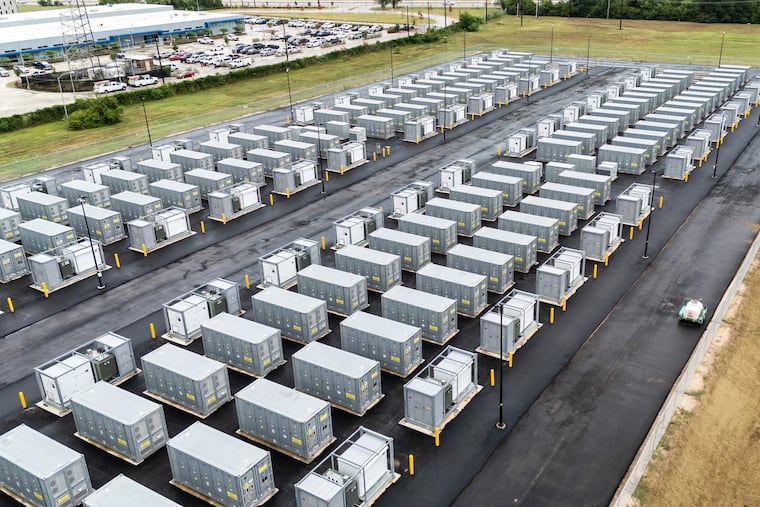
WASHINGTON — President Donald Trump has been scornful of electric cars for years. But his administration is now pouring billions of dollars into the battery technology that powers them.
Large lithium-ion batteries have become one of the rare energy technologies that both parties in Washington strongly support — though for very different reasons.
The Biden administration saw batteries as a green energy tool crucial for addressing global warming and sought to encourage manufacturing them, for use in electric vehicles and to backstop wind and solar power on electric grids. The Trump administration has rolled back efforts to expand clean energy, but officials have nonetheless come to see batteries as essential for many of Trump’s priorities, including powering data centers for artificial intelligence and manufacturing drones for the military.
The Trump administration has been particularly alarmed by China’s dominance of global supply chains for lithium-ion batteries, and in recent months has made a major push to bolster domestic production of many battery components and associated critical minerals.
“There has been a growing appreciation for just how important batteries are for so many things,” said Tom Moerenhout, who leads the critical minerals initiative at Columbia University’s Center on Global Energy Policy. “It’s not just EVs, it’s automation, robotics, data centers, drones for defense. And there’s a real move to making sure China doesn’t have a choke point here.”
In August, the Energy Department awarded $500 million to seven companies that make battery components or process critical minerals like cobalt in the United States. Also last month, the Pentagon announced a $1.4 billion loan to an advanced battery start-up building a factory in Washington state. Federal agencies are funding various domestic efforts to produce graphite and lithium, two raw materials for batteries.
“For too long, America has depended on foreign actors for critical materials essential to modern life that underpin our economy, energy security, and national security,” Energy Secretary Chris Wright said in announcing the battery awards.
Still, loosening China’s grip on the global battery industry could be difficult without boosting the domestic market for electric cars, which are by far the largest source of demand for lithium-ion batteries, experts said. Last year, Republicans in Congress repealed a $7,500 tax credit for consumers to buy electric cars with U.S.-made components, which provided a significant incentive for domestic battery manufacturing.
“If you really want to onshore supply chains, you need electric vehicles, it’s as simple as that,” said Moerenhout. “The defense sector alone is just too small to underwrite a full supply chain for batteries.”
For years, the Chinese government has made a concerted effort to lead the world in electric vehicles and heavily subsidize its battery industry. The country now sells roughly as many EVs each year as the rest of the world combined, and it has become the preeminent producer of lithium iron phosphate batteries, or LFP, which have become widespread in electric vehicles and stationary storage. The country also dominates the refining of raw materials like lithium and graphite and the production of key components like cathodes and anodes.
Many officials in Washington have been eager to reduce dependence on China for national security reasons. The U.S. military uses batteries in lasers, hand-held radios, night vision goggles, satellites, and drones, and Chinese components are still needed to make many of these items. AI data centers are increasingly using lithium-ion batteries for backup power.
China recognizes the leverage it has. Last fall, amid a period of trade tensions, the country threatened to limit exports of a range of battery materials, including graphite, which businesses said would have devastated the nascent U.S. battery industry.
When Trump returned to office, his administration initially froze billions of dollars in Biden-era grants for battery manufacturing, grouping batteries in with electric vehicles, solar farms, wind turbines, and other clean energy technologies that officials wanted to downplay.
But that stance quickly shifted.
While the administration has throttled funding for other clean-energy technologies, the Energy Department has allowed many Biden-era grants for battery makers to proceed. The government has also invested in firms that develop battery components or critical minerals, including Eos, a next-generation battery company.
The Trump administration has also been more active than the Biden administration in encouraging U.S. mining, and the government has begun taking direct financial stakes in mining companies. That has prompted pushback from Democrats in Congress, who have called for investigations into some mining deals and raised questions about conflicts of interest.
Last month, Trump held an event at the White House with mining executives and announced more than $2 billion in funding to help revitalize the domestic mining industry, including for battery materials.
That included a $1.4 billion loan from the Pentagon’s Office of Strategic Capital to Sila Nanotechnologies, a company that has developed a type of lithium-ion battery that uses silicon materials instead of Chinese graphite.
The company has spent nearly 15 years developing its technology, and its factory in Moses Lake, Washington, can now make enough material for tens of thousands of batteries each year. But that’s still only enough to supply less than 0.1% of the global market, and Sila is hoping to expand production drastically while competing against ferocious Chinese competition.
“It takes an immense amount of time and effort to expand and do this right,” said Gene Berdichevsky, CEO of Sila. “And for investors to bet on that, they need confidence that we have the right policies to support this kind of industry and not just let it go offshore.”
This article originally appeared in the New York Times.