Sea rise prompts Stone Harbor’s Wetlands Institute to move temporarily with plans for a new building
Much of the institute’s 34-acre campus in Stone Harbor sits on low marsh and has become increasingly at risk due to flooding.
The Wetlands Institute in Stone Harbor, N.J., has been a research and education stalwart for decades, instructing thousands of visitors annually on the importance of salt marshes and the marine world.
Starting this week, though, the nonprofit’s staff will pack up and move to a temporary headquarters, so its main trail can be raised to stave off sea-level rise.
The existing headquarters will ultimately be razed, with a new, elevated building rising in its place. The current wooden headquarters was built in 1972 and was originally intended for short-term seasonal use.
Sea level “is rising fast enough that it’s outpacing the ability of the marshes to keep up,” said Lenore Tedesco, executive director of the Wetlands Institute. “They’re starting to drown.”
“You can see that even right at the institute, where there are more open-water pockets and mud flats, instead of the grasses,” she added.
Much of the institute’s 34-acre campus sits on low marsh and has become increasingly at risk due to flooding.
In 2000, the Salt Marsh Trail flooded twice a year. Now, it is flooding up to 70 times a year, Tedesco said.
For now, staff will move from the Stone Harbor Boulevard location to the New Jersey Coastal Conservation Center on North Delsea Drive in Cape May Court House.
All programs have been paused as of Tuesday, but the Wetlands Institute will reopen Nov. 7 at the temporary location.
Salt Marsh Trail
Most of the 31,000 annual visitors to the Wetlands Institute walk the quarter-mile Salt Marsh Trail looking at the bountiful birds and wildlife.
About half of it and the surrounding ecosystem will be considered unstable low marsh by 2030 if nothing is done. The surrounding marsh sits at about two feet of elevation, while the Salt Marsh Trail, built on an old 1950s road, ranges from three to four feet.
Tedesco said dredge material from Avalon will be spread on the trail to raise it and surrounding land to create a new high marsh. It will have more vegetation to help buttress the area from storm-driven waves and provide habitat for diamondback terrapins and at-risk coastal birds.
Tedesco expects trail work to start in October. It will be paid for through a $3 million grant from New Jersey’s Regional Greenhouse Gas Initiative Natural Climate Solutions program.
The work will not affect the existing elevated metal boardwalk, which will remain as is.
The institute undertook a similar project last year with state and federal officials to save the adjacent Scotch Bonnet Island, which was drowning.
» READ MORE: Racing to save Stone Harbor’s Scotch Bonnet Island before it’s swallowed by rising seas
About five acres of Scotch Bonnet Island was raised with dredge material to keep it above rising seas.
The island is situated in Scotch Bonnet Channel, a waterway that cuts through the bay to connect the barrier island to the mainland. The channel has widened by 70 feet since 1970.
Scientists say sea-level rise in New Jersey is running at twice the global average. They estimate the sea could rise 2 to 5 feet along the coast by 2100.
New Jersey has 200,000 acres of tidal wetlands, valuable habitat used by shore birds and other wildlife. The Wetlands Institute abuts those tidal wetlands.
Tedesco said the lessons learned on Scotch Bonnet Island are being used to reimagine the institute’s campus.
Construction on the Salt Marsh Trail is expected to continue through spring before sensitive wildlife returns.
A new building
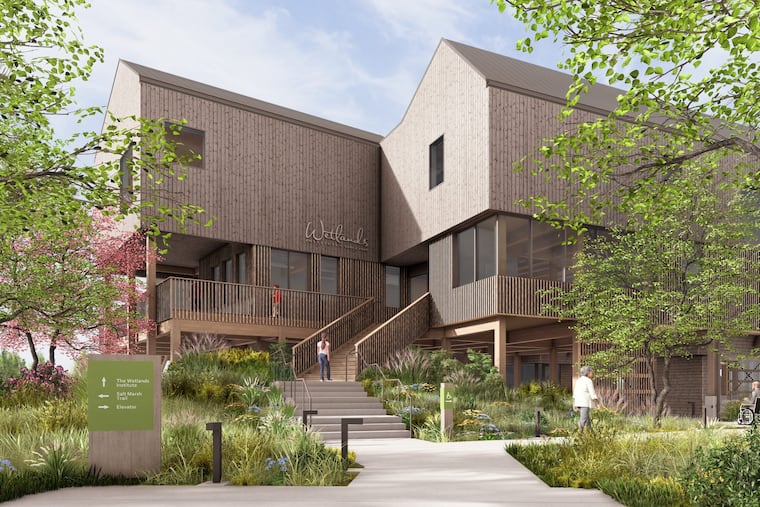
Tedesco said architects and engineers are working with the institute’s board of trustees on a proposed new building.
Those plans call for both the building and grounds to be elevated, while maintaining the “coastal character” of the current institute.
She said federal, state, and local permits are needed given the sensitive area.
The Wetlands Institute is getting construction bids for the new building but does not have a final estimated cost or timeline. Tedesco said the institute is still raising money.
The new headquarters would be built using sustainable methods, such as mass timber construction that uses engineered wood panels, columns, or beams.
The facility would have more indoor and outdoor classroom space for educational programs, a new lecture hall, modern labs with twice the space, outdoor decks, an aquarium enlarged by 50%, and new exhibits.
Tedesco said the institute worked with experts to explore keeping the existing building, which was designed by Malcolm Wells, a mid-20th-century designer famed for his “gentle architecture.”
The structure was used as a biological research station by Lehigh University from 1972 to 1986. It has been expanded multiple times over decades.
Tedesco said it became clear that it is not feasible to continue using the building because it is so outdated and cannot be raised. She said the institute has expanded into “world-class” research and the facilities are at capacity.
“We’re in a 55-year-old wooden building in the marsh that was built to residential standards for seasonal use,” Tedesco said. “But you have to give kudos to the building. Nobody expected that a wooden building in a marsh in 1972 would still be functional today.”