Airport deals carefully with homeless
Passenger complaints about the homeless at the Phila. airport have led to a careful, compassionate policy.
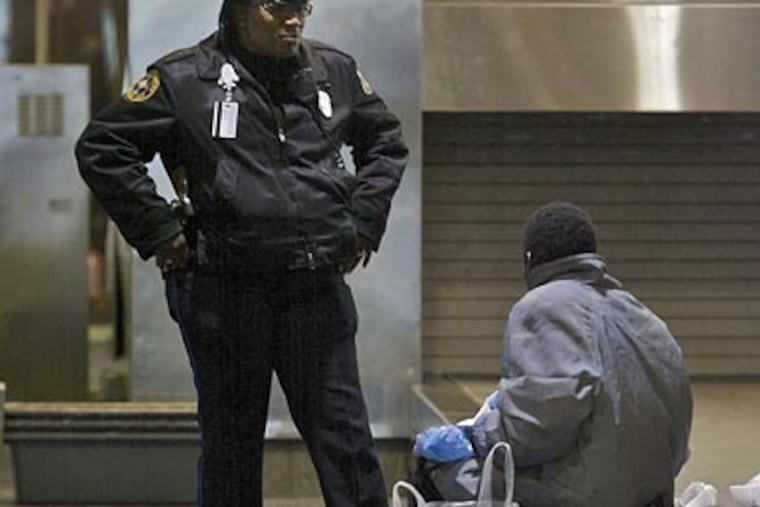
Homeless men and women used to snooze in the wee hours inside Philadelphia International Airport, seeking warmth, safety and quiet, and trying to blend with weary travelers.
For years, airport officials tolerated the 25 to 40 people who slumbered on the carpeted floors and hidden nooks in the baggage-claim areas from Terminals A to F.
No longer.
Philadelphia airport police, working with outreach workers from the Mental Health Association of Southeastern Pennsylvania, are enforcing a regulation that has been on the books for years: Only ticketed passengers or those who work at the airport can be inside terminals between midnight and 5 a.m.
The homeless, who typically use public transportation to travel from downtown or the suburbs, are now being given three choices: be driven to a shelter, leave on their own, or be arrested and charged with defiant trespass.
Since airport officials began enforcing the regulation in early February, word has gotten out. Now, on a typical night, fewer than a half dozen homeless people congregate in the late evening, compared with 43 on a chilly night last fall.
"The police are very supportive," said Charles Williams, the mental-health association's division director for case management and homeless services.
"They tell them there is an ordinance and that they have to go, or they can go with us. We have beds at the Otley House at 68th and Woodland Avenue," Williams said. "The vast majority of people are going there."
For years, homeless people have flocked to airports in cities, including Chicago, New York, Cleveland and Atlanta. An airport is like a good hotel: warm in winter, cool in summer, carpeted, clean, with lavatories to wash up, and nobody bothers you.
"It is very warm, comfortable, quiet and safe," Williams said. "It is one of the better places that a lot of homeless folks would rather go."
In fall 2006, airport officials began to notice the that overnight homeless population was growing. Some passengers were noticing, too, and complaining.
To try to coax them to shelters, the airport will have spent $310,000 on outreach in the 30 months between Jan. 1, 2007, and June 30. Teams roam the baggage-claim areas and public corridors between 9 p.m. and 5 a.m. five nights a week. The airport would like to increase coverage to seven nights.
"We wanted a soup-to-nuts approach, where if you are homeless and are down here, we're not just going to kick you out," said assistant aviation director Thomas Becker.
During January, outreach workers began telling the overnight homeless that after Feb. 1, they could no longer spend the night. "They were asked, 'Do you want services? Do you want us to transport you to one of the cafes or shelters in Center City?' " Becker said.
William Dinwiddie, the mental-health association's chief executive, said, "it's been a very closely coordinated initiative," with care not to force people onto the street again.
"We've had relationships with a lot of people who have been living at the airport," he said. "By the time we gave people notice of what was going to happen, we were able to work with them pretty aggressively to have them placed in other alternatives."
Shortly before midnight, airport police meet up with the outreach teams and approach any homeless people who remain. Some nights there are none.
One man, who identified himself only as Tyrone, was the only homeless person in any of the terminals Monday night. He sat alone, talking to himself, on an empty baggage carousel in Terminal B.
"We go out and give the warning and send them on their way," said Philadelphia police Lt. Louis Liberati. "By and large, everyone leaves." Either they leave on their own, hopping on the last train to the city or buses that run all night, or are taken in a mental-health association van to a shelter or cafe.
Police keep track of all homeless people they meet late at night, and warn that they'll be arrested if they return again to stay overnight.
Since the first of February, police have encountered 45 homeless at midnight inside terminals. Of those, seven who had been previously warned were arrested, Liberati said. They were charged with a misdemeanor offense - defiant trespass - and taken to Southwest Detectives at 55th and Pine Streets to spend the night in a cell.
Airport officials also asked SEPTA to check tickets before passengers could get on Center City trains bound for the airport after 8:30 p.m., to ensure that each traveler had a ticket.
Deputy aviation director for property management James Tyrrell said the airport "expended a tremendous amount of effort and resources trying to deal with the situation that we found undesirable, at least from our passengers' perspective."
"It's not an easy issue," said Becker, who oversees the airport budget and central services. "We have responsibility to operate a first-class facility here. When we get complaints, we look to respond. We hope we are doing it in a smart and compassionate way, and we are going to continue to do it by utilizing the professional outreach workers."
A photo slide show at http://go.philly.com/ PhillyAirport chronicles how the airport deals with the homeless.EndText