Immediate prospects for Philadelphia's oil refineries are dim
The sun is setting on Philadelphia as an oil-refining center. Unless Sunoco Inc. and ConocoPhillips can find buyers for three plants on the Delaware River, more than half the region's refining capacity will be shut down by summer.
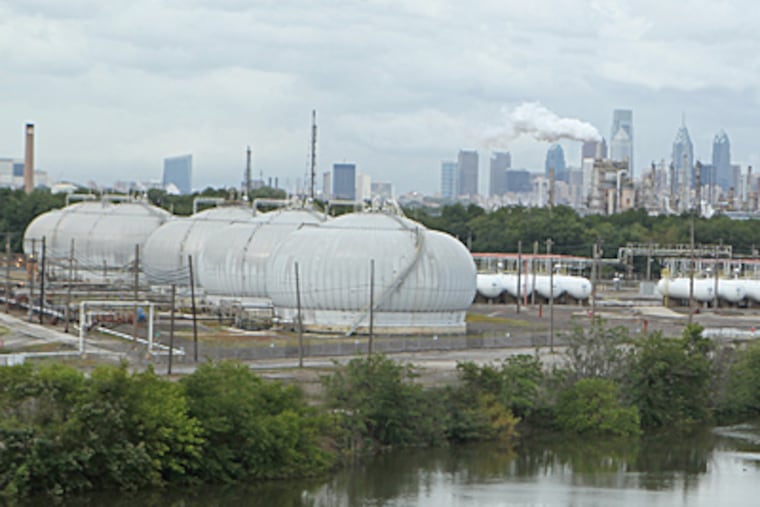
The sun is setting on Philadelphia as an oil-refining center. Unless Sunoco Inc. and ConocoPhillips can find buyers for three plants on the Delaware River, more than half the region's refining capacity will be shut down by summer.
Why is this happening now? With gasoline prices creeping upward, how can refiners lose money making fuel?
"There may be the point where we've reached peak demand in the United States," said James J. Balaschak, an energy specialist with Deloitte Services L.P.'s Philadelphia office. "There's just an overcapacity."
Analysts say there are no signs that demand for motor fuel will go anywhere but down, as biofuels such as ethanol displace petroleum and federal mandates for fuel-economy standards double in the next 13 years to 54.5 miles per gallon. More hybrid vehicles and electric vehicles mean less demand for fuel.
Despite public officials' efforts to help find buyers for the refineries, a growing chorus of experts says it believes that Sunoco's Marcus Hook refinery and ConocoPhillips' plant in Trainer will not reopen and Sunoco's Philadelphia plant will shut down this year.
Merrill Lynch analyst Doug Leggate told clients Wednesday that it appears unlikely that Marcus Hook and Trainer will open and that Sunoco's Philadelphia refinery "is likely shuttered in our view by midyear."
Tom Kloza, chief analyst for the Oil Price Information Service, said that Marathon Petroleum was rumored to be interested in the ConocoPhillips refinery until Marathon reported this week a disappointing earnings outlook.
"There is interest in Sun's Philadelphia refinery, which remains in operation, but there is little chance that a buyer for the Marcus Hook refinery can be found," Kloza wrote to his clients last week.
The Energy Information Administration last month said the closure of 700,000 barrels per day of refining capacity could provoke shortages of low-sulphur diesel fuel, gasoline, and jet fuel.
"If these three refineries are idled, there will be significant changes to U.S. East Coast supply patterns," Susan W. Grissom, an analyst with Stillwater Associates L.L.C., of Irvine, Calif., wrote to clients last week.
The United Steelworkers Union, which represents refinery workers across the country, tried last week to prod the government to intervene by raising alarms about regional fuel shortages and price spikes.
"If the nation is down to 118 refineries now and there's a bunch of them for sale, to shut them down and forget about them seems crazy," said Denis Stephano, president of Steelworkers Local 10-234, which represents more than 200 workers at the Trainer refinery.
But Deloitte's Balaschak, whose firm anticipated the overcapacity in reports two years ago, said there were plenty of unused refining capacity, fuel terminals, ports, and pipelines to accommodate supplies.
"Concerns about pricing in the Northeast are probably exaggerated," he said.
The three older plants that are up for sale are known as simple refineries because they cannot process heavier, cheaper crude oil. They require lighter, sweet crudes, which are more expensive and less profitable to process.
Kloza said the economics of refining here were poor. The wholesale price of gasoline (not including taxes) is about $2.75 to $2.80 a gallon in Philadelphia Harbor, or about $115.50 to $117.50 a barrel. The cost of North Sea or West African crude used by the refineries is about $115 a barrel.
To modernize the facilities to use cheaper crude and to comply with environmental regulations would require a massive investment without any guarantee that there would be a market for the fuel, analysts say.
Not every refinery in the region is burdened.
PBF Holding Company L.L.C., which acquired the Paulsboro, N.J., refinery and the Delaware City refinery in the last two years, announced in December that it would spend $1 billion to upgrade the Delaware refinery to produce ultralow-sulfur distillates, which includes diesel, heating oil, and jet fuel.
The PBF Clean Fuels Project will take three years to complete.
While publicly traded oil refiners such as Sunoco and ConocoPhillips are under pressure from investors to improve their profit margins, not all potential buyers of the refineries are in the same position, said Balaschak, the Deloitte principal.
He said private-equity investors might be interested in the properties, or a national oil company with its own supply of crude oil that would not be at the mercy of market prices.
"These plants can probably be purchased for well below replacement cost," said Balaschak, the Deloitte principal.
A new owner may not produce fuel for a domestic market, where profit margins will remain snug if the refineries remain open. But the product could be aimed for export.
"There may be opportunities there," he said.