Benevolent hackers convene at Penn
More than 1,000 programmers converged over the weekend at Penn for what was billed as "the biggest university hackathon in the world."
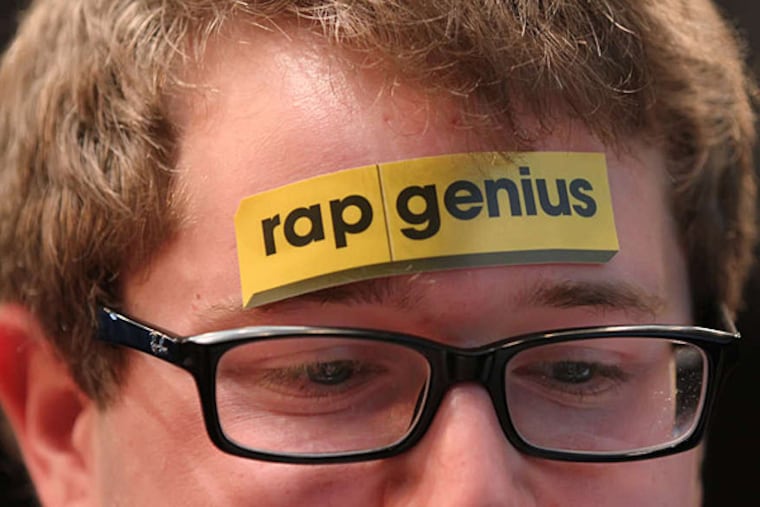
More than 1,000 programmers converged over the weekend at Penn for what was billed as "the biggest university hackathon in the world."
To the public, the word hack may bring up visions of Edward Snowden and digital terrorism. But in the tech world, hack is used as a synonym for build. And "hackathons" are the programmer's version of a slumber party, science fair, and Super Bowl rolled into one.
The students spent 48 hours at the Palestra, working in small teams to brainstorm, design, and build an app, website, or hardware product. Food and caffeine flowed freely, and most participants slept only five to 10 hours the whole weekend.
Twenty teams were selected to demonstrate their products Sunday, and more than $30,000 in cash and product prizes were awarded.
The grand prize - $10,000 in addition to some side pots and publicity perks - went to Swap, a platform where developers can make changes to their mobile apps in real time without having to send a new version through Apple's time-consuming, download-dependent App Store.
A member of the four-man team was Conrad Kramer, 16, from Cherry Hill High School East. He met his three teammates - two Stanford sophomores and a University of Chicago senior - last summer in California, where he was interning for the hot travel start-up Airbnb.
Kramer, a self-taught programmer who already has started a company, had no idea what they what would do with the money.
"We were so focused on building the product, making it work," he said, they hadn't discussed the possibility of winning.
Some hackathons have themes - nonprofit, health-related, mobile-only - but PennApps is "open-ended, so a lot of fun, quirky things come out of it," said Jasdev Singh, 21, a senior at the University of Virginia.
One of those fun, quirky projects took second prize and $5,000. Super Duper Mario Bros. is a smartphone game played through the user's camera. So instead of running on bricks and grass, Mario is jumping over the Schuylkill or the skyline or whatever vista is directly in front of the player.
Obviously, the game presents some copyright issues. And Kramer's Swap may run afoul of the App Store's user guidelines.
But judge Tom Lehman, cofounder of the website Rap Genius, said the point was just to get like minds in a room together to build something - fast.
"A huge start-up can come out of a day, two days of programming," Lehman said. "You don't have to have a huge team, a huge amount of time, a huge amount of money to build something that can snowball into a real thing."
That's one reason public relations agent Chris Barrett was so impressed by the Swap team.
"There's another company in Philadelphia, called Artisan, that does something similar. They've been working on that for a year, and these guys pulled it off in a weekend," Barrett said.
PennApps has long been one of the East Coast's premier hackathons, and this year it doubled in size. About 600 participants came from more than 100 universities, including MIT, Columbia, Stanford, and Georgia Tech. There were also teams from Hong Kong; Singapore; Zurich, Switzerland; and Israel.
Thanks to the event's corporate sponsors, all of the hackers got free travel and food for the weekend.
But PennApps' "biggest university hackathon" title may prove short-lived. The University of Michigan has reserved a football stadium for its Sept. 20 MHacks event.