Business leaders are leaning into AI, but they can’t do it without hiring humans. Where are the profits?
Professionals who can help companies implement AI and cope with its complexity are in high demand.
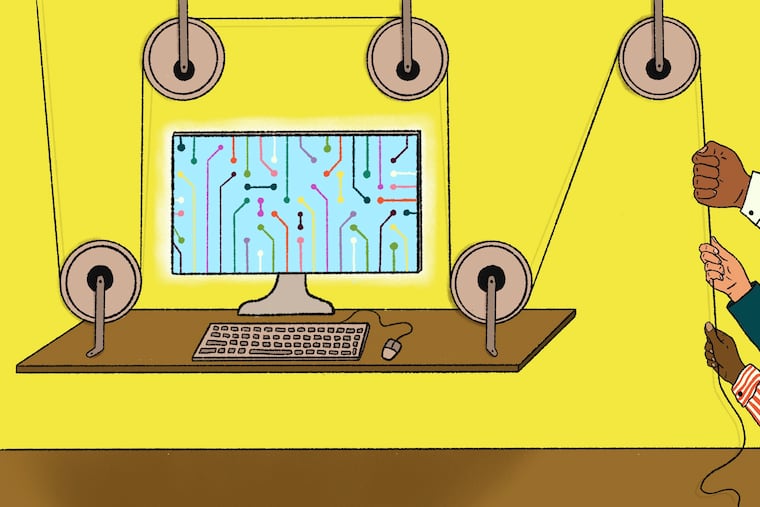
Technology updates are a constant in business. Artificial intelligence applications are hitting differently, forcing structural change.
That doesn’t mean slashing jobs for tech to take over, at least at first. Professionals who can figure out how to get staff to use AI safely and efficiently are in high demand. Some businesses have to hire, not cut, to make AI work.
The Inquirer spoke recently with practitioners who share what has changed. Their insights have been edited for clarity and brevity.
The consultant: This time it’s different

CEO
Company: Bridgenext, a multinational consulting firm based in Conshohocken that employs 1,850 engineers, architects, data scientists, and other professionals.
Castleman previously headed Mobiquity, now part of Hexaware Technologies, and Alliance Global Services, now part of EPAM.
Anytime you have a new technology cycle, the beginning is incredibly disruptive. Companies scramble to do something with the new technology. Their boards ask, ‘What are you doing about this? Is our business going to be obsolete?’
So many people in the tech space are tinkering and creating new whizbang stuff. The technology is iterating very quickly. A lot of stuff will get thrown away.
Everyone is messing around with Claude. But for our clients, CFOs are saying‚ what’s the return-on-investment here? Let’s try to get your ideas better aligned to what’s important for the business.
The technology will become better and more stable. You hope to get to the productive stuff more quickly. And most companies have layers of applications. They can’t just say, ‘Let’s build.’
The first mobile apps were just billboards on your phone. Mobile only became really useful when it was integrated to do transactions on your phone. That took retailers years. AI is like that.
Internet, mobile, cloud, AI are all amazing technology. But there is still a human element to deal with.
We have a client in manufacturing. We’ve been working with AI agents for their sales team to watch for buying behavior: ‘Your customer is not reordering like they used to every week.’ Or ‘they are buying something they didn’t used to.’
We have another client in the insurance industry. The CEO wanted their sales team to consult more with customers on the policies they need. We helped them enhance a new platform to be smarter going into the sales call.
AI is where all the buzz is. The shiny object. But data is really where the action is.
Your data is a product you can sell. But almost every client we go into, there is a significant data effort that needs to be undertaken.
The designer: More AI output, more human review
Cofounder and chief innovation officer
Company: O3 World, a Fishtown-based design and engineering consultancy
Gadsby hosted this year’s 1682 Business of Innovation conference, which took place in October at the Barnes Museum.
AI is very different from Web and product development. It is easily the most transformative factor, in business, that we’ve ever seen. Mobile, the cloud, digitization, none of that comes close to this.
The most ironic thing about dealing with AI is that we are dealing with more philosophical and human-centered issues than we are dealing with technology problems.
When we hire the individuals we are looking for — engineers, FDEs — we are really looking for problem solvers, people who can talk to people and suss out not just where the problem sources are, but how people feel about that.
We talk to them about augmentation — not replacement. When AI generates 10 times the output, that’s 10 times more that needs to be looked at — by people.
There was this real fear students won’t have jobs. Where are the entry positions when AI [can do so much]? But in my world, they are getting hired left and right. They are killing it because with AI tools, we can immediately make them valuable on client work.
I see accounting departments now where these CFOs and controllers are knee-deep into building their own dashboards and connecting data feeds and all the stuff they required an engineer to do. And yet there’s no drop in the need for engineers. Their role changes. They were doing a lot of tedious work, copying and pasting data. If you’re still doing that, it’s a sign you’re doing it wrong.
Now, engineers get to think more, about more and better ways to build things, and the quality-added value of what we are providing.
We need AI for all, accessibility to tech, to solve problems. Because AI is not going anywhere. The expectations from employers and employees is increasing.
The organizer: Pacing AI so it doesn’t overwhelm
Founder and chief
Organization: Philly Builds AI, an alliance of business leaders aiming to promote AI investment and start-up formation in the Philly area
Francisco earned two patents at IBM. In her 20-year Silicon Valley career, she was a tech evangelist at Microsoft and a development relations executive, investor, and strategist, work she continues here.
I was just at Launchpad Philadelphia, where they were graduating another group of young people. They work as interns at companies like Bentley Systems. Even though they are at the start of their careers, they have a lot to offer. They are seeing enterprises with fresh eyes, they listen well, and they are seeing how they can use these new tools to start to put together solutions that benefit clients.
You hear a lot about organizing your data for AI. But at this year’s 1682 Business of Innovation Conference [at the Barnes Foundation Oct. 6], one of the construction company leaders said that’s not the route they chose. They said the first thing they did was review their business processes. What’s the most important thing they do? Review that, and that’s where you start with AI.
If you have problems in your business that are not resolved, adding AI isn’t likely to solve those problems; it could make things worse.
Organize your main process — whether you’re a construction company, a hospitality company where you need to focus on [customer-facing] people, a financial institution. Payroll and other functions you can add later. Or you risk overwhelming the enterprise with too much change at once.
AI lets you do that — you move so fast — sometimes you need to set a measured pace that enables you to bring more people along together.
You know Aramark is a very large company, headquartered here in Philadelphia, and they have been recognized for doing this very well. They are fundamentally a hospitality company, and their approach to AI has been to focus agents to the needs of their frontline people — their chefs, their site managers, their procurement staff.
The hiring boss: AI is easier; people are tough
Chief people officer
Company: EPAM Systems, a Newtown-based IT outsourcing company with 65,000 workers
Solomon shared his thoughts on AI in the workplace at a Sept. 22 conference for HR managers in Philadelphia hosted by From Day One.
The top corporate-hiring position as of 2026 is the forward deployed engineer (FDE) who understands AI agents and technology, has a deep understanding of the business, has solid change-management and relationship skills.
‘Adjusting to AI’ goes beyond learning the products; it means you can work your way around an office and a bureaucracy and make yourself understood at different levels of an organization to implement AI agents and systems. For that, you often need to have experience — with meshing systems, and with failures.
AI hasn’t reduced the need for most technical staff. It has shifted AI spending, disrupting legacy commercial models, and has changed the way sellers sell and buyers buy services.
That’s a business opportunity, not a technical problem.
We put a greater emphasis on continuous learning and developing the skills, tools, and capabilities employees need to operate effectively in an AI-driven environment.
Given HR’s role in understanding the new technology, negotiating and implementing pricing, using AI insights to [justify] staffing decisions, the HR function is becoming more important, not less.
AI will not take jobs away. The resistance to change, experimentation, learning, and adopting these new technical realities is the threat.
The Ph.D.: Good AI rules make complex legal work fast, cheap, abundant
Founder and CEO
Company: Norm Ai, a New York legal-software engineering company
Norm Ai builds agents to automate and govern legal work, and its law firm affiliate Norm Law has more than 50 lawyers. Nay is working with the state of Delaware to develop Agent-Managed Companies (AMCs), a proposed class of autonomous business entities.
We developed a process for tailoring and supervising AI agents in live workflows, with AI agents and practicing attorneys collaborating to provide faster, consistent, and more scalable legal work.
We have raised more than $140 million in investment capital, from financial institutions such as Blackstone, Vanguard, Citi, New York Life, TIAA.
With AI agent deployments, we can pursue things that would otherwise be too costly. You can give more investment advice, you can analyze a permit or a loan, you can create a new building, and other things, more abundantly, through an AI agent provision. AI deployments have proven more efficient and cost effective.
We think AI should be deployed in a governed way with industry rules and appropriate oversight built in.