Book Shelf
Alice Waters wants to teach the world to cook. The owner of the famed Chez Panisse restaurant in Berkeley, Calif., who has become a national advocate for eating locally and sustainably, has now published a "how to" book on techniques she thinks every cook should master.
In the Green Kitchen, Techniques to Learn by Heart
By Alice Waters
Clarkson Potter 151 pp; $28
Alice Waters wants to teach the world to cook.
The owner of the famed Chez Panisse restaurant in Berkeley, Calif., who has become a national advocate for eating locally and sustainably, has now published a "how to" book on techniques she thinks every cook should master.
In the Green Kitchen, Techniques to Learn by Heart, is an offshoot of "The Green Kitchen," an ongoing video project in which Waters' favorite cooks teach fundamental cooking techniques.
The philosophy behind the project: If you commit these techniques to memory, you can get over the fear of improvising in the kitchen and rid yourself of the shackles of recipes. And, of course, Waters wants you to do this using fresh, local, organic food, with a minimum of kitchen equipment.
The techniques in the book range from cooking rice, to grilling a steak, to tossing salad greens. ("The best way to toss a bowl of delicate salad greens is with your fingers: You won't crush the tender leaves and you can feel when there is enough, but not too much dressing.")
The accompanying recipes are those of Waters' friends, who include respected chefs and professional cooks: Thomas Keller, Rick Bayless, and Charlie Trotter, to name a few.
The recipes, for the most part, are terrific, even if some are a bit complicated.
I started with the creamy, herbaceous Green Goddess Dressing on lettuces from our garden - fresh and delicious.
I was suspicious from the get-go about the No-Knead Bread, but it turned out perfectly - crusty on the outside and tender on the inside. My children could not wait for the one-hour cooling time, and I was glad we didn't; it was warm and delicious, and we bathed it in butter.
The Moroccan Braised Vegetables were good, but involved way too many steps. Roast the butternut squash, parboil the turnips and carrots; it felt like KP duty, and I think you could probably roast the whole lot of veggies in one go to achieve a similar result.
The Fava Bean Puree seasoned with rosemary and garlic was tasty, but fava beans could easily win the award for nature's most overpackaged vegetable. First they must be shelled from the Styrofoam-like pod, then blanched and peeled, and then cooked. It took an awfully long time to get a scant one cup of beans, but the resulting puree was happily eaten in a matter of minutes.
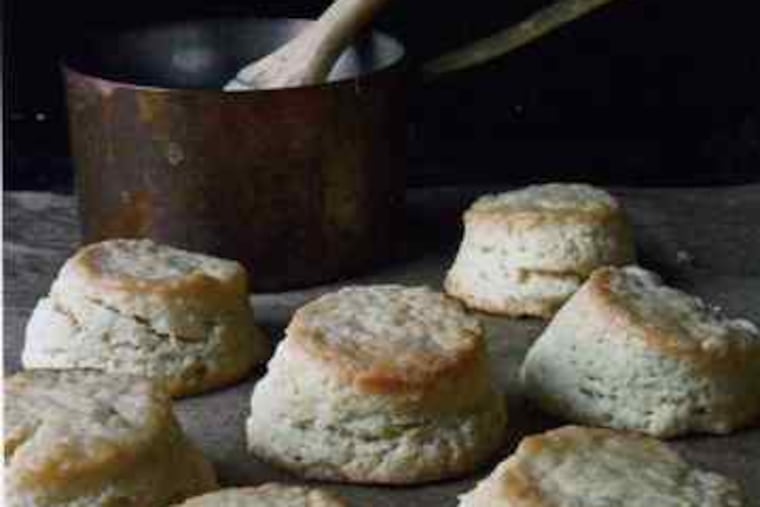
One of my favorite chefs, Scott Peacock of the Watershed Restaurant in Decatur, Ga., provided the recipe for the Sweet Cream Biscuits, a variation of his Buttermilk Biscuits. These were ridiculously easy to make and light as a cloud, and the biscuits served as the topping for the Nectarine and Berry Cobbler. It was the perfect ending to a summer meal.
I love the Waters philosophy that less is more and I love the idea of this book. But with its compilation of different chefs and their recipes, I found it a little like having a party with a lot people you like individually but who don't always mesh as a group.
That said, In The Green Kitchen contains good information for both the new and the experienced cook. Sale proceeds benefit the Chez Panisse Foundation in support of edible education, so you can learn and do good at the same time.
Buttermilk Biscuits
Makes about 15 2 1/2-inch biscuits
EndTextStartText
5 cups unbleached all-purpose flour
1 tablespoon plus 1 1/2 teaspoons homemade baking powder (see note)
1 tablespoon kosher salt
1/2 cup plus 2 tablespoons cold, good-quality lard or unsalted butter
1 3/4 to 2 cups buttermilk
3 tablespoons unsalted butter, melted
EndTextStartText
1. Preheat the oven to 500 degrees. Put the flour, baking powder, and salt in a large bowl and blend thoroughly. Add the lard or butter (cut into pieces), and, working quickly, lightly rub the lard and flour together with your fingertips until about half the lard is coarsely blended and the other half remains in pieces about 1/2-inch in diameter.
2. Make a well in the flour mixture and pour in 13/4 cups buttermilk. Stir briefly, just until the dough is blended and begins to form a mass. The dough should be soft and a bit sticky and there should not be large amounts of unincorporated flour in the bowl. If the dough is too dry, add a few tablespoons more buttermilk.
3. Turn the dough onto a generously floured surface. With floured hands, knead briskly 8 to 10 times until a cohesive dough is formed. Gently flatten the dough to an even thickness. Using a floured rolling pin, roll it out to a uniform thickness of 1/2 inch. With a floured dinner fork, pierce the dough completely through at 1/2-inch intervals.
4. Lightly flour a 2 1/2- or 3-inch biscuit cutter and stamp out rounds. Avoid twisting the cutter as you stamp, and cut the biscuits as close together as possible for maximum yield. Arrange the biscuits on an ungreased or parchment-lined heavy baking sheet so that they almost touch. Don't reroll the scraps, just bake them as is and enjoy as a treat.
Note: To make your own baking powder, measure and sift together, three times, two parts cream of tartar and one part baking soda. Make it in small batches and store in an airtight container. Use it within four weeks.
Per biscuit: 257 calories, 5 grams protein, 33 grams carbohydrates, 1 gram sugar, 11 grams fat, 29 milligrams cholesterol, 460 milligrams sodium, 1 gram dietary fiber.EndText