Black Main Line soldier finally recognized as a hero
On the day 70 years ago that an atomic bomb killed more than 100,000 Japanese and shocked the world, an obscure war-related incident in the woods of Oregon claimed the life of Pfc. Malvin L. Brown, a paratrooper from the Main Line.
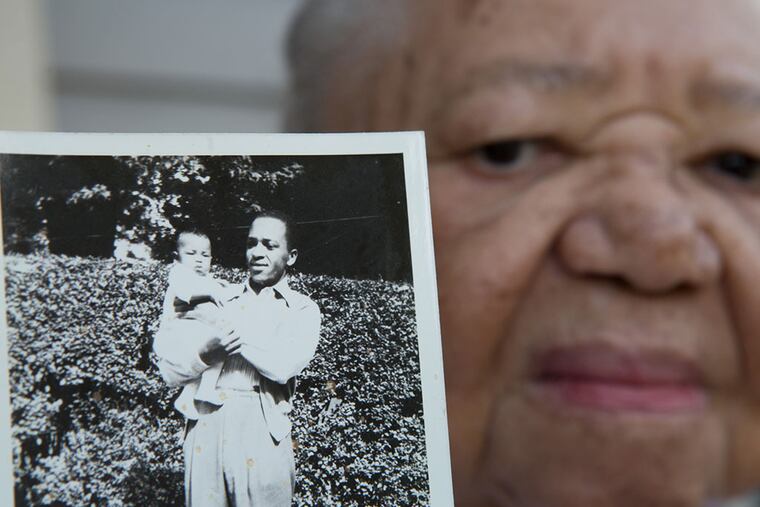
On the day 70 years ago that an atomic bomb killed more than 100,000 Japanese and shocked the world, an obscure war-related incident in the woods of Oregon claimed the life of Pfc. Malvin L. Brown, a paratrooper from the Main Line.
Brown's death was entangled in one of the stranger sagas in the history of warfare, involving the Japanese; a discovery that forever changed aviation and meteorology; and racial discrimination in his homeland.
But so little was known about him that decades later, when members of Brown's unit - the storied 555th Parachute Infantry, the Triple Nickles - and the allied National Smoke jumpers Association wanted to place a marker on his grave, they didn't know where it was.
After an article mentioning Brown appeared in The Inquirer, an association member, Fred Donner, sought help in locating the grave, and it was identified last year at Mount Calvary Cemetery, just outside Baltimore.
On Thursday, the anniversary of the day Brown died on a firefighting jump while on an assignment - "Operation Firefly" - so hush-hush that surviving family members learned about it only recently, a historical marker will be placed at the grave. Representatives of the Triple Nickles, the smoke jumpers' group, and the U.S. Forest Service will be on hand to honor a no-longer-forgotten figure.
Relatives describe the revived interest in Brown's life and military career as "a miracle."
"The more I hear about this, the more fantastic it seems," said Brown's niece Juanita Hays.
In their youths, Hays, two siblings, and Brown lived under the care of Hays' parents, Winfield and Dorothy Atley, in a twin house on Old Lancaster Road in the Haverford section of Lower Merion Township.
The Main Line was and is far more diverse than its Philadelphia Story image. Hays recalled the street as part of an integrated, working-class neighborhood. Winfield Atley worked for the township as a truck driver, and his wife was a domestic. Hays said racial strife on their block was a foreign concept: "We all got along."
But Malvin Brown did encounter racism in the military.
Brown, who dropped out of Lower Merion High School at age 16, according to school records, joined the Army in November 1942, 11 months after Pearl Harbor.
"When he went in the service, it didn't surprise us at all," said Vernell Brown, Hays' sister, who was nine years younger than Malvin Brown. "He was very compassionate, and he liked people."
When he came home on leave with that boot-camp chiseled body, everyone made a fuss over him, she said. Brown told them he was training to become a paratrooper.
But if he had any ambitions of joining the paratroopers in the European theater, by various accounts race disqualified him.
Most black servicemen were more likely to be assigned to food service, supply, and transportation jobs rather than combat duty. But under orders from President Franklin D. Roosevelt, the Army created an all-black paratroop unit, the Triple Nickles, and Brown volunteered.
"Roosevelt said, 'Let's have colored paratroopers,' " according to Walter Morris, who served with Brown and who died in 2013. "No one, including President Roosevelt, believed you could take a dishwasher and he could go through the four weeks of training that it took to become a paratrooper."
The black paratroopers were trained, but U.S. commanding officers in Europe feared that their presence might cause animosity among white soldiers.
The unit would not participate in D-Day. Instead, 300 of its members were dispatched to join the Forest Service's smoke jumpers - parachuting firefighters - in the Northwestern United States as part of a secret war.
Found the jet stream
Few outside military intelligence were aware of it, but the Japanese were bombing the United States - with balloons, exploiting one of the most important discoveries in the history of meteorology.
Using pilot balloons and making 1,228 observations from March 1923 to February 1925, a meteorological genius named Wasaburo Oishi documented the existence of the west-to-east winds that howl three to nine miles above the Earth, sometimes at 200 m.p.h., where warm and cold air collide. He had found the jet stream, the planetary system that is the mover and maker of storms.
Oishi tried to share his findings with the West, but he published them in Esperanto, then being promoted as a scientific "universal language" and spoken by almost no one, and they were ignored outside Japan.
Thus, when Allied bomber pilots reached higher altitudes during World War II, they were ambushed by headwinds that consumed their fuel and blew their bombs off-target.
Meanwhile, the Japanese were using the currents to carry bomb-carrying balloons, about 9,000 of them, to the Pacific Northwest in an attempt to set off forest fires and cause nationwide panic.
U.S. intelligence did all it could to conceal the attacks from the public, lest the Japanese be encouraged. The Nickles were assigned to tamp out the threat.
Under sealed orders, they were sent to Pendleton (Ore.) Air Force Base, in an area not known as a hotbed of diversity. They confined themselves to Pendleton for the most part, trained, and fought fires.
"They are colored paratroopers, but we have very good report on their ability," read one internal Army document.
The balloon-bomb campaign was a bust. While the Japanese had discovered the jet stream, they had not accounted for the complexities of the wind system that circumnavigates the globe in sometimes serpentine and chaotic patterns. Balloon fragments would be found from Alaska to Mexico and Michigan.
Three months before Brown died, a detonated balloon remnant did kill six people attending a Sunday school picnic in Oregon.
Honored as a hero
The number of fires set by the balloons is uncertain, but one in the Umpqua Forest evidently was unrelated.
Brown, a trained medic, was on the crew that responded to that one, on Aug. 6, 1945, volunteering to replace a medic who had become ill. The circumstances of his death remain a mystery. No one has ascertained whether it was due to an equipment problem or an inevitable occurrence during a dangerous mission.
Paratroopers traditionally were trained to land in clearings, and here they had to land in tall trees, said Joseph Murchison, president of the Triple Nickles Association.
Brown's chute became entangled in a tree, and he fell 150 feet. The official cause of death was a basal skull fracture, with cerebral hemorrhage as a contributing factor. He became the first smoke jumper to die in the line of duty.
Morris accompanied the body back to Philadelphia. He remembered Brown as a "good medic."
Vernell Brown said the family was told almost nothing about the circumstances of the death. According to the death certificate, Brown's wife, Edna, now deceased, as is a daughter, was billed $472.22 for funeral expenses.
On Thursday, Malvin Brown will be honored as a hero. Family members say they still have a hard time digesting that this actually is happening.
Said Vernell Brown, "To me, it was a miracle that all this came about."
610-313-8210 @woodt15