Tehran securing S. American ties
In Bolivia, Ahmadinejad pledged $1 billion for the poor. He will also visit Venezuela's Chavez.
LA PAZ, Bolivia - Iran's president opened his nation's wallet to Bolivia yesterday during a trip to strengthen ties with leftist leaders of South America who are increasingly embracing Iran as a counterweight to U.S. influence.
Mahmoud Ahmadinejad pledged to invest $1 billion in Bolivia over the next five years to help the poor Andean nation tap its vast natural gas reserves, extract minerals, generate more electricity, and fund agricultural and construction projects.
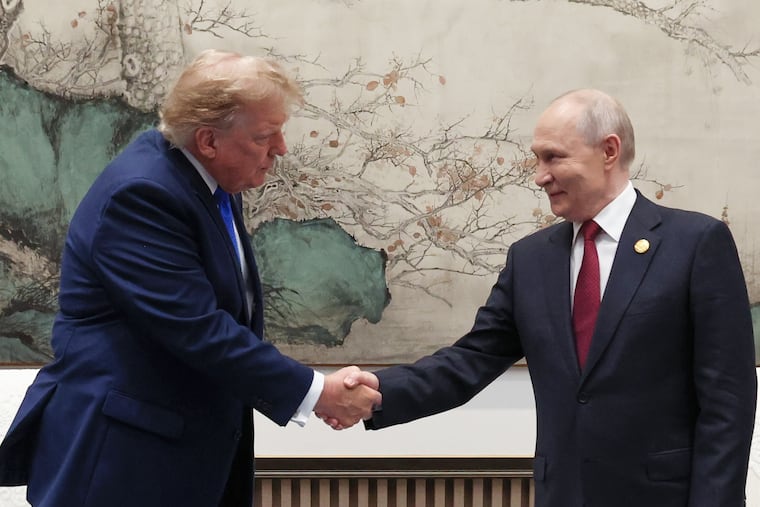
Bolivian President Evo Morales, who joins Venezuela's Hugo Chavez as one of Iran's key allies, called Ahmadinejad's visit historic. The two nations established diplomatic relations for the first time, and Morales pledged they "will work together from this day on, for our people, for life and for humanity."
He brushed off concerns about close Bolivian ties to a nation that Washington says is a sponsor of terrorism, declaring that the "international community can rest assured that Bolivia's foreign policy is dedicated to peace with equality and social justice."
Ahmadinejad's appearance before the U.N. General Assembly this week exacerbated concerns about Iranian bellicosity, and his South America trip includes time with Venezuela's Chavez, a vocal defender of Iran's nuclear program.
Chavez accuses the United States of trumping up charges to indicate that one of its enemies is pursuing nuclear weapons.
Bolivian Vice President Alvaro Garcia said that his government did not endorse nuclear proliferation, that his nation simply wanted to build commercial ties with Iran.
Ahmadinejad called Morales a "dear brother" and said his trip would be "the start of deep relations between both governments."
"We'll get rid of the poverty in our lands and give well-being to our peoples, and the people of Bolivia and the people of Iran will emerge victoriously."
Ahmadinejad's trip underscored growing ties to Latin American nations, including Nicaragua and Ecuador, even as the United States tried to isolate him internationally.
"It's Iran's answer to the United States on its own home turf," said Alberto Garrido, a Venezuelan writer and political analyst. "The United States is in the Middle East, so Iran is in Latin America."
The closer ties are viewed with alarm by the opposition in Venezuela and Bolivia - and by Washington. Rep. Connie Mack (D., Fla.) said they reminded him "of the relationship that Fidel Castro had with Russia." He urged Washington to reach out more to a region that analysts say it has largely ignored since the 9/11 attacks.
Indeed, a bipartisan bill introduced in the U.S. Congress yesterday would establish a 10-year, $2.5 billion program aimed at reducing poverty and expanding the middle class in Latin America. It would require recipient countries to contribute and encourage matching funds from businesses and nongovernmental organizations.
Chavez, meanwhile, has promised more than $8.8 billion this year in aid, financing, and energy funding to the region.