Lines in the Sand
In the 1920s, in Atlantic City, there were no segregated beaches in the resort town, and black residents rented bathing suits from bathhouses and waved from Miss America Parade floats like any other bathing beauties. But by 1928, influential hotel owners
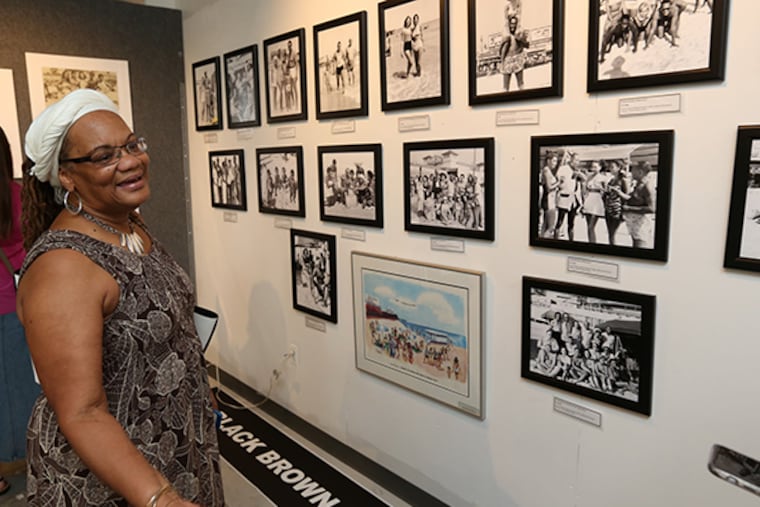
In the 1920s, in Atlantic City, there were no segregated beaches in the resort town, and black residents rented bathing suits from bathhouses and waved from Miss America Parade floats like any other bathing beauties. But by 1928, influential hotel owners were pressured by wealthy white guests who did not want to "bathe side by side with colored bathers," to quote a letter on Hotel Strand letterhead, a copy of which is in the new blockbuster exhibit
"Jet Black, Brown and Tan on the Beach," at the city's Arts Garage at 2200 Fairmount Ave., across from Angelo's.
The town fathers gave in to the powerful hotel owners and designated the Missouri Avenue beach, in front of what is now Boardwalk Hall (and not any particular hotel), as the designated beach for African Americans. But oh, what a beach it became. Celebrities from Sammy Davis Jr. to Sugar Ray Robinson to the Rev. Dr. Martin Luther King Jr. frequented the beach, which had its own hierarchy of a "Glamour Row" of cabanas for its wealthier (or lighter-skinned, by some people's memory) beachgoers.
The exhibit has hundreds of photos taken between 1910 and 1970 from individual collections and from the Diane Graves and George E. Dickerson Collection, the Chicken Bone Beach Historical Foundation, and the Charles L. Blockson Collection of Temple University. Many are from the camera of John W. Mosley, who took photos of people on the beach to sell back to them. Some are marked with post-it notes from people who have come in to identify themselves or relatives.
Last month, three people in the photos, plus curator Ralph E. Hunter Sr., president of the African American Heritage Museum of Southern New Jersey, Chicken Bone Beach Foundation president Henrietta Shelton, and ace Atlantic City Free Public Library archivist Heather Perez, gathered to talk about the Missouri Avenue beach and its place in Atlantic City history. The exhibit is on display until Oct. 8.
Bobby McCurdy
I had to be 7 or 8. I'm 73 now. I was a former jockey, and a businessman. There's Capt. [Rube] Albouy, he was captain of the beach. And Sugar Ray Robinson, of course, the famous Sugar Ray Robinson, and Dr. Lee. I was a junior lifeguard/mascot. Now, I was the one designated to go to the store for people. Because there was a row of chairs that we called Society Row, the only way I can describe it, it was real prime time, showtime. That's what it was. On the weekends, all the big-time athletes all over the world, entertainers, they would all come to the Missouri Avenue beach. A lot of them came to perform at the 500 Club and the Club Harlem. So they were on the beach. It was real prime-time showtime, where all the celebrities sat. I would go up on the Boardwalk and get them a hot dog, whatever they wanted, and bring it back. And they would tip me.
Delores Mitchell
These were taken in the late '50s, '60s, and early '70s. This is 1959; I was 19 in this one. These were all taken on Chicken Bone Beach [another name for the Missouri Avenue beach], the only beach we could go to. Was it the late '70s when we were allowed to come across Atlantic Avenue to room and board? I'm from Philly. Now, we go to the Inlet. The best beach now in Atlantic City is Maine Avenue. It's small, and it's cozy, and everybody knows everybody. Missouri Avenue was always crowded. I met them all on the beach, all the people that live here.
Betty Steptoe-Reid
I still come to the beaches here. I was born in Atlantic City. On the Westside. To me it was good, though it was discriminatory. We just followed and went to the beaches. My father was a hotel waiter; he was black. My mother was German; her family lived in Swarthmore. She was a militant. I was born in 1933. We used to walk barefooted, nothing but a bathing suit. No towels. The lifeguards were from your neighborhood. They always had a basket out there under the lifeguard stand. They used to take it out and fill it up with clams. We used to just bang them together and eat them raw. We lived the good life here. My brothers are much fairer than I am. My brothers could go to the other beaches to collect soda bottles for a 2-cent return, 5 cents for the big ones.
Ralph E. Hunter Sr.
It's called Jet Black, Brown and Tan on the Beach. It signifies the different hues one could become, jet black by lying in the sun all day, brown if you lay in the sun for a period of time, tan if you were down just for a while and leaving. Glamour Row was the row where very, very fair people would be. There was only one dark-skinned lady on Glamour Row. That's how it was. After Brown v. Board of Education in 1954, it pretty much ended. But it was a bad ending for me, a disturbing ending for me and many other African Americans. Because we had our own self-contained community. We knew exactly where we were welcome, where we could come, drink our champagne. A man known as Champagne George would come down from New York with the champagne. We could do anything we wanted. The lifeguards were all African American. In the mid-'50s, it started to slack off a bit. But they still flocked back there until the late '60s. You have to remember, in the 1970s, the casinos came to town and they thought they owned the beach. So most of us decided to go to the beach uptown.
(Interviews condensed and edited.)