How Cherry Hill East will prepare students to handle N-word in 'Ragtime'
Cherry Hill East students will tackle racial issues in classroom to prepare for opening of controversial musical Ragtime
History and English classes for thousands of students at Cherry Hill East will take a detour to tackle a hefty subject: race and the N-word.
The South Jersey district has developed a special curriculum to discuss those sensitive themes before a controversial production of the musical Ragtime hits the school's stage next month for a nine-day run.
It was added to lesson plans that will begin sometime after Monday after a furor erupted last month over the use of the N-word in the award-winning musical that brought national attention to the school, one of two high schools in Cherry Hill.
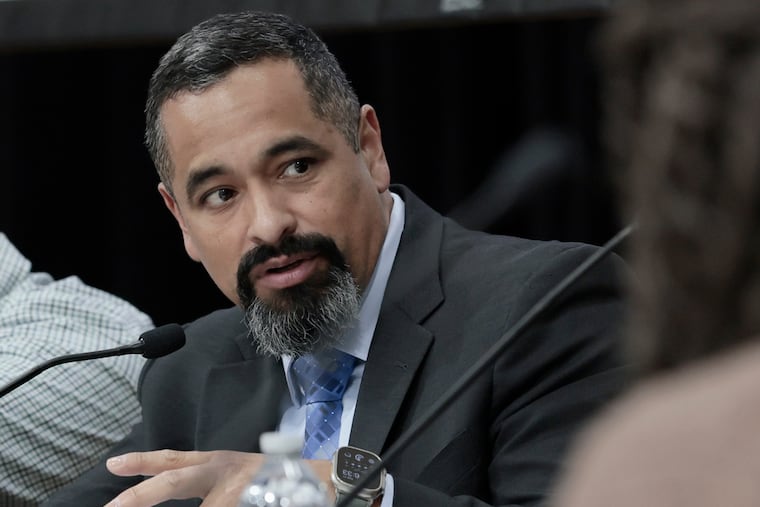
Superintendent Joseph Meloche, who made the decision to allow the musical to go on as written with racial slurs, said the required class discussions about racism and stereotypes were an important first step for the district of 11,350 students.
"This is a discussion that has to take place," Meloche said in an interview Friday. "This is not a discussion that will end when the curtain closes for the final time on Ragtime."
Ragtime depicts the fictional story of a black family, a Jewish immigrant family, and a wealthy white couple in New York at the start of the 20th century. It includes themes of racism, intolerance, and injustice. The N-word is uttered several times by the lead character.
It opens March 10 and runs through March 19.
Before the production hits the stage, Meloche said, the 2,200 students in grades nine through 12 at Cherry Hill East will talk about the themes from Ragtime in two English class periods and one history class. Each period lasts about 90 minutes.
"High school students need to be able to talk about the power of that word," said Maureen Costello, who heads the Teaching Tolerance Project at the Southern Poverty Law Center in Alabama.
The district took similar action after reinstating the novel The Adventures of Huckleberry Finn to the curriculum in 1998. The novel was removed after black parents complained about the racial slur used more than 200 times in the Mark Twain classic.
Meloche said the district received guidance on preparing the curriculum to address Ragtime from Barbara Moore Williams, a well-known education consultant who has provided diversity training for Philadelphia and suburban schools.
"If it reaches the students in the way I hope it would, it's a beginning," said Pat McCargo, a member of the Cherry Hill African American Civic Association. "It will go a long way in helping to prepare them."
The civic association and the Camden County East branch of the NAACP objected to the use of the N-word and last month petitioned the district to scrap the play. The mother of a black student at Cherry Hill East who is a stagehand in the production complained to the NAACP.
Broadway stars, people affiliated with the arts, and civic groups countered that the play should be presented with the historical context and language to accurately reflect the bigotry and racism of that time.
Meloche initially said the racial slur would not be uttered and would be replaced with a substitute word. But copyright laws prohibited modifying the script, leaving the district with the option to perform the musical as written or not at all.
In addition to the classroom discussion, every student at Cherry Hill East will have the option to see the play during school, the superintendent said. Attendance is voluntary, he said. Meloche said he met with a group of black students about two weeks ago to hear their concerns. Another meeting is planned, he said.
The district is also trying to arrange for Brian Stokes Mitchell, who starred in Ragtime on Broadway as Coalhouse Walker Jr., to meet with Cherry Hill East students to discuss the musical and racism.
Mitchell, who was nominated for a Tony for his role as a Harlem musician, offered to visit Cherry Hill when the controversy erupted. Ragtime debuted on Broadway in January 1998 and is based on the 1975 novel by E.L. Doctorow.
"Dialogue about art can only enhance the experience of viewing it or participating in it," said Howard Sherman of the Arts Integrity Institute at the New School for Drama in New York.
The NAACP argued in part that artistic rights should not outweigh the civil rights of black students and those in the community who find the racial slur offensive.
Of the roughly 2,200 students at East, 61 percent are white, 17 percent are Asian, 11 percent are Latino, 8 percent are African American, and 4 percent are multiracial, according to Meloche.
Meloche said signs will be displayed at the Ragtime performances to alert the audience about the themes and language. The cast will also make a brief statement before the curtain goes up at each performance, he said. At the end of every performance, the audience will again be reminded that the show reflects bigotry of that time, he said.
"At the end of the show, they want people to learn from it and not use that language or behavior," Meloche said.
A talk-back session will be held with the audience after the two Sunday matinees, he said. There will also be a display outside the 1,000-seat auditorium.
"Using art as a stimulus for discussion, particularly about societal concerns, is what we try to encourage every day," said Drew Cohen, of Music Theatre International, the New York licensing agency that would not allow changes to the script.
An advisory on the school's website to purchase tickets for the show warns: "This program contains strong, potentially offensive language. Parental discretion is advised."
"I plan to attend the play," said McCargo. "I probably will flinch even though I know the word is going to be in the play."
Because of the controversy, the district will change how theatrical productions are selected in the future, Meloche said. The same curriculum standards used to review other classroom materials will be applied and will require approval by the superintendent, he said.
Ragtime was selected last spring by Cherry Hill East students and approved by the theater department, officials said. The production will cost about $38,000, officials said.