Suburban Democrats focused on GOTV - get out the vote
As usual, the motherlode for Pennsylvania's gubernatorial candidates this November isn't in coal country or around the Marcellus Shale.
As usual, the motherlode for Pennsylvania's gubernatorial candidates this November isn't in coal country or around the Marcellus Shale.
It's in and around Philadelphia.
The city and Bucks, Chester, Delaware and Montgomery counties account for more than 33 percent of Pennsylvania's registered voters, according to the latest totals.
"Victory in statewide elections run through the Philly suburbs," said Chris Borick, director of Muhlenberg College's Institute of Public Opinion. "The number of voters and their ability to swing makes them the Holy Grail of state politics."
And, in a less than encouraging re-election sign for Gov. Corbett, those once solidly Republican areas are no longer.
Democrats now account for more than 43 percent of voters in the counties, and own the registration edge in Bucks, Montgomery and Delaware. Republicans still hold the advantage in Chester, though even that lead is dwindling, the data shows.
"The Republicans have spent a significant amount of money and energy attacking the President," said John Cordisco, the Bucks County Democratic Committee chair. "I would have thought that would have an effect on the registration, which it has not."
If the trend continues, one party could outnumber the other across the southeastern part of the state for the first time since the late 1940s, when the Philadelphia area consistently voted Republican for statewide elections.
Democrat gains mirror a statewide shift that started with President Obama's 2008 campaign and has steadily increased. Pennsylvania reports 49.5 percent of its voters registered as Democrats, more than a million-voter advantage over Republicans.
"Unless it's an extraordinarily moderate candidate for the Republicans, I think we're locked into being a blue state going forward," said Wes Leckrone, a Widener University political science professor.
That may bode well not just for Tom Wolf, Corbett's opponent, but also for the Democrats' 2016 presidential nominee.
Still, registrations do not assure victory, as Democrat Det Ansinn will attest.
Three years ago, Ansinn ran for Bucks County commissioner. At the time, county Democrats outnumbered Republicans by almost 13,000.
Ansinn still lost by almost 8,000 votes.
"It was a beautiful November day," Ansinn, now council president in Doylestown, remembered. "I joked in the morning, 'It's almost too nice for Democrats to vote.' They don't take the same fervor voting for their county."
Politicians, party leaders and experts interviewed this week cited voter turnout, incumbency and redrawn district lines as factors that favor Republicans. One Bucks Democrat running for for state representative in 2012, Brian Munroe, said an organizational advantage on the part of Republicans sunk his candidacy.
"The organization here for the Democratic party is just crumbled," Munroe said of the 29th district in Bucks County.
Four of the seven congressional districts that represent southeastern Pennsylvania have Republican congressmen and two of those seats contested this year, in the 8th and 6th districts, appear likely to stay red.
"What looks on paper like a wonderful scenario for Democrats is in reality much less positive," said Borick, the Muhlenberg analyst.
One Republican who's done well in these increasingly Democratic counties is U.S. Rep. Pat Meehan (R., Pa.), who is running for his third term in a district that winds through Chester, Delaware and Montgomery counties. He credits his reputation as a prosecutor and his moderate record for his success with voters.
"Those are characteristics that rise apart from party identification," he said. "I go back again to what is an educated voter who looks at a lot of variables as they're making their decision."
Corbett himself has bucked the trend before.
In 2010, running against an Allegheny County Democrat, Corbett won Bucks and Chester counties and took more than 45 percent of the vote in Delaware and Montgomery counties - which had roughly the same number of registered Democrats as they do this year.
Borick said suburban voters include moderates put off by conservative social positions and still hung over from the Bush presidency, Borick said. But that doesn't mean those voters have let go of their fiscal conservatism. "A lot of these voters are truly independent," he said.
That means Wolf's anticipated success in the suburbs may not have much trickle down effect for other Democratic candidates.
Republican leaders believe they can take advantage of that to convert registered Democrats. They say migration from the city to the suburbs is growing the number of registered Democrats. The challenge, several GOP leaders said, is selling the message that Republican leadership in the suburbs is responsible for the quality of life available there.
"What we as a party haven't taken advantage of is the fact Democrats leave the city of Philadelphia to come out here for low taxes, safe communities and good schools, and they vote for the party that they're leaving in Philadelphia," said John Kelemen, the Montgomery County Republican Committee executive director.
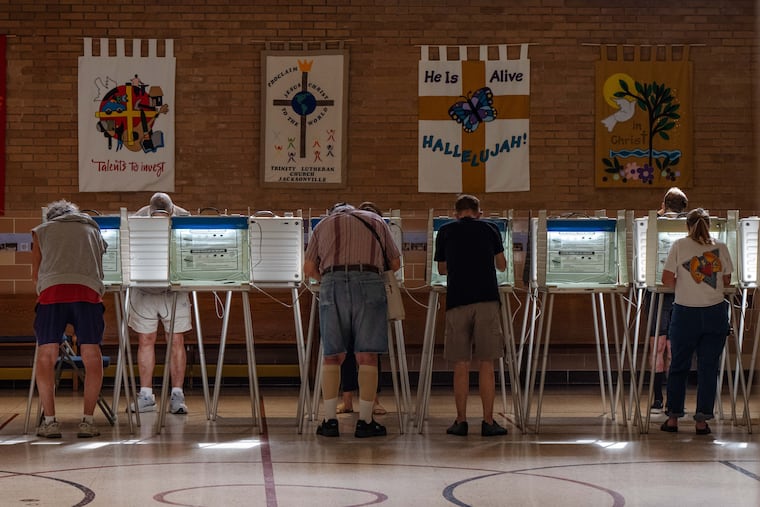
Back in Bucks County, where Ansinn and Munroe couldn't get enough Democrats out to win, party leaders are wary about turnout. Without a presidential election this year, only 42 or 43 percent of registered voters are expected to hit the polls, Borick said.
Statewide, 41 percent voted in 2010, a big drop from 2008. Democrats worry Corbett could pull off re-election despite their registration advantage.
"I can assure you we will not take that for granted," Cordisco said.
610-313-8114