Mass transit, minimum wage, weed: Here’s what Pa. Democrats say they’ll address next year — and what is still uncertain
With a Democratic trifecta in power for the first time in more than three decades, Harrisburg is about to look a lot different come January.
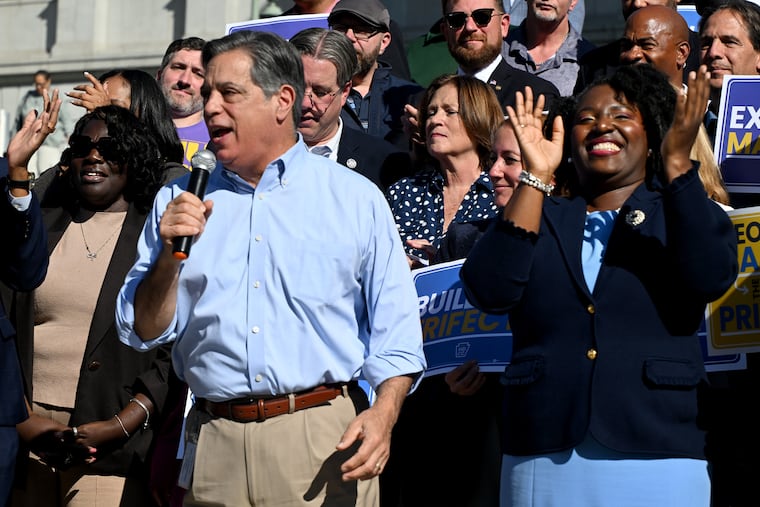
With a Democratic trifecta in power for the first time in more than three decades, Harrisburg is going to look a lot different come January.
Gov. Josh Shapiro, who was resoundingly reelected Tuesday alongside a Democratic House and Senate, will no longer have to negotiate with a politically split legislature that had often faced gridlock and disagreement during his first term.
» READ MORE: Democrats win trifecta control of Pennsylvania Senate, House and governorship for the first time since 1993
Shapiro and top legislative leaders are beginning to lay out their First 100 Day plan, the governor told reporters on Wednesday. And they’ve already committed to a number of top Democratic priorities they’ll address as their first orders of business.
Here’s what Democrats have committed to passing into law early next year in Pennsylvania — as well as some of the long-held priorities where they have yet to reach a consensus.
What Democrats have committed to
Minimum wage
There’s no question about it: Pennsylvania will raise its minimum wage early next year, with Democrats at the helm. Shapiro and other top Democrats have for years pushed for a $15-an-hour minimum wage, pitching a number of compromise ideas to try to get Senate Republicans on board. Pennsylvania’s minimum wage is the lowest in the region and is still set to the federal minimum of $7.25 an hour.
» READ MORE: Gov. Shapiro wants to raise minimum wage again, but this time with a Democratic majority. Here’s what to know.
Now that Democrats are poised to be in control, they have vowed to raise the wage to at least $15 an hour. It’s a move that would have major impacts across the state, and would mean a pay bump for more than 500,000 Pennsylvanians who currently earn less than that. How much Democrats agree to raise the minimum wage — and how quickly that wage increase will take to go into effect — is still to be determined.
Mass transit
Pennsylvania’s mass transit systems, including SEPTA, have been begging for years for a new revenue stream to help support them.
When GOP and Democratic lawmakers in 2025 failed to reach agreement on how to fund mass transit — with the issue reviving the state’s rural-urban divide — SEPTA faced a steep fiscal cliff that led them to reduce services by 20%. Shapiro later tapped into a special transit capital fund to reverse the cuts, but it was only a temporary solution that still needs a permanent fix by this summer.
» READ MORE: Pa.’s Democratic trifecta could mean more funding for schools and SEPTA — if Harrisburg can find the money
Shapiro and top Democrats, most of whom hail from Philadelphia or the surrounding region that benefits from SEPTA services, said this week that mass transit funding will be among the first issues they address at the start of the year.
Exactly how Democrats will fund mass transit is still to be determined, but SEPTA riders can be confident new funding is on the way.
Abortion rights in the Pennsylvania Constitution
On the campaign trail, Shapiro promised to enshrine abortion rights in the state constitution if he wins a Democratic trifecta. But it’s not a simple — or speedy — task.
Establishing abortion rights in the state constitution will require a ballot referendum to be put before voters, and that will come only after a yearslong process that will be contingent on Democrats retaining their trifecta in 2028.
Constitutional amendments in Pennsylvania require lawmakers to approve the change in two consecutive two-year legislative sessions — all before the question is ever put before voters.
As a result of this week’s election, Democrats will take control of the state House and Senate at the start of the 2027-28 legislative session in January. Put simply, Harrisburg Democrats need to approve the constitutional amendment in January 2027 and again in January 2029 to allow the question to be presented to voters in the 2029 primary election.
Separately, Shapiro said he wants to codify reproductive and LGTBQ rights into state law, which could be done swiftly, and without changing the state constitution — but the move could be more easily undone by future lawmakers.
Statute of limitations
As attorney general, Shapiro in 2018 championed the release of a bombshell grand jury report of thousands of cases of clergy abuse by Catholic priests. He promised to help the victims get justice by advocating to the General Assembly to create a two-year window of the state’s statute of limitations to allow child abuse victims to file lawsuits against their abusers and the institutions that protected them.
But those changes never came, following a long and winding series of partisan disagreements and a consequential mistake by former Gov. Tom Wolf’s administration.
» READ MORE: Josh Shapiro’s clergy abuse investigation boosted his reputation. Years later, some survivors feel he abandoned them.
During his first term as governor, survivors had lost hope that Shapiro would deliver for them. But Shapiro appears not to have forgotten, propping up the issue as a top priority at the start of the next legislative session. It’s unclear whether Democrats will take the lengthy route of amending the state constitution, or opt to change existing state laws to deliver more immediate relief.
Housing
Pennsylvania is in desperate need of affordable housing, with more than one million state residents currently spending above a third of their income on housing. This need is only expected to exacerbate, as the state is on track to have 185,000 fewer homes than it needs to meet expected demands over the next decade, according to state projections.
Shapiro’s administration released an ambitious 10-year Housing Action Plan earlier this year that laid out a number of reforms and initiatives to increase the state’s housing production, address housing instability, and make homebuying more possible.
It’s likely Democrats would restore a popular home repair program, too, that was championed by State Sen. Nikil Saval (D., Philadelphia). A version of the Whole Home Repairs program is now being piloted at the federal level.
The issues they’re still working out
Recreational marijuana
Shapiro, House Democrats, and Senate Democrats support legalizing adult-use cannabis. But doing sowill be more complicated, as the chambers may have different ideas on the best way to do so.
Medical marijuana is already legal in Pennsylvania. But legislators have been critical of the ways the law was applied in the state, after Spotlight PA found that a small number of doctors approved one-third of all medical cards.
With this in mind, House Democrats sought a more comprehensive approach through a state-store model that also attempted to address equity in the burgeoning industry, following decades of racial disparities in marijuana convictions.
Shapiro, for his part, has proposed taxing and legalizing recreational marijuana during each of his first four budget proposals. In his 2026 pitch, he requested a 20% sales tax on cannabis with a hefty one-time licensing fee for producers and sellers.
Residents should expect Democrats to finally approve adult-use cannabis this legislative session, but it could be a year or two before it’s available for sale in Pennsylvania.
Gun control
Democrats also have broad consensus that they want to enact stricter gun control in Pennsylvania, but doing so is likely to take time for legislative changes to pass the General Assembly. On Democrats’ wishlist: A red-flag law a ban on homemade “ghost guns,” and expanded background checks.
Due to Democrats’ narrow majority during the 2025-26 legislative session — and because not everyone in the party was unified on the legislation— two gun control bills failed on the House floor in 2025, including a red-flag law bill which would have removed firearms from a person deemed in serious risk of hurting themself or others.
Democrats are on track to have a 111-90 majority in the House next year, while Senate Democrats will lead their chamber with a 26-24 margin that could require extra negotiation to come to a final agreement on how to best address the issue of gun safety.
Data centers
The GOP Senate and Democratic House this year both passed their own versions of data center restrictions, but never agreed on the best approach to take.
In the absence of legislative action, Shapiro in August signed a sweeping executive order requiring developers to meet a number of community and environmental standards to be able to access state permits and tax incentives.
» READ MORE: Does Pennsylvania now have ‘the strictest guardrails in the nation’ for data centers?
Whether Democrats will advance a data center moratorium — a priority of some in the party who say Shapiro’s order did not go far enough — is yet to be determined. Shapiro, who previously championed data center development in Pennsylvania, has touted his executive order as the “strictest guardrails in the nation” on the unpopular data centers, arguing that blue states with moratoriums don’t have any guardrails at all.