Ready to Catch Fire
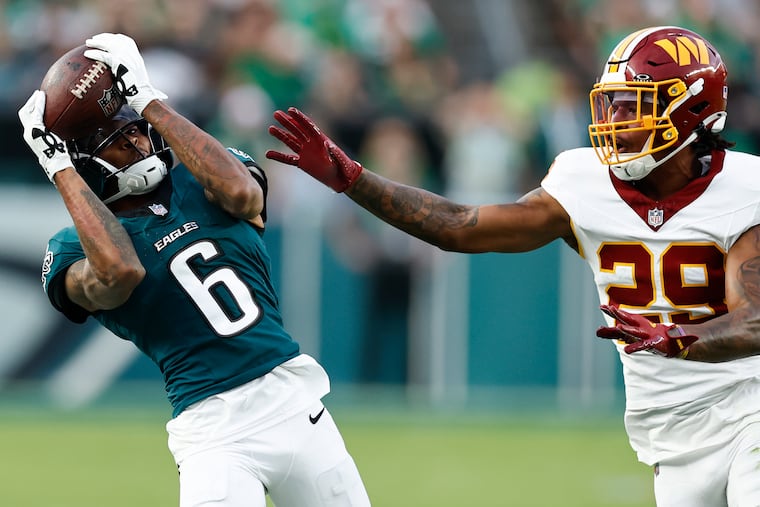
BETHLEHEM, Pa. - When Reggie Brown was a rookie, he answered questions about playing with Terrell Owens. When Brown entered his second training camp, the questions were about playing without Owens.
BETHLEHEM, Pa. - When Reggie Brown was a rookie, he answered questions about playing with Terrell Owens.
When Brown entered his second training camp, the questions were about playing without Owens.
Now in his third season, Brown is facing another T.O. question: Whether he can become the only Eagles receiver besides Owens to surpass the 1,000-yard benchmark in the Andy Reid era.
If there was ever a candidate and ever a time, it is Brown this season. The NFL has a noticeable trend of receivers taking three years to develop into 1,000-yard players. Forty-seven active NFL receivers have registered 1,000-yard seasons; 12 of those receivers, or 25.5 percent, recorded their first 1,000-yard season in their third year in the NFL. The next highest is a players' fourth year, when nine players reached the mark for the first time.
"You have two years to learn the system, two years to get acclimated to the speed of the game," Brown said. "[The third year] is one of the years that people who have been taught this stuff shoot up a little bit and get more comfortable in their own game. And big things happen when you have confidence."
Among the receivers who have had breakout seasons in their third year in the NFL are Owens, Carolina Panthers star Steve Smith, and NFC East foe Santana Moss of the Washington Redskins.
Two third-year players had their first 1,000-yard season last year: Detroit's Roy Williams and Buffalo's Lee Evans.
Brown even has a head start. He was thrust into action in his rookie season and recorded 43 catches for 571 yards. Last year, he had 816 yards on just 46 catches, an average of 17.7 yards per catch. He had more combined yards in his first two years than Smith and Moss did in their first two seasons.
"As you saw last year, it was a good start for Reggie's career," offensive coordinator Marty Mornhinweg said. "It should have a big jump this year as well."
If Brown reaches 1,000 yards, he would become an anomaly in recent Eagles history. With the exception of the 2004 season, when Owens dominated the Eagles' offense and caught 77 passes for 1,200 yards, the Eagles have favored spreading the ball around instead of featuring one receiver.
"If you have a go-to guy, you still need to spread it around," Mornhinweg said. "That tends to happen naturally with our offense anyway and the way we teach it. But it's awfully good to have a go-to guy you can count on any down to make the play."
Part of the reason for the lack of 1,000-yard receivers is the Eagles haven't had a player capable of being featured like Owens. Since Reid took over in 1999, the Eagles have drafted a receiver on the first day of the NFL draft four times. Freddie Mitchell and Todd Pinkston, first and second-round picks, respectively, are both out of the NFL. Billy McMullen, a third-round pick in 2003, is now a reserve with the Vikings.
That leaves Brown, a second-round pick in 2005, as the lone first-day receiver the Eagles still have around. The Eagles already proved they have confidence in Brown, giving him a five-year contract extension last season that included a $10 million bonus. The contract will keep Brown in Philadelphia until 2014.
The Eagles signed veteran receiver Kevin Curtis to a six-year, $32 million contract in the off-season and have a pair of second-year receivers - Jason Avant and Hank Baskett - who figure to be a part of the offense. Add in the passes to running back Brian Westbrook and tight end L.J. Smith, and Brown might not even get the opportunity to surpass 1,000 yards.
"This system is designed to spread the ball out, and we have so many weapons on this team that anyone can have a 100-yard game," Brown said. "But if you're consistently on your game week in and week out, you're going to get more balls."
Donovan McNabb, for one, is bullish on Brown. The quarterback compares Brown to his former teammate at Syracuse, Indianapolis Colts standout Marvin Harrison. McNabb identified Harrison's route running, big-play abilities and deceptive speed as traits Brown possesses.
Harrison has stats that Brown likely wouldn't be able to sniff. Harrison holds the NFL season record with 143 receptions in 2002. The most receptions in the Reid era: Owens' 77 catches in 2004.
"We'd have to throw the ball a lot, and you all would talk about the percentages again and blame me for it," McNabb joked about Brown ever reaching Harrison's numbers.
Brown shook his head at the Harrison comparisons. He insisted they were premature. But Brown is aware he's on the verge. Like any Eagles player, he's steadfast that the numbers aren't as important as winning. But some of the players who have reached the 1,000-yard level in their third seasons are among the NFL elite - and Brown wouldn't mind joining their company.
"I think everyone wants to be the best, or one of the best at whatever position they play in the league," Brown said. "I think if I go out and do my job the way I do it, the stats will come."
Going for a Grand
Here are the 12 active receivers who collected at least 1,000 yards in their third NFL season. The Eagles' Reggie Brown could join the list this season:
Player Yards Year
Rod Smith....................... 1,180 1997
Terrell Owens ................ 1,097 1998
Eric Moulds ................... 1,368 1998
Marcus Robinson............ 1,400 1999
Marty Booker ................ 1,071 2001
Laveranues Coles........... 1,264 2002
Steve Smith .................. 1,110 2003
Santana Moss ................ 1,105 2003
Javon Walker ................ 1,382 2004
Ashley Lelie ................... 1,084 2004
Roy Williams ................. 1,310 2006
Lee Evans ...................... 1,292 2006
Note: Robinson reached 1,000 yards in his third season in the NFL but his second season playing. He was on the reserve/injured list during his rookie year.
- Zach BermanEndText