Phillies may take another swing at Mariners
If the Phils make a deal before the deadline with Seattle, they need to do better than they did when they sent Cliff Lee there.
OVER THE next 2 weeks, you will hear a lot of numbers that attempt to quantify the quality of prospects the Phillies receive in exchange for the veterans they inevitably will trade away. As you attempt to digest all of that information, keep this number in mind: one. That's the number of players currently playing major league baseball at a league-average level who were considered to be among the top 15 prospects in the Mariners' organization at the time of the Phillies' infamous trade of Cliff Lee.
Of all the players Ruben Amaro Jr. and Co. did not acquire in exchange for their ace, only Michael Saunders would be helping them in their attempt to avoid an ugly transition to the future. Michael Pineda might have helped them in the 2011 postseason, but shoulder injuries have limited him to four starts since.
Dustin Ackley hit .273/.348/.766 in 2011, numbers that could have helped the Phillies avoid feeling compelled to trade for Hunter Pence, either directly, by calling up Ackley to play rightfield, or indirectly, by playing him at second base at the start of the season while Chase Utley was on the disabled list. That perhaps would have resulted in more offensive production, and more wins, and less desperation come the trade deadline. But Ackley has hit .234/.299/.632 in 351 games since his rookie year, and has a career OPS+ of 89 (100 is average).
Brandon Morrow may have bolstered the rotation from 2010-12, when he made 77 starts with a 4.16 ERA (102 ERA+). He may have led them to focus on improving the offense instead of dealing for Roy Oswalt at the trade deadline in 2010. He may have helped them sneak into the postseason in 2012, when the rotation went to tatters. But he has made only 16 starts the last two seasons and could become a free agent after this season (he has a $10 million team option for 2015).
Besides Saunders, who was hitting .276/.327/.434 with six home runs before landing on the disabled list last week, the three players in the Mariners' system on Dec. 16, 2009, who would be current factors in the Phillies' future are righthander Doug Fister, infielder Kyle Seager, and infielder Nick Franklin. Yet neither Fister nor Seager was included among Baseball Prospectus' top 15 Mariners prospects for the 2010 season or Baseball America's top 10. Franklin was regarded as one of the organization's top position prospects, and he is only 23 years old, and he is raking at Triple A. But he has a career OPS+ of 85 in 464 major league plate appearances.
None of this should be regarded as an argument that the Phillies were wise to acquire Phillippe Aumont, Tyson Gillies and J.C. Ramirez in exchange for Lee. Nor should it suggest that the fates of some of the aforementioned prospects-gone-bust would have played out the same in the Phillies' system, or that they would not have helped the organization in ancillary ways. Maybe they would be Astros now.
The purpose of this exercise is to underscore just how rare it is for a prospect to make good, and to remind ourselves of the long odds that all teams face when attempting to parlay a veteran into a young component of the future.
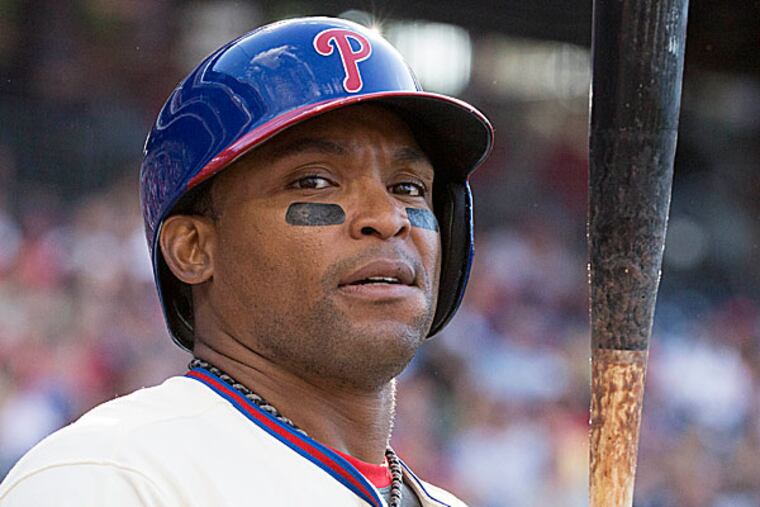
Nearly 5 years after their curious decision to part ways with Lee, the Phillies' assessment of the Mariners' system could once again play a crucial role in their ability to restock their supply of young talent. While Amaro has consistently declined to comment on trade negotiations, Seattle is the most logical landing place for outfielder Marlon Byrd, and the unsourced smoke signals from the national media suggest that the poker match between the two clubs is nearing its critical phase. Is Seattle really pursuing the Rays' Ben Zobrist as an alternative to Byrd, as a report from Fox Sports suggested? Is whatever the Phillies are demanding really a deal-breaker? Would the Rays really accept less?
The irony in the current situation is that the "quality" of prospect the Phillies might realistically expect in return for Byrd is the "quality" of prospect that Seager and Fister were regarded to be back in December 2009. Fister, who has a 2.90 ERA in 12 starts for the Nationals this year, was a 25-year-old who split time between Triple A and the back of the Mariners' rotation. Seager, who has an .843 OPS and 15 home runs for Seattle, was a third-round draft pick who one year later would rank only ninth in the Mariners' system, in Baseball America's estimation.
Maybe the Phillies, who open the unofficial second half of the season tonight in Atlanta, will land themselves that kind of prospect this time around. The only certainty is that none of us really knows.
On Twitter: @ByDavidMurphy