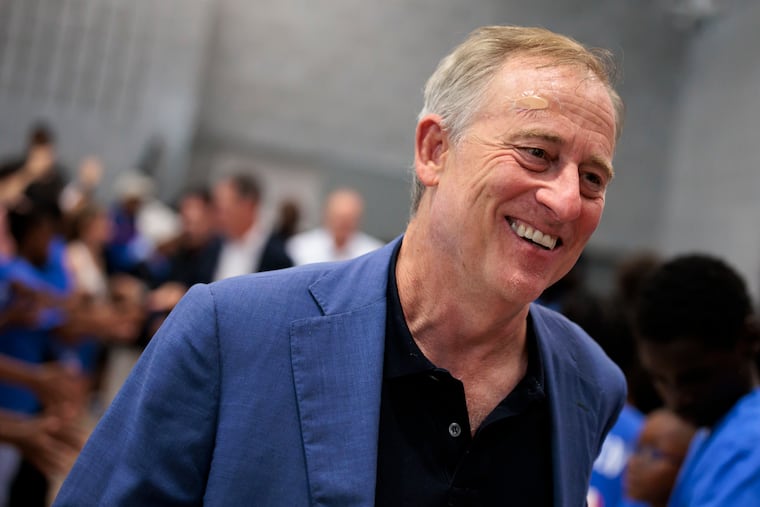
To Dave Dombrowski, the Phillies’ problems begin an arm’s length away
Dombrowski had a lot of answers for a disappointing Phillies season during his year-end news conference on Thursday. He didn’t offer many solutions.
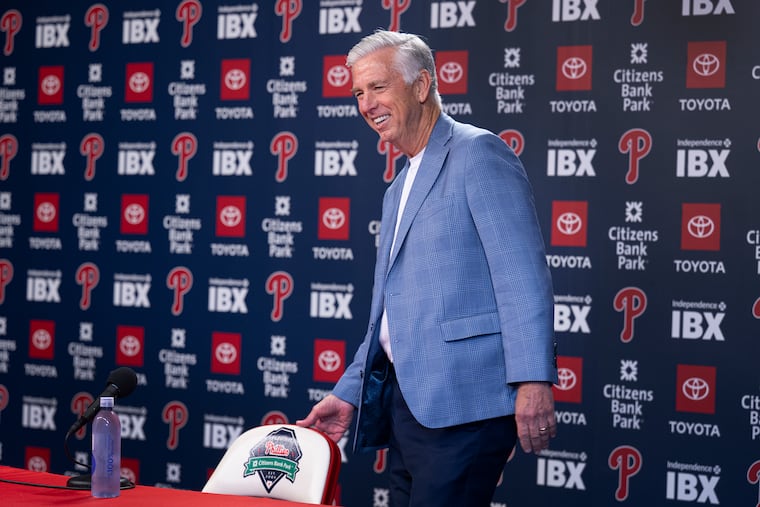
Dave Dombrowski had a lot to say about the ways everybody else on the Phillies can improve.
“We were very clear,” the Phillies president of baseball operations said during his nearly hourlong year-end media availability on Thursday. “He knows he has to be better at shortstop. I told him that’s really mandatory … if he plays shortstop like he did in 2025, he can play shortstop. But if he plays it like he did in 2026, he can’t.”
“We like Stott,” Dombrowski said. “I think he can be better than what he is. He had a good June, July, August. I don’t know why he can’t be that player all the time.”

David Murphy alerts
“We need to get Crawford better,” Dombrowski said. “There’s no question on that. He needs to improve. He did like we thought he would have thought this year, but there’s got to be another level where he hits better, he gets on base more, he steals more bases.”
“I don’t know what happened to Marshy the second half of the year,” Dombrowski said. “He was not good. He was an All-Star the first half of the year. We need to get him back to playing better.”
But when the conversation turned to the things that are listed in Dombrowski’s job description, the detailed checklists disappeared.
He was asked about his three trade deadline acquisitions, none of whom wound up playing in the Phillies’ wild-card loss to the Braves.
‘I don’t think anything went wrong,“ Dombrowski said. ”We felt very good about those moves, that they would give us the strength that we needed to … We’re comfortable with where we were at the time. Unfortunately a couple of them didn’t work out.”
He was asked about his comfort level with the Phillies’ organizational depth, given that they carried a couple of light-hitting backup catchers for much of the season and throughout the wild-card series.
“Organizational depth, yes, I’m very comfortable,” Dombrowski said. “We did have a lot of injuries at the end of the year at triple A that were very unfortunate for us. We probably would have had a different looking roster for those three games. We had a lot of guys we were talking about bringing up and maybe having be the 26th guy on the roster. It’s just the way it went at that time. We had a bunch of unfortunate injuries.”
» READ MORE: Don Mattingly says he ‘never felt slighted’ by the Phillies’ pursuit of Alex Cora
He was asked about a farm system that national experts rank among the most barren in the majors.
“I know that our system gets hit hard from a critical perspective,” Dombrowski said. “But the reality is, this year, [Andrew] Painter took awhile to get over the hump, but I don’t know another club in baseball that wouldn’t want him in their rotation going into 2027. Crawford did a solid job. He needs to get better. But, sometimes you have to take growing pains at the big-league level. …. “[Alex] McFarlane, I think is going to be outstanding in the bullpen … I think we have to be careful of this now because of where we are. We’ve traded for [Jesús] Luzardo, we’ve traded for [Jhoan] Duran, so a lot of them have been used in these types of deals that have helped us in other factors when you’re trying to win.”
Dombrowski not only defended the Phillies’ signing of veteran right fielder Adolís Garcia, who suffered a season-ending injury after posting a .599 OPS in 259 plate appearances, but pointed to it as the type of signing the team could need to make again.
“I know that the Garcia move didn’t per se work out real well last year, but the reality is there weren’t a lot of right-handed hitting outfielders that did have a great year,” Dombrowski said. “If Adolís had stayed healthy, he was starting to make some adjustments with his swing, he was an outstanding defensive outfielder and I think he had seven home runs already at that time, so maybe he hits 25 to 30 home runs and plays outstanding defense.
“Maybe at some point he ends up being a platoon basis with Marsh. So I think he could have been helpful to us. But I think you have to look at all different ways — not necessarily a big contract with dollars is going to make a difference in that regard, because we have a lot of those.”
» READ MORE: Phillies will keep Trea Turner at shortstop for now: ‘He knows he has to be better’
All of which leads to a natural question … Is there anything the Phillies front office can do better?
Dombrowski was asked that specific question on Thursday. He could have responded a lot of different ways. He could have pointed to the acquisitions of Luzardo, and setup man Jonathan Bowlan, and, years ago, José Alvarado as examples of the offseason trade market bearing more fruit than the midseason trade deadline scramble.
Dombrowski could have said that the Phillies need to take a fresh look at all of the pieces on their roster and ask themselves if there is a deal that would make them a more sensible whole, the way they did when they traded Matt Strahm for Bowlan. Does it really make sense to try to get Marshy back to his All-Star form? Or does it make more sense to find another team who believes he can do it? Maybe there is a right-handed Marshy the Phillies can trade for? Same goes for Crawford. Even Stott. Dombrowski obviously can’t mention these players by name. Chances are, it won’t make sense to trade any of them. But he can certainly say that he and his front office need to take harder and more creative looks at potential structural remedies for an offense that ranked dead last in the majors in OPS+.
Dombrowski could have said that he will spend part of his offseason double-checking his prior math on bullpen arms like Jordan Romano, and Brad Keller, and trade deadline acquisitions Caleb Killian and Brooks Raley. Maybe it is sheer coincidence that the Phillies keep adding guys who keep breaking down shortly thereafter, while watching a guy like Jeff Hoffman keep on ticking. Maybe there really isn’t a more viable offseason strategy for the corner outfield than to keep fishing from the pool that produced Whit Merrifield, Max Kepler, and Garcia.
Dombrowski could have said they need to look at the emergence of McFarlane not as evidence of their developmental brilliance but as an example of how to build a bullpen. He could have said that the immediacy of McFarlane’s success might encourage them to be even more assertive with pitching prospects Gage Wood and Mavis Graves, both of whom he cited as potentially helping the team next season. Did the Phillies call up the 25-year-old McFarlane at the exact moment he was ready to help him? Did they transition him from starter to reliever at the exact right time? Could he have helped them sooner?
Dombrowski didn’t say any of this. Instead, he responded as if he were being entrapped.
» READ MORE: Alex Cora did the smart thing. The Phillies will be fine with Don Mattingly. But, really, who cares?
“That’s a tricky question,” Dombrowski said. “That’s why you asked it like that. I understand it. Because the reality is, you’re always looking at ways to improve yourself. I’ve been doing this a long time. Every year we sit down and have a meeting internally and with our staff members on how we can get better and how we can improve our methods.”
This isn’t about a lack of public accountability. Public accountability is overrated. It was far more illuminating to hear Dombrowski explain his view on the Phillies’ season than it would have been to watch him self-flagellate for an hour. But explanations without solutions are excuses disguised as answers. Dombrowski had a lot of answers. He didn’t offer many solutions.
Telling Turner that he needs to be better is not a solution. Dombrowski has been around baseball long enough to know that a career-worst OPS at the age of 33 is unlikely to be a blip. Since 2013, there have been exactly two instances of a shortstop older than 33 finishing a season with an OPS+ of league average or above (minimum 400 PAs). Brandon Crawford had a 141 OPS+ in 2021 at the age of 34. Jimmy Rollins had a 100 OPS+ in 2014 at the age of 35.
Getting J.T. Realmuto more days off isn’t a solution. Sure, it’s a worthy goal. But only seven teams in the majors had a backup catcher who logged at least 200 plate appearances with an OPS+ of at least 90. There aren’t a lot of catchers out there. It’s why the Phillies gave Realmuto a three-year, $45 million deal.
As far as Dombrowski is concerned, the solution is to trust him.
“Well, the reality is that, ‘Hey, it’s up to me,’” Dombrowski said. “I’ve created this situation, right?”
That’s clearly good enough for his boss. The Phillies have yet to publicly acknowledge an agreement with Dombrowski to remain with the club beyond the 2027 expiration of his most recently disclosed (and presumably current) deal. But the team president sure talks like a man with political capital.
“I plan on being here for a while,” Dombrowski said. “It’s not my liberty to announce contracts, but it’s a situation I plan on being here for a while.”
» READ MORE: Phillies add former Mets manager Carlos Mendoza to their coaching staff
Time could very well prove Dombrowski correct in his belief that the Phillies’ decline and fall is being greatly exaggerated. If Aidan Miller ends up being Kevin McGonigle or Chase DeLauter or even Carson Benge, and if Painter ends up being the guy he was down the stretch, and if Graves and/or Wood can team with McFarlane and Bowlan in front of Duran, the Phillies will be a lot closer to where they need to be. The ultimate judge of Dombrowski’s tenure will be the team’s scouting and development system, where the time horizon is long.
The question is whether Dombrowski is nimble enough to keep pace with front offices like those in Tampa Bay, Milwaukee, Cleveland and Los Angeles, all of which are led by executives with expert-level training in the art of doing more with less. The story of the Dodgers’ run of dominance isn’t their payroll but marrying it with Andrew Friedman’s experience building Rays rosters without money.
Dombrowski isn’t wrong to hope for more production out of players like Turner. But hope is not a strategy. At a certain level of necessity, it becomes a false belief.

The Phillies haven't won a playoff series since 2023, and their postseasons keep getting shorter and shorter. How can they fix it? Radio play-by-play announcer Scott Franzke joins Phillies Extra, The Inquirer's baseball podcast, to discuss Trea Turner's future, the managerial uncertainty, whether the Phillies can get "creative" to change the mix of the roster, and more. Watch here.
You can also subscribe to the podcast version of Phillies Extra on Spotify or Apple Podcasts.
Previous episodes: Larry Andersen | Matt Klentak | Jeff Francoeur | Luke Murton | Mike Hazen | Tony Gwynn Jr. | Kevin Stocker | Bobby Dickerson | Jim Bowden | John Middleton