How two Philadelphia brothers became the perfect people to make a documentary about the Phanatic
Big Phan — which premiers Saturday at the Philadelphia Film Festival — took two years to finish as the Kepner brothers tapped into their childhood and told a story that only they could.
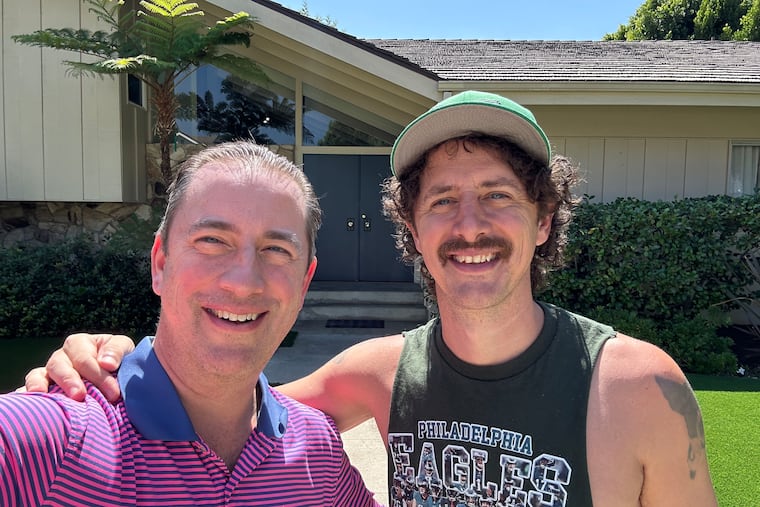
Dave Raymond always opened himself to the conversation but he often knew how it would end. Someone wanted to do a project about the Phillie Phanatic and they wanted Raymond on board. Raymond, the first person to wear the costume in 1978, was usually interested. And then that was it.
Sometimes the people never called back. Some projects stalled at the finish line. Others got caught in Hollywood purgatory.
But Raymond knew there was something different about the brothers who reached out in August of 2024. Hoag Kepner and his older brother Tyler grew up Phillies-obsessed in Montgomery County where they loved the mascot as much as they did Mike Schmidt.
» READ MORE: A new Wing Bowl documentary chose to celebrate the event instead of focusing on the ‘ugly’
They sat in Section 234 of Veterans Stadium, roared at the Phanatic’s bits, and shrieked when their grandmother plucked a feather from the mascot’s tail.
Hoag couldn’t believe there had never been a documentary about the Phanatic and he told Raymond he wanted to be the filmmaker who finally did it. He sent him a pitch, explaining why this project would not sputter like the rest.
Big Phan — which premieres Saturday at the Philadelphia Film Festival — took two years to finish as the brothers tapped into their childhood and told a story that only they could. First, Hoag and Tyler Kepner needed to convince Raymond that they were the right people to do it.
The last page of their pitch included an illustration of the Phanatic from 1994 that Hoag made for the baseball newsletter his brother produced from their Montgomery County home. Tyler, now a national baseball writer with The Athletic, wrote the words for KP Baseball Monthly and Hoag drew the covers.
The January/February 1994 issue included a feature on Raymond — “KP Interviews The Phillie Phanatic,” it said — shortly after Raymond retired from the Phils. The brothers told Raymond that they wanted to tell the mascot’s story again. Yes, there was something different about this conversation.
“That’s what really sold me: two Philadelphia brothers who have all this backstory,” Raymond said. “At the very least, I have to say yes just because of that.”
He was magic
The Kepners had season tickets at The Vet and their plan came with perks.
“We had the Dave Montgomery plan,” said Tyler, 51.
Their father John served in Army Reserves with Montgomery, the longtime team executive who later became part owner. Montgomery let the Kepner boys pick out 16 games every offseason as the brothers built their own partial season-ticket package without any filler games. They only paid for the games they wanted to go to.
“How great is that?” Tyler said.
» READ MORE: Tom Burgoyne insists he’s just the Phanatic’s best friend. A new documentary convinced him to admit he’s more.
Montgomery placed the Kepners in Section 234, which was usually filled with notable faces. Arlen Specter sat behind them once and kept score. Charles Barkley signed their baseball. And the Phanatic always seemed to barrel through.
“He was magic, man,” said the 46-year-old Hoag, who is the film’s director while his brother is an executive producer. “It’s the same with Santa Claus. I still wonder about that. When you’re little, you have one foot in knowing that something isn’t real, but you want to believe so you do. He just came alive. This seemed real. He seemed animated.”
“He was enormous. I think that’s something that as you get taller, you lose sight of. But as a kid, he’s like 7-feet tall. I think there’s an initial fear, but you know he’s friendly.”
The Phillies introduced the Phanatic in 1978 as another way to drum up interest at The Vet. Bill Giles already tried Kite Man, Benny The Human Bomb, and the Great Wallenda. He was up for anything, but the documentary details how Giles needed to be convinced before greenlighting the Phanatic.
The costume was designed by the same people who created Miss Piggy and the Phanatic was introduced on a random weeknight in case the mascot was a bust. Giles tapped Raymond, then an intern from the University of Delaware, to step into the costume. Big Phan explains why that choice was perfect: Raymond had a big personality and had communicated non-verbally at home because his mother lost her hearing from Meniere’s disease.
The Phanatic became a sensation that quickly outgrew South Philly. The mascot has appeared everywhere from late night TV to The Simpsons to rock concerts. In Philly, he’s the Phanatic. But elsewhere, he’s more than just a Major League Baseball team’s biggest fan. The Phanatic grew into a piece of pop culture. So who better to tell the story than people who lived it?
“I’m not under the illusion that I’m the only one who could make it, by any means,” Hoag said. “But I do feel like you have to be from Philly. I think it helps if you were around the Phanatic as a kid and had those experiences that I did and had a personal connection to it.”
‘A very selfish idea’
Hoag had recently finished his latest film and was wondering what he could do next while he was watching a Phillies game on TV. There was his next project: The Phanatic.
“Who wouldn’t want to make a documentary about the Phanatic?” said Hoag, who lives in Austin, Texas. “In many ways, it was a very selfish idea. I wanted there to be one so I tried to get people to let me make one.”
The film was funded by local donors, worked on by a Philly illustrator, and aided by a local puppeteering company. Morgan Betz, the grandson of a former Phillies owner, is a producer. The brothers were not the only local connection to a film about a local icon. Hoag said they hope to secure a distribution deal with a streaming service after the Philadelphia Film Festival.
The 95-minute film encapsulates how a green flightless bird from the Galápagos Islands became a piece of Philadelphia. It helped that everyone working on it already knew why.
» READ MORE: Flag Man marched around Veterans Stadium after 9/11. 25 years later, he’s better for it.
“I didn’t have to explain to them how powerful the Phanatic is to young kids because they lived it,” Raymond said.
The brothers from Section 234 traveled the country as they conducted interviews with people like Bryce Harper, Chase Utley, and Schmidt along with Lil’ Dickey, Jason Kelce, and Simpsons producer Christine Nangle, who grew up in Northeast Philly. Tyler peppered the questions while Hoag rolled the camera, working together just like they did in their home in Gwynedd Valley.
“We really became kids again,” Hoag said. “We would always be texting about mascots. I don’t want to talk smack on other mascots, but we have opinions on the other ones we see. He goes to a lot of games and he would snap a photo and be like ‘Look at this clown’ or ‘This one’s pretty good.’ It was fun to relive our Phillies days.”
The documentary traces the mascot’s history before it tackles the depression Raymond battled, the stress of being the Phanatic, and the death of his mother. Raymond left the Phillies after the 1994 season and handed the Phanatic to Tom Burgoyne, his understudy who has done the job ever since.
Raymond has spent years as a motivational speaker, training himself to not become emotional when he talks. But that didn’t help him when he sat with the Kepners and talked about his mom.
“As a speaker, the worst thing you can do is to disengage your audience,” Raymond said. “So what they teach you is if you’re going to go through something emotional, you don’t want to lose your audience. It’s a human feeling but as soon as you lose composure, the audience is worried about you and you’ve disengaged them. I’ve told this story so many times on stage and it requires practice and focus.
“When I told it in front of the cameras, I just broke down. So what I felt good about is that it was finally coming out in a way for me. It was cathartic because I wasn’t worried about telling it to an audience. It just happened.”
The brothers interviewed Giles, who died earlier this month, and spoke to the person inside the Gritty costume but didn’t reveal their identity. The doc tells how Burgoyne found the job by searching The Inquirer’s classified ads after feeling burned out by his entry-level sales gig. And it follows Burgoyne around the ballpark as the 61-year-old still makes the mascot come alive all these years later.
“It’s about the Phanatic, but don’t think it’s about this furry mascot,” Hoag said. “It’s about these two guys and their journey and purpose. Talk about two people whose purpose was so clearly defined. That’s all we want in life: What’s my purpose? I want to feel like I was made for something and I really do something. These guys were perfectly suited for it and they fulfilled their purpose in a way that’s like, ‘Ahh, Wouldn’t it be great if we all had that?’ Hopefully this inspires people to find that.”
The coup de gras
The Phanatic came into Section 234 with the same chaotic energy he did years earlier when he visited the Plymouth Meeting Mall.
“You’re that little and you can’t believe he’s at your mall,” Tyler said. “Like ‘Oh my god, he’s here.’ He’s not at the stadium. He’s where I hang out. It was like seeing Bob Dernier at the Magarity Chevrolet. I was like, ‘I can’t believe Bob Dernier is at the Magarity Chevrolet.’ It blew my mind. It was the same thing with the Phanatic.”
The mascot spotted Barkley in Section 234, started bowing to him, and then brought him gifts. First, he stole someone’s popcorn and brought it to Barkley. Next, a hot dog.
“Then he grabs a woman’s purse and gives it to Charles,” Tyler said. “And then in a bit that you could never do anymore, he grabs a lovely young lady, sweeps her off her feet, and brings her to Charles as the ultimate gift he could give Charles Barkley. Charles was dying. He was literally knee slapping. That was the Phanatic. He could go right up to the edge sometimes. That’s the stuff you would see in 234.”
» READ MORE: Slapshot, the Flyers’ first mascot, didn’t last long. But the memories endure for Gritty’s ‘grandfather.’
Phillies PR director Larry Shenk gave Tyler a press credential when he was still a kid, allowing him to go into dugouts and interview players for his newsletter. Tyler typed them at home, had friends armed with magic markers help color the covers, and mailed it to subscribers like Bob Costas, Harry Kalas, and Tug McGraw.
One of Tyler’s final issues was the cover story with Raymond. He mailed Raymond a copy and the Phanatic returned it with a signature.
“To Tyler, I will see you at the top someday” Raymond wrote. “Love, The Phillie Phanatic.”
The newsletter was the launching pad for Tyler’s sports writing career as he is now one of baseball’s esteemed chroniclers. And the brothers dug up that old issue two years ago, hoping it would convince an old friend that they were the guys for the job.
“I think that was the coup de grâce for Dave,” Hoag said. “He said he was looking at it with his wife and she said, ‘These are the guys.’ I think he enjoyed that there was a real connection. I said, ‘We met when I was 8 and you high-fived me in Section 234. He said, ‘Oh yeah, I remember.’ All of a sudden I have this responsibility that I wanted. But I’m like, ‘Wait, I’m telling the Phanatic story? Whoa. This is important.’”

The Phillies haven't won a playoff series since 2023, and their postseasons keep getting shorter and shorter. How can they fix it? Radio play-by-play announcer Scott Franzke joins Phillies Extra, The Inquirer's baseball podcast, to discuss Trea Turner's future, the managerial uncertainty, whether the Phillies can get "creative" to change the mix of the roster, and more. Watch here.
You can also subscribe to the podcast version of Phillies Extra on Spotify or Apple Podcasts.
Previous episodes: Larry Andersen | Matt Klentak | Jeff Francoeur | Luke Murton | Mike Hazen | Tony Gwynn Jr. | Kevin Stocker | Bobby Dickerson | Jim Bowden | John Middleton