U.S. Rep. Jeff Van Drew accuses N.J. Democrats of ‘cover-up’ at congressional hearing over noncitizen voting
U.S. Rep. Jeff Van Drew, a South Jersey Republican, held a hearing about noncitizen voters Gov. Mikie Sherrill had disclosed in New Jersey. No one involved in N.J. elections was a witness.
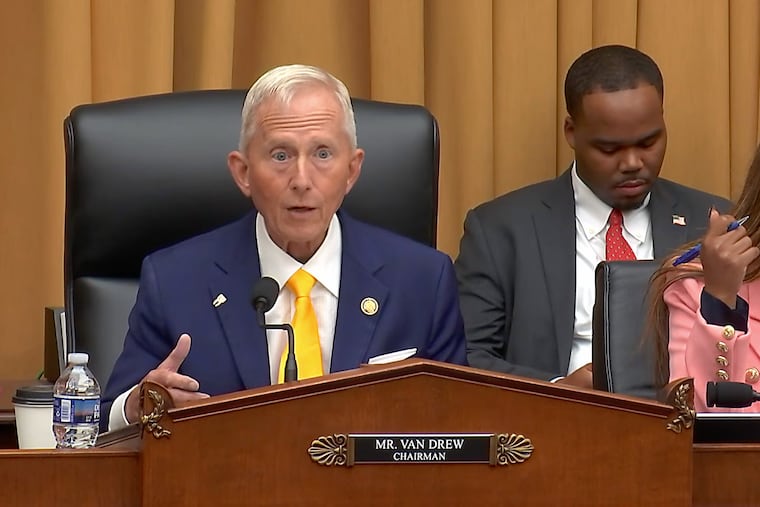
South Jersey Republican Rep. Jeff Van Drew tried to ramp up pressure on Democratic Gov. Mikie Sherrill over the state’s noncitizen voter registrations at a Tuesday hearing in Washington, which did not feature testimony from anyone from Sherrill’s administration.
“Whose side is New Jersey government on?” Van Drew said early in the congressional hearing as he aired grievances with Sherrill and the state’s immigration policies. “That’s the question hanging over this entire hearing.”
None of the witnesses at the hearing are employees of New Jersey or IDEMIA, the software vendor which Sherrill has blamed for the issue, a point disputed by the company.
Van Drew, the chair of the House Judiciary Subcommittee on Oversight, has been a thorn in Sherrill’s side since she announced in July that about 6,600 noncitizens were registered to vote due to an issue with the software at the Motor Vehicle Commission (MVC) under former Democratic Gov. Phil Murphy.
The hearing came the day after the Supreme Court rejected President Donald Trump’s mail ballot restrictions, allowing states to continue sending ballots under the same processes they’ve been using for years. Van Drew has been a vocal supporter of Trump’s efforts to overhaul national elections, including passing legislation to require proof of citizenship, like a birth certificate or passport, to register to vote.
Three witnesses, including the former chief counsel of the Republican National Committee, advocated for stricter rules around voting. A fourth witness, a former election official from Arizona, said the issue of noncitizen voter registration is incredibly rare.
Van Drew claims state knew of problem sooner
At the hearing, Van Drew repeatedly accused the state of New Jersey of knowing about the noncitizen registration issue since 2024.
“In political terms, that’s called a cover-up,” he said.
The Cape May County lawmaker contended that “internal documents” show that the state government “tested and approved” the software that led to the improper registrations.
He said IDEMIA “received a request” from the state in 2024 that showed the state knew about the problem but he did not explain what the request or internal documents were. IDEMIA did not respond to requests asking for clarification after the hearing.
Van Drew spokesperson Paxton Antonucci told The Inquirer Tuesday evening that the documents showed that New Jersey reached out to IDEMIA in June 2024 after noticing individuals who were registered to vote had missing information on their age and party affiliation. She said that information was missing because the software failed to flag that the group of individuals selected they were not citizens but were still registered to vote.
“The Committee is working with IDEMIA to obtain additional information on how this was allowed to happen, and we are seeking documents from New Jersey as to why this error was never disclosed to the public prior to 2026,” she said.
A Sherrill official said they did not know what Van Drew was referencing. Mahen Gunaratna, Murphy’s spokesperson, pointed to a previous statement on Tuesday that said Murphy “had no knowledge” of the issue and applauded Sherrill for investigating it.
Sherrill spokesperson Darwin Pham said in a statement Tuesday that congressional Republicans are weaponizing the issue “to advance Trump’s voter suppression agenda” while the governor “is focused on continuing to solve the problem she inherited from the previous administration.” He called the hearing “political theater.” Sherrill hired an independent firm to conduct an investigation that’s ongoing. She said she will present the findings to the public.
Sherrill’s administration said earlier this summer that the state removed roughly 4,000 voters from the rolls and left the rest to county election officials to verify whether they were citizens or not. Locally, Burlington County confirmed removing noncitizens from the rolls but did not specify a number.
Sherrill’s administration said fewer than 400 of the noncitizens voted but did not impact the results of an election. Van Drew pushed back against this assertion on Tuesday, saying he still doesn’t know the details of which elections these noncitizens voted in.
“Anybody knows if you follow local elections, they can be a handful of votes very often. It can even happen in Congress,” said Van Drew, who was elected as a Democrat in 2018 before declaring his loyalty to President Donald Trump and switching parties a year later. This November, he will face Democrat Zack Mullock, the Cape May Mayor, at the ballot box.
Van Drew said IDEMIA, the vendor, has cooperated with the committee’s investigation. He said Lt. Gov. Dale Caldwell, the secretary of state, has been “somewhat cooperative” but that the state has broadly “done everything it can to not cooperate and stonewall the investigation.”
A Sherrill official said Tuesday her administration provided the committee with public documents. The governor has pledged to protect New Jerseyans’ data, and her administration has been in a legal battle with the Trump administration over providing the personal information of noncitizens.
Van Drew referred to Caldwell being under investigation without going into details. Sherrill has touted her transparency in disclosing the noncitizen voter registrations, but she’s been criticized by some in her party for staying tight-lipped over a reported investigation into Caldwell and his alleged behavior with women.
Noncitizens removed from voter rolls in Burlington County
David Levinsky, spokesperson for Burlington County, confirmed there were some ineligible voters that were removed from the rolls in the South Jersey county but deferred to the state on specific numbers.
“The Superintendent of Elections Office continues to follow all relevant state laws and guidance to ensure that all residents who register to vote are eligible,” he said.
Stephanie Salvatore, the Gloucester County superintendent of elections, said Tuesday that the county had not been notified of any questionable voters due to the MVC issues from the state.
Salvatore, who has been in the election office for more than three decades, said the issue has come up “a handful of times” before.
“I have police powers over elections, and an investigator assigned full time. We work closely with many agencies including the FBI, the State Police, the County prosecutor among other agencies,” she said. “If I cannot verify the voter eligibility in question within my office, I send it to the professionals and/or the courts to decide.”
Camden County did not have specifics as of Tuesday evening, but spokesperson Dan Keashen said “the county board of elections has had a dialogue and been working with the state division of elections on the issue.”
‘Worst-case scenario’
Stephen Richer, a legal fellow with the libertarian Cato Institute’s Robert A. Levy Center for Constitutional Studies, was the one witness who strayed from Van Drew’s position on noncitizen voting. Richer, who previously served as a Republican responsible for voter registration in Maricopa County, Arizona, cited an audit in Utah as an example, which found that 0.001% of voters were noncitizens. He said New Jersey’s case is the worst he’s seen.
“Even in this scenario, this worst-case scenario, noncitizens made up a fraction of a percent of voters,” he said.
Josh Findlay, a senior fellow for election integrity policy at the Trump-aligned America First Policy Institute, argued that every noncitizen vote “cancels out” a citizen’s vote.
“The default should be that voters must verify their eligibility before being added to lists, not that people are added to lists and then we hope that the state catches them,” he said. “Even small numbers matter.”
U.S. Rep. Jasmine Crockett, a Texas Democrat and ranking member on the subcommittee, called Trump “the biggest threat to democracy” pushing back on the GOP messaging.
Van Drew contended that pressure from the federal government led to the revelation, but U.S. Reps Jamie Raskin, a Maryland Democrat, emphasized that the error was discovered and disclosed by New Jersey itself.
“No matter how much our colleagues seek to inflate it, a clerical error is not structural corruption, much less is it a criminal conspiracy,” said Raskin, the top Democrat on the Judiciary Committee. “It does not rise to the level of, say, a violent insurrection deliberately incited and organized to overthrow a completed presidential election.”