Candidates race to break with their parties in only debate of critical Northeast Pa. race for Congress
U.S. Rep. Rob Bresnahan, a Republican fighting to hold on to a swing seat, and his Democratic challenger distanced themselves from their parties on Iran, voter ID and more.
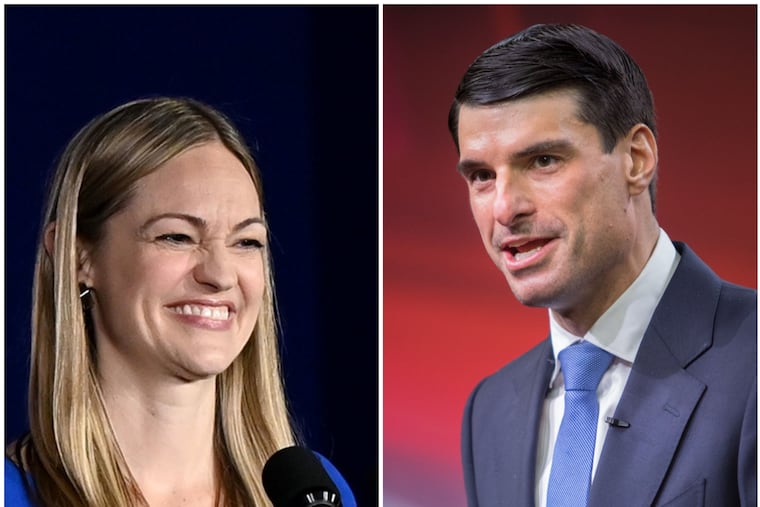
U.S. Rep. Rob Bresnahan — a Luzerne County Republican fighting to hold on to a Northeastern Pennsylvania swing seat — in a debate on Thursday criticized President Donald Trump’s deal to purchase Russian oil and said the war in Iran “absolutely needs to end.”
Meanwhile, his Democratic challenger, Scranton Mayor Paige Cognetti, backed voter ID and the GOP efforts to eliminate taxes on tips and overtime.
The emphasis on breaking party lines was the most prevalent theme in what was the only scheduled debate in the 8th Congressional District before Election Day.
Both candidates repeatedly stressed their independence — while also taking a few shots at each other and largely backing their party platforms — in a region where voters have been known to swing in different directions.
Trump won the district in 2024 by 8.5 percentage points, the most of any of four consequential swing districts this year. More than anywhere else in the state, the president saw some of his largest gains in the region between 2020 and that last campaign, helping Bresnahan narrowly beat a five-term Democratic lawmaker.
But a recent Inquirer/New York Times/Siena University poll found Trump’s approval rating sunk to 43% in the district and Cognetti was leading Bresnahan, 51% to 46%, less than two weeks before Tuesday’s election.
Voters said they trusted Cognetti more than Bresnahan on every issue included in the poll — cost of living, foreign wars, data centers and AI, and corruption — except for immigration, which Bresnahan led by 1 percentage point.
In the debate, Cognetti pointedly criticized her party on immigration, saying President Joe Biden, whose Scranton roots Cognetti has celebrated, “failed at the border” and that she was glad it was now secure under Trump.
Comprehensive immigration reform is needed, with clear pathways to citizenship for immigrants who are contributing to their communities and the country, she said. And while she did not comment specifically on ICE’s controversial tactics, Cognetti underscored a need for “not alienating people” and making them “feel less safe.”
Bresnahan, for his part, took strides to break from Trump on two key areas of foreign policy.
After Cognetti criticized him for repeatedly voting against war powers resolutions that would have reined in the president’s ability to attack Iran, he said he agreed that “this has gone on far too long.”
“I feel the mission has been accomplished and the war absolutely needs to end,” he said before adding a caveat. “My concern would be ripping out the rug from underneath our service members that are serving overseas. We’ve seen what happens during disastrous withdrawals. Like in Afghanistan, where you had people hanging onto airplane wheels. There needs to be a pragmatic, concentrated approach to figure out how to withdraw from Iran.”
On Trump’s deal to buy diesel from Russia to lower gas prices, which has evoked condemnation on both sides of the aisle, Bresnahan said he was part of a bipartisan group looking for a “legislative solution to push back against the administration to stop what’s happening and empower Vladimir Putin.”
Bresnahan later stressed in his closing statement that “there’s been plenty of examples of where we’ve pushed back on the administration.”
He said he supported Building Resilient Infrastructure and Communities, a program that provides funds for local emergency mitigation projects, and Job Corps, a training initiative, both of which the administration tried to cut. And he emphasized his push alongside a few other Republicans at the end of 2025 to extend the Affordable Care Act tax credits before GOP leaders let them expire and ultimately raise premiums for millions of people.
“I did every single thing I could to break with my party, to force a vote on the floor through a discharge petition,” Bresnahan said.
Cognetti, for her part, said she supported efforts to require people to have identification to vote. The SAVE Act, however, “goes too far” in adding burdensome requirements that would make it significantly harder for people to vote, particularly women who’ve changed their names after they get married and who would be unable to use their birth certificates to prove their identification, she said.
She also said she supported eliminating taxes on tips and overtime — which Bresnahan has highlighted as a primary accomplishment of the Republican-led Congress — and her desire to cut “waste, fraud and abuse,” a common refrain from Republicans.
But Cognetti said she did not support the “cruel cuts” to Medicaid that paid for the rest of the One Big Beautiful Bill, which she repeatedly criticized her opponent for supporting — as well as for reportedly selling stocks in companies that manage Medicaid enrollees before doing so.
“Congressman Bresnahan voting for that bill was atrocious,” she said. “Just a few days before he did that, he signed onto a letter saying he’d never cut those benefits. He wasn’t truthful. He hurt us, and he got a tax break in the process.”
Bresnahan didn’t respond to the claim that he sold $130,000 in Medicaid provider stocks, and Cognetti did not otherwise specifically mention his stock trading while in office — a message that has dominated her entire campaign. She spoke more generally about corruption, and with a bipartisan twist.
“I’ll take on that corruption wherever I see it, Democrats and Republicans,” she said, adding that “we need to ban congressional stock trading for real.”
Bresnahan’s sharpest attacks came when he took aim at her over what he said were rising rates of violent crime in Scranton during her tenure, which began in 2020 after she originally ran as an independent. Cognetti said his statistics were cherry-picked, and WVIA, the Luzerne County station that hosted the debate, has reported that crime declined during her tenure.
The debate was, overall, more cordial than the contentious debate in another swing district earlier this month, when U.S. Rep. Scott Perry (R., York) and Democratic challenger Janelle Stelson went head to head and made numerous personal attacks.
There were ultimately no debates in the two other nationally watched Pennsylvania races. Democrat Bob Brooks pulled out of a scheduled debate last week with U.S. Rep. Ryan Mackenzie (R., Lehigh) in the Lehigh Valley-based 7th Congressional District as the Republican targeted him with multiple attacks and declined to take down an ad that Brooks said was “false and defamatory.”
And in Bucks County’s 1st Congressional District U.S. Rep. Brian Fitzpatrick and Democrat Bob Harvie could not agree on terms for a debate, despite trading dueling challenges.