How Josh Shapiro’s early embrace of data centers is testing his high popularity in Pennsylvania
In a year’s time, the politics — and public opinion on both sides of the aisle — have dramatically shifted on data center development. So has Shapiro — but not fast enough for some voters.

Gov. Josh Shapiro made a declaration in the early days of his administration: Pennsylvania is open for business.
The move would ultimately include promises to slash bureaucratic red tape, cut permit wait times, and offer a new direct line to Shapiro’s office for major corporations hoping to set up shop in Pennsylvania.
Pennsylvania would “move at the speed of business” and “get stuff done,” the new mottos used by his administration, he said. He’s campaigning for reelection in November on the same catchphrases, and boasting major successes like the 12-day repair of I-95 in 2023 that traditionally would have taken months to reopen as an example of how he can think outside the box to solve problems.
What’s more: He sees delivering for residents — showing them government can actually solve problems — as the future of the national Democratic Party, while it searches for an effective message and messenger heading into the 2028 presidential primary, which he is widely expected to enter.
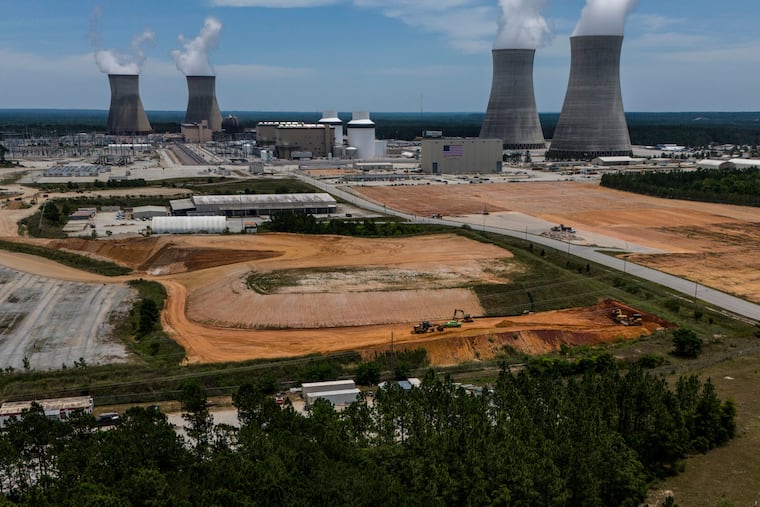
It was with this same spirit last summer that Shapiro announced the largest single private sector investment in Pennsylvania history: Amazon committed $20 billion in Pennsylvania that included two data center campuses in Luzerne and Bucks Counties. Pennsylvania scored the project because of its promise to fast-track permitting and use tax breaks for the massive developments.
“Pennsylvania’s gonna be better off. I think America’s gonna be better off, because we’re going to win the battle of AI supremacy and it’s going to be done right here in the commonwealth of Pennsylvania,” Shapiro said in an interview on CNBC’s Squawk Box on the day he announced the deal.
But in a year’s time, the politics — and public opinion on both sides of the aisle — have dramatically shifted on data center development. Shapiro’s early welcome of data centers has created an opening for criticism from his gubernatorial opponent and members of his own party.
Yet efforts to cut red tape have proven to be slow and overblown: Only six data centers are actually under construction in Pennsylvania since the announcement, and 10 have received at least one state-level permit approval, according to Shapiro’s office. Still, Shapiro’s popularity is being evaluated by some voters and anti-data center activists on a perception that he moved too quickly and sacrificed the state’s safety in favor of Big Tech.
“I am all about legislators and decision makers getting s— done. This version of it is reckless and it’s irresponsible and it’s not actually serving our people,” said Carrie Santoro, the executive director of progressive advocacy group Pennsylvania Stands Up who has been holding town hall meetings in communities around the state on data centers.
As public opposition to data center development has grown over the last year, Shapiro has begun to soften his position, citing his personal evolution on the projects. He’s gone from consulting Amazon and the data center industry earlier this year to draft data center incentives, to vowing his own executive actions to curb the projects in communities that oppose them.
» READ MORE: Pa. state lawmakers found common ground on this data center policy — but still couldn’t reach a deal
“Governor Shapiro intends to use all the tools available to him to stop the dozens of speculative data center projects that do not meet community needs and Pennsylvania should expect to hear more from him on that in the coming weeks,” said Shapiro’s press secretary, Rosie Lapowsky.
Now Shapiro, who otherwise maintains vast popularity ratings in the state, faces a vulnerability on one of voters’ top priorities as he heads into November, and a particularly sensitive concern among Democrats as he potentially vies for the party’s nomination in two years.
A liability among some voters
Data centers were not broadly known or understood by many until this year, as public outcry continues to grow.
Many states, including Pennsylvania, had already begun welcoming the major projects, and some hyperscale developers plan to spend billions of dollars to build them. Pennsylvania’s General Assembly first approved a sales tax exemption for data center developments in 2021, when Shapiro’s predecessor, Democratic Gov. Tom Wolf, was still in office.
Shapiro, for his part, initially embraced data centers as an economic opportunity for Pennsylvania, bringing union jobs for construction workers to build out the physical infrastructure for the computers running AI software. He also wanted to position Pennsylvania to inherit the most benefit from providing space for AI to operate, leading not only other states but also other countries in the race to advance new technology. He and U.S. Sen. Dave McCormick (R., Pa.) appeared together as early embracers of the technology and the massive buildings needed to power it, speaking together during McCormick’s first AI summit in Pittsburgh last summer.
But as communities began to push back against the rapid proliferation of data center proposals, in part to protect their water and energy resources, Shapiro adjusted.
Shapiro, like many elected officials, has changed his positions and rhetoric on the unpopular developments. He announced his Governor’s Responsible Infrastructure Standards (GRID) as a way to incentivize developers to follow transparency and environmental requirements in order to receive tax breaks. And when the General Assembly failed to approve his GRID standards or any substantial data center restrictions, Shapiro said he’d act on his own, though it’s still unclear what that will entail.
“You want to build a data center there? You’ve got to bring your own power; you’ve got to pay for your own power. You’ve got to be transparent with the local community — tell them who the hyperscaler is, tell them what’s going to go on there. You’ve got to have a local benefits agreement to help that community. You’ve got to protect the water sources that are used to cool off those facilities,” he said in a June interview with GZERO.
The Democratic governor has been lauded nationally for challenging PJM Interconnection, which is the electric grid operator for Pennsylvania and 12 other states over its efforts to raise prices on ratepayers. He capped the price Pennsylvania consumers could pay through 2029, as residents fear rate hikes due to the data center boom.
But Shapiro’s plan on data centers is too little, too late, Santoro said.
“I saw the GRID proposal as him moving on this issue, and the thing that I am concerned about is he didn’t move enough to keep up with how much voters have moved on this issue,” she said.
Some of those voters would agree. A Quinnipiac University poll of Pennsylvania voters, conducted in early June, found just 24% of those surveyed — and 40% of Democrats — approved of “the way Gov. Josh Shapiro is handling data centers in Pennsylvania.” It’s a stark contrast to Shapiro’s overall approval numbers, in which he’s maintained above 50% approvals — record-high favorability ratings for a first-term Pennsylvania governor.
Joanna Tenney, 36, of East Vincent in Chester County, held a sign at a June rally in the state Capitol that read: “Shapiro: Amazon’s bootlicker.” A registered Democrat, she voted for him in 2022, and believes he should be held accountable for supporting data center development in Pennsylvania that led to the fast-tracking of a now-stalled 125-acre data center project near where she lives.
She’s so fed up with Shapiro’s approach to data centers that she said will be writing in the name of her state senator, Sen. Katie Muth (D., Chester), who has been on the front lines of advocating for many state environmental issues, for governor on her November ballot. Tenney said she and a few other anti-data center advocates plan to run a write-in campaign for Muth.
“We’ve elected somebody that we thought was going to make the right choices by us, and we don’t really see that happening,” Tenney said.
Muth, who took office in 2018, said she would not be supporting Shapiro or “any elected official who puts the interests of Big Tech ahead of the health, safety, and future of Pennsylvania communities.”
If Shapiro changes his stance on data centers, she would support him, Muth said. She is the prime sponsor of a bipartisan bill to place a three-year moratorium on hyperscale data center development.
“Get right on the issue, Right your wrongs. If you can’t be on the side of science and people, my support is MIA,” she added.
Emily VanFleet, 26, lives in Archbald in Northeastern Pennsylvania, where six data center projects are underway comprising more than 50 buildings that, when completed, will cover 14% of the town. VanFleet, who is an unaffiliated voter, said she also supported Shapiro in 2022. But because of his public support for speeding up data center development in Pennsylvania, she is “certainly not going to vote for him this upcoming election,” she said. She isn’t sure she’s going to vote at all.
“I want Shapiro to stop being a coward,” VanFleet said in June. “I have emailed him, I have called him, I have reached out to him so many times. I have not heard back, not once. I see his videos all over social media that he has an open-door policy, but I have yet to see it.”
(In May, Shapiro’s administration announced that one of the unpopular Archbald developments, Project Gravity, was removed from a fast-track permitting program for failing to properly engage with the community.)
But negative attitudes toward Shapiro’s position on data centers may be limited statewide and his position is unlikely to dramatically knock down his high popularity or reelection odds: The June Quinnipiac poll found 56% of those surveyed approve of the way he is handling his job as governor overall, and recent polling shows Shapiro ahead 53% to 40% against his Republican challenger, state Treasurer Stacy Garrity.
The data center pitfall
Shapiro’s political opponents — both immediate and prospective — are also seizing on the issue.
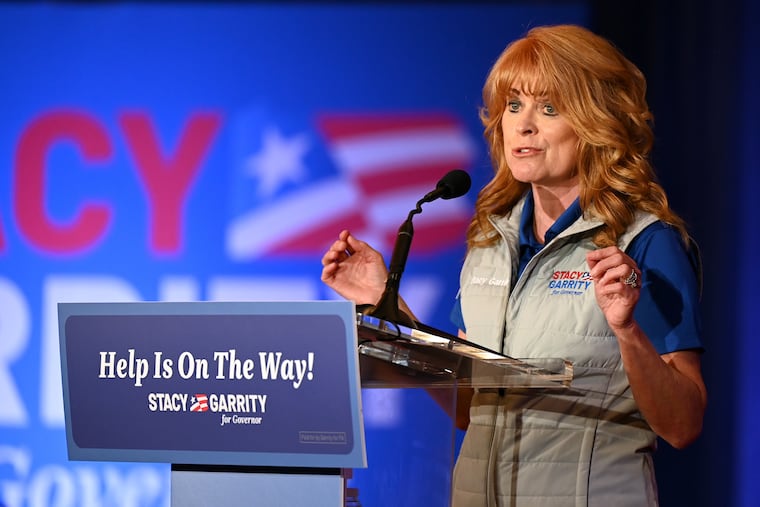
Garrity, the GOP nominee endorsed by President Donald Trump, made her first TV ad an attack on Shapiro’s support for the Amazon project and other data center developments — even as Trump himself has remained open and excited about AI and data centers.
Garrity, of Athens in Northeastern Pennsylvania, has also led a statewide listening tour on the topic. In June, she convened one of those sessions in Hatfield with a group of commissioners, zoning planners and emergency responders to talk about how they have been impacted by data centers. She blasted Shapiro for his role in attracting Amazon and said his proposed new requirements amount to a “flip flop.”
“Josh Shapiro has failed on this topic. He was the biggest cheerleader for data center development in Pennsylvania, until he wasn’t,” Garrity said at the June 24 meeting.
Garrity has her own mixed record on data centers.
At the time of the Amazon announcement, Garrity called the investment “great news” that would bring “historic investment” and “create thousands of jobs.” And her current position remains unclear. She has said she opposes a statewide moratorium but wants “a pause” on development instead.
Like Republicans running in districts that supported Trump in 2024 but oppose data centers, she appears to be attempting to find a pro-business and pro-regulation path.
“We want to make sure data centers are an addition to the grid, not a contraction. If there’s infrastructure that needs to be added to the grid, rate payers shouldn’t be paying for it,” she said. “I’m not opposed to data centers, but we have to do them the right way, and we haven’t done it. It’s because of a lack of leadership from the government.”
Garrity’s “long record of supporting completely unregulated data center development makes it clear that she just can’t be trusted,” said Manuel Bonder, a spokesperson for Shapiro’s campaign.
More recently, Garrity has said she would prevent data centers construction on prime agricultural fields.
Local government leaders said at Garrity’s campaign roundtable in June that there has been lack of guidance around issues, especially around power demand, water use, infrastructure, environmental impacts, and community compatibility.
Kathie Doyle, a Republican on the Richland Township Board of Supervisors, said confusion around data centers have “set off a firestorm” in her community. Earlier this year, warnings of a supposed proposal for a data center in the Bucks County township circulated on social media, but turned out to be a “business park” with two buildings.
“Our residents don’t understand that we just cannot say no,” she said. Municipalities in Pennsylvania cannot outright ban data center development.
Santoro said Shapiro’s inconsistency is a liability that could sway some voters away from casting their ballot for him.
“Certainly he is giving her an ‘in’ by staying on the wrong side of this,” she said.
And it’s not just Republicans seizing on Shapiro’s position. The early reputation Shapiro earned as a champion of data centers may become a point of attack among other Democratic contenders for the presidency in 2028, too. In a veiled jab at Shapiro in June, Illinois Gov. JB Pritzker, knocked Pennsylvania on a business podcast for allowing Constellation Energy to restart Three Mile Island nuclear plant just to power Microsoft’s data centers.
“My guess is that’s going to be a reasonably unpopular thing to have done,” Pritzker said, without noting Shapiro by name on the Prof G Markets podcast.
Vulnerability for down-ballot Democrats
With a $50 million campaign war chest and high approval ratings, Shapiro is widely favored to win reelection this year. But his record on data centers could prove a liability for those he’s hoping to pull along, some advocates, like Santoro, say.
Shapiro has been staking much of his national political clout on his ability to flip four House districts in Pennsylvania for Democratic control of the U.S. House, drawing voters to the polls with his name at the top of the ticket. He’s also aiming to flip Pennsylvania’s Senate into Democratic control for the first time since 1993, giving him a Democratic trifecta in Harrisburg, as the state’s split legislature has blocked many of Democrats’ priorities from becoming law.
Santoro predicted that could be in jeopardy “if he does not change course.”
“Shapiro’s leadership on data centers will be the thing that costs us the first Democratic trifecta in 31 years, and I think that while he will likely win reelection with this wildly unpopular position on data centers, other elected officials and candidates will not,” she said.
Other Democratic candidates aware of data centers’ deep unpopularity are differentiating themselves on the issue, despite remaining otherwise aligned with Shapiro. Scranton Mayor Paige Cognetti, who is running in Pennsylvania’s 8th Congressional District, released a new ad last month putting data center developers on notice.
“Big Tech needs to pay their own way, not hide behind [nondisclosure agreements]. No tax breaks. Don’t raise our electric bills. Don’t poison our water. And hire local union labor,” she said, in the ad spot. “You can’t meet that? Then get out.”
Cognetti’s stance isn’t vastly different from Shapiro’s — both want to end blanket tax breaks — but her rhetoric is much stronger, and she’s putting the issue at the forefront of her campaign.
Democrats insist Republicans, including those running at the state level, don’t have the moral high ground on data centers after failing to pass through several measures that would have enacted stricter controls for their approval.
Sam Silverman, a former congressional aide and founder of Silverman Strategy Group, a strategic communications firm focused on technology and politics, said Shapiro’s approach to data centers — proposing a plan rather than enacting a moratorium — presents a risk that could either pay off and become the model for other states, or fail to fully address all future concerns and is unpopular.
“Shapiro is going out in front by proposing a bargain now. If the standards protect ratepayers, produce visible benefits, and hold bad actors accountable, Pennsylvania could have a model others can follow,” he said. “But because he is putting forward the deal now, he will be judged on whether it delivers.”
Taking a risk involves trust, though. Shapiro can afford to make a big swing at one of the hottest issues in politics because voters put so much faith in him, Silverman said.
“Most politicians do not have the amount of trust and political capital to take a risk, either,” Silverman said.
Whether the governor is triumphant will come down to what standards go into effect and whether bad actors are held accountable, he said, “and whether Pennsylvanians believe those standards are working.”