Mayor Parker turns to Harrisburg — and GOP allies — to make her budget priorities work
The mayor’s proposal, which aims to juice revenue by hiking the city’s hotel tax and expanding its sales tax, relies in part on authorization from Harrisburg.
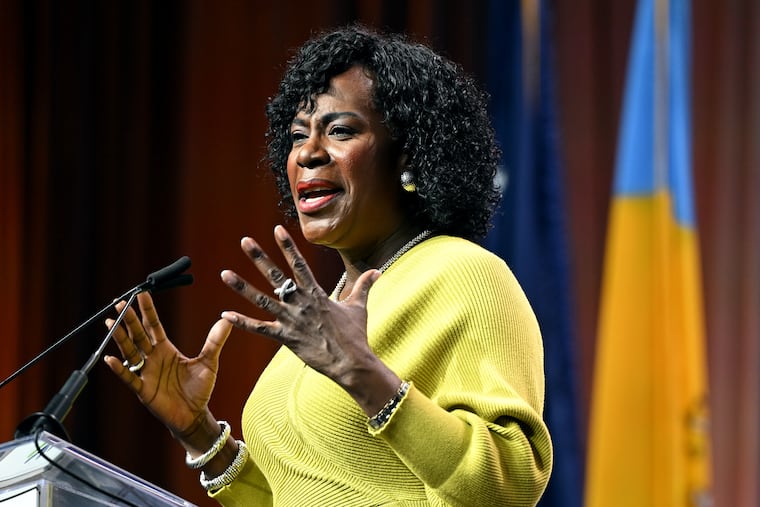
When Mayor Cherelle L. Parker unveiled her $7 billion budget plan in a televised address to Philadelphia City Council this month, she put out a call for help from beyond the walls of City Hall.
Pennsylvania’s largest city, Parker said, is relying on Gov. Josh Shapiro and the state legislature to “help fix our Philadelphia crumbling infrastructure” and “ensure that Philadelphia gets its fair share” of funding to build housing.
The Democratic mayor’s proposal, which aims to juice revenue by hiking taxes and fees, relies in part on authorization from Harrisburg. But in the Capitol, the appetite to raise taxes is low and a politically divided legislature means gridlock is commonplace.
Hanging in the balance for Philadelphia is more than $100 million in potential tax revenue over the next five years.
To win over state lawmakers, Parker, a former state representative who campaigned on her skills as a bipartisan dealmaker, is employing a multipronged strategy that includes working with Pennsylvania’s top Republicans and subtly calling on the Democratic governor to provide more state support.
It comes as other big-city mayors are similarly putting public pressure on governors from their own party. Most notably, newly sworn-in New York City Mayor Zohran Mamdani, a Democrat, has called on the state’s Democratic governor, Kathy Hochul, to allow the city more latitude to hike taxes and expand services.
The tactic is notable for Parker, who has carefully avoided antagonizing other officials — including President Donald Trump — who could exert influence over the millions of dollars in state and federal funding that balance the city’s budget.
» READ MORE: Who benefits — and who pays — in Mayor Cherelle Parker’s new Philadelphia budget plan
Shapiro, who is running for reelection and has often emphasized his efforts to cut taxes, has not committed to backing Parker’s plan.
But the mayor may find allies in unlikely places.
Senate Majority Leader Joe Pittman, a Republican from rural Indiana County, said he is open to Parker’s proposals and would defer to Philadelphia’s delegation in Harrisburg on whether it recommends the tax increases the mayor has floated.
That is a departure from his past opposition to some requests for funding from Philadelphia Democrats, including a battle last year over state dollars for mass transit that highlighted the state’s long-standing rural-urban divide. And he could persuade others in his chamber to follow suit.
“I admire the mayor,” Pittman said in an interview last week. “I work very well with her, and I’ve appreciated her leadership.”
Two of Parker’s proposals will need support from Harrisburg, where Republicans control the Senate and Democrats narrowly hold the House.
First, she is seeking to increase Philadelphia’s hotel tax from 15.5% to 17.5%, which would generate an estimated $20 million per year to pay for 1,000 new homeless shelter beds.
That provision could be passed by City Council before the end of the fiscal year in late June and would require the state legislature to pass — and the governor to sign — authorizing legislation.
Parker also wants the state to close a loophole in the sales tax that allows online retailers to sell goods to Philadelphia customers without charging the city’s 2% sales tax. (Right now, sellers based outside the city have to collect only the 6% state sales tax.)
That proposal also requires legislation to be passed by the state.
Parker said in an interview Friday that she will lean on her experience as a state legislator to persuade lawmakers that the city is “not afraid to make the tough decisions that are necessary for our institutions to be self-sufficient.”
And she said she will leverage relationships with leaders of both parties to get it done. She called a trio of Republicans — Pittman, Senate President Pro Tempore Kim Ward of Westmoreland County, and State Sen. Joe Picozzi of Philadelphia — “amazing allies.”
“We’re going to be working very hard to earn the support of leadership in Harrisburg, along with our governor,” she said, “as we ask Harrisburg to give Philadelphia the tools that are necessary so that we can do our best to take care of ourselves.”
Walking a tightrope from Philly to Harrisburg
Historically, the relationship between Philadelphia’s mayor and lawmakers in Harrisburg has been tense.
Mayors have long argued that the city is Pennsylvania’s economic engine, but that state aid has fallen short. Funding the Philadelphia School District has been a perennial sore spot, with the city contending that its children do not receive a fair share of education dollars.
Most critically, long-standing state law preempts Philadelphia from making certain policy changes for itself, including those related to some forms of taxation.
» READ MORE: Why is it so hard for Philly to pass its own gun laws?
For example, in the aftermath of the 2008 global financial collapse, former Mayor Michael Nutter sought to raise the city’s sales tax by 1 percentage point to help close a $1.4 billion budget shortfall. He spent weeks working to persuade the Republicans who controlled the Senate to allow the city to impose the tax. They eventually agreed.
Nutter said in an interview last week that two Philadelphia Democrats played a critical role in those negotiations: U.S. Rep. Dwight Evans and Parker, both of whom were then state lawmakers.
“Knowing the mayor the way I do, I am quite sure she has maintained a lot of those relationships [in Harrisburg],” Nutter said. “Her history, her relationships, her style is going to serve Mayor Parker very, very well in these efforts.”
Parker, who has displayed an unbending approach to negotiations in City Hall, may rely on her existing relationships to get state lawmakers to agree to the two key tax changes that make her budget proposal work.
Pittman, a lead negotiator in closed-door state budget talks, said he is open to closing the sales tax loophole. The hotel tax in the city, he said, “sounds like an aggressive rate” — but allowing a hike is not off the table.
More broadly, Pittman said the state should expand how Pennsylvania’s smaller counties can use revenue from their hotel taxes.
Currently, counties with fewer than 1 million residents must send the proceeds from the hotel tax to the county’s government-run tourism board. But Philadelphia, with a population of more than 1.5 million, can direct its hotel tax proceeds to multiple tourism promotion agencies and the Pennsylvania Convention Center.
Parker is likely to find ample support in the state House, where Democrats control the chamber and top leaders are from the city, including Speaker Joanna McClinton.
State Rep. Jordan Harris (D., Philadelphia), who chairs the powerful House Appropriations Committee that helps finalize any final state budget agreement, said House Democrats agree that additional funding should address issues like homelessness.
But he said Parker must find support for her plan in City Council. Beginning this week, Council will spend the next two months holding hearings to examine the mayor’s budget proposal on a department-by-department basis.
“We look forward to seeing what they do,” Harris said, “and we will review what they might be looking at in Harrisburg.”
Leveraging a relationship with Shapiro
To get her tax plan over the finish line, Parker may need to leverage her relationship with Shapiro.
The two leaders go back years and call each other friends. Shapiro is from the Philadelphia suburbs, and Parker served alongside him in the state House from 2005 to 2012. In general, the two are politically aligned in that they are both centrists who say they value bipartisanship.
» READ MORE: Parker supports Shapiro to be Kamala Harris' VP pick
However, the relationship between any Pennsylvania governor and Philadelphia mayor can be complicated. The city has myriad financial needs, while the swing-state governor answers to an electorate that is far more moderate and geographically diverse than that of deep-blue Philadelphia.
There are also new political realities. Shapiro is running for reelection as a pragmatic operator, and he is a rumored 2028 presidential contender. He often emphasizes that his budget plans cut taxes and do not create new ones.
In a statement last week, Shapiro spokesperson Rosie Lapowsky said the governor has a “strong working relationship” with Parker.
But she would not say whether Shapiro would support Parker’s plan to increase taxes in the city, adding that the mayor “is best positioned to recommend and speak on city-specific proposals.”
The two have not always been in lockstep when it comes to funding.
Shapiro earlier this year implicitly rejected a request from Parker for more than half a billion dollars in state money. The requested funding was for a range of Parker’s agenda items, including addressing homelessness, building affordable housing, improving school facilities, fixing roads, and treating people in recovery from addiction.
In a February letter to Shapiro obtained by The Inquirer, Parker called her asks “practical, targeted, and built for impact.”
But most of them were not included in Shapiro’s budget proposal unveiled later that month.
During an interview in the state Capitol after the governor presented his plan to the legislature, Parker said Shapiro is “a strong and willing and able partner for Philadelphia.”
A reporter then asked Parker if there were items that she had hoped would be part of Shapiro’s budget but were not included in his plan. The mayor ended the interview.
Staff writer Sean Collins Walsh contributed to this article.