The advice about rooftop solar panels is changing. Do this instead.
The end of federal tax credits for rooftop solar and flexible new subscriptions have changed the pros and cons of leasing vs. buying.
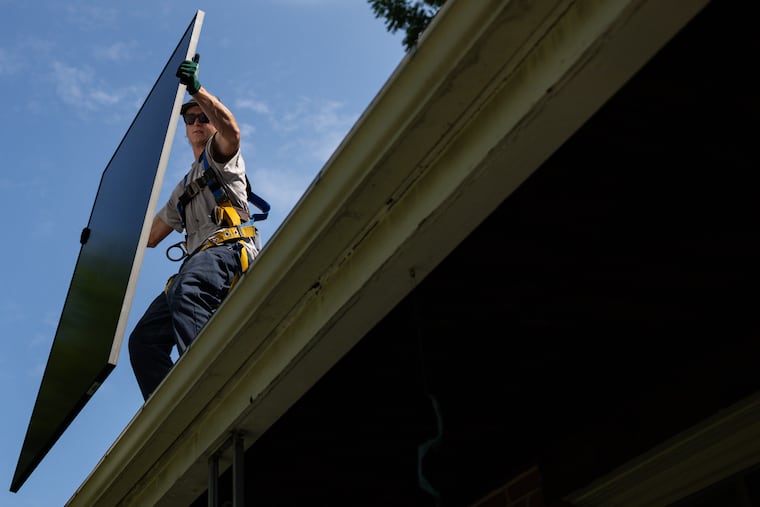
For a decade, it was a better deal to own, not lease, rooftop solar panels. The end of solar tax credits for homeowners may flip that on its head.
New subscription offerings are making solar more like subscribing to a cellular or streaming service: Pay monthly to reap the benefits, and cancel when it no longer suits you. If you don’t like the deal you’re getting, the company will remove the panels free of charge.
The solar industry has long used the word subscription to describe something rather different: long-term, often 25-year leases or power purchase agreements, known as PPAs, that could be canceled only by paying fees or penalties.
But a new model from an upstart company called Terra Energy is shaking things up in Florida, Texas, and soon California. After subscribing for three years, customers can cancel and have the panels removed from their roof free of charge. If they keep them, they lock in a low, predictable electricity rate relative to their local utility, like any other leasing model.
Bankrupt companies litter the solar industry. An estimated 50% of residential solar systems in the U.S. are “orphaned,” installed by companies that no longer exist, said Sam Thompson of the solar and home electrification marketplace EnergySage. Although most solar systems deliver on their promises to homeowners, shady sales practices and bankruptcies have plagued the market.
But industry analysts and some of Terra Energy’s customers say this subscription model might just be the future.
Here’s why the loss of federal tax credits means that leasing now dominates new home solar sales, and why subscribing to the sun can now be a better bet than owning those rooftop panels.
When renting beats owning
Bob Scheeler, 65, had been interested in going solar for years. But as a retired real estate agent in Cape Coral, Fla., he had seen homeowners run into trouble with leased solar panels when securing insurance coverage, qualifying for financing, or reselling their property.
Then he ran across Terra Energy’s subscription offer and signed up. Earlier this year, the company installed about two dozen panels on his roof, with the option to add more. His typical $250 utility bill has since fallen by about 40%: He pays $120 to Terra and $30 to his utility.
Scheeler said the subscription offered the most appealing package. “This actually came out the least expensive and the best bet,” he said. “I think it’s great.” He has no plans to remove the panels once he reaches the three-year mark, when Terra would do it for free.
Solar deals typically come in three flavors: leases, purchase power agreements (PPA), or ownership.
Leases get panels onto your roof for a fixed monthly payment, often 25 years, but the company you’re leasing from owns the solar array (some let you purchase them after a fixed period).
PPAs are similar, but a homeowner pays only for the electricity that the panels on their roof produce, generally for less than what the utility charges.
Finally, homeowners can finance or purchase their own solar systems. Self-financed ownership is still likely to deliver the best return on investment in the long term: a cash purchase of a home solar system averages $30,500 before any incentives, with average savings of $61,093 over 25 years, EnergySage estimates, a roughly 10-year payback period.
But the elimination of a 30% tax credit for homeowners in the One Big Beautiful Bill last year effectively raised the cost of the average home solar system by $8,000.
While homeowners lose out, businesses enjoy the solar investment tax credit through 2027, making leases and PPAs more attractive. That’s scrambling two decades of “own, don’t lease” advice because only businesses like Terra and others can pass on the tax credit to homeowners.
Third-party ownership now makes up the majority of new residential solar sales, according to Wood Mackenzie, an energy research firm, up from a minority share last year.
“Our view has historically been that ownership is the best path,” said Thompson of EnergySage. “But not everyone can pony up $30,000 or get a loan. New leasing models are a vehicle that gives people the opportunity.”
Free of commitment
Terra Energy, which was founded in Mexico in 2016 and started operating in the United States in 2023, placed a bold bet as its home country began deregulating its electricity market. It offered to remove its solar panels at company expense if customers weren’t happy after the first few years.
Terra faced huge bills if many customers canceled. But founder and CEO Jaime Martinez said the promise eliminated one of new customers’ biggest fears: commitment. “We’re going to be your best energy provider,” Martinez argued when I asked about the strategy. “We’re proving that by allowing customers to cancel. They almost never do.”
Terra says that its retention rates beyond the three-year mark are 98% in Mexico and 100% in Florida, where it launched in 2023 and is now one of the largest residential solar providers. When people do cancel, Martinez said, it tends to be because the home is no longer occupied. The company runs sales, financing, and installation under one roof, so it can deliver good customer service with electricity prices 20% to 60% below utility rates where it operates.
In Texas, where Terra launched in June, it offers a package of rooftop solar panels, a 40-kWh whole-home battery backup system, and retail electricity in a single monthly bill.
The company is now adding about 1,000 new customers per month, said Martinez, with plans to expand to California later this year and then across the South.
Can you trust a subscription?
I asked EnergySage to review a sample Terra Energy contract. “The customer opt-out options are more consumer-friendly than typical. Otherwise, most contents are fairly standard,” wrote EnergySage energy adviser Matt Schuler. “[But] every homeowner should evaluate the contract to see if the subscription costs pencil out with their electric rates and usage.”
The major difference was the option to cancel free anytime after three years. Terra will remove the panels and then repair the roof so it remains “watertight” at no cost.
Otherwise, the 10-year lease continues and then renews annually at the customer’s discretion once the decade is up. Terra repairs and maintains the system, and will remove and reinstall the panels for free if roof repairs are needed. (Doing that triggers a 36-month extension of the contract.)
Buyers of a home that already has a Terra system may assume the contract, if they pass a credit check, or choose to end it free of charge. Martinez said the company ensures that annual cost increases, or escalators, are under 2%. Escalators above 3% risk negating the energy bill savings from solar.
The primary restriction is that you can’t buy the system even if you want to. While that could cut into long-term returns, Terra says it has historically upgraded customers’ solar panels over the course of their 10-year contract as technology improves.
The home solar market, researchers said, is maturing. Residential solar remains more expensive in the United States than almost anywhere else in the developed world. It’s one of the reasons that utility and community solar is a more cost-effective way for society to deploy panels and electrify.
But for most individual homeowners, subscribing pencils out as a positive and should only get more attractive as utility rates surge. After a wild-west period, the solar industry will keep consolidating into something more professional and profitable, even after the remaining tax credits expire.
For homeowners on the sidelines, subscriptions prioritize flexibility and convenience over maximizing long-run savings, a deal many are willing to make.
“It has the potential to be the national model,” says EnergySage’s Thompson.