Ben Crimm lived in silence for 25 years. Now, he’s raising awareness for non-speakers through the AACR Charity Ride
The charity ride will take place Sunday on a 14-mile loop along the main course as part of the Philadelphia Cycling Classic.
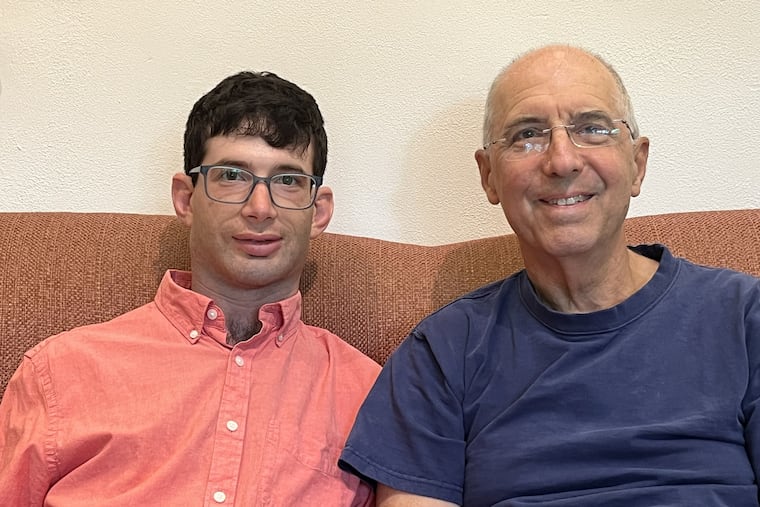
Ben Crimm slowly lifted his arm and began to point at different letters on a laminated alphabet board in front of him. The board is a means of communication for Crimm, who is a 34-year-old nonverbal autistic individual.
As Crimm continued to spell out his thoughts, his father, Allan, sat beside him and read his sentences aloud.
When Ben finished pointing, he put down his hand, and Allan read the sentence he had spelled out: Non-speaking does not mean we cannot think and learn.
Ben lived in silence for 25 years.
After finding his voice through International Association for Spelling as Communication, he’s become an advocate for nonverbal autistic individuals.
“This organization has changed my life in so many ways,” Ben said. “Without the ability to communicate for the first 25 years of my life, I had no ability to tell anyone what I wanted to do. Now, I do. And I have a resolve to raise awareness about nonspeakers and our capabilities and our communication access needs. Without this, I would be trapped in silence.”
» READ MORE: Robin Carpenter will be thinking of his former Masterman teacher as he conquers the Manayunk Wall
Alongside work with Spellers Empowering Education for Nonspeakers, a Philadelphia-based advocacy group founded in 2020, the Crimm family also is raising awareness through the Philadelphia Cycling Classic’s charity ride for the American Association of Cancer Research.
Ben and Allan will ride in Sunday’s charity ride to raise money and awareness for the AACR and I-ASC.
Both organizations are important to Ben. The I-ASC provides training and access for nonspeakers, and AACR is dedicated to preventing and curing cancer through research — a mission close to Ben’s heart after his uncle, Jon Shipp, died of lung cancer in 2006 at 49 years old.
The charity ride will feature a 14-mile loop along the course of the professional PCC race. As both Ben and Allan prepare for the event, Ben said he’ll be staying in the back of the pack.
“I’m not a fast cyclist,” Ben said. “[I’m looking forward to] good weather and being with so many wonderful folks.”
» READ MORE: Philadelphia Cycling Classic 2026: Where to spectate, the route, and road closures
Proceeds will go to the AACR, the official charity partner of the charity ride. As of Friday afternoon, the total fundraising was over $145,000, all from small-dollar donations, according to the AACR.
“This is sort of a natural partnership where sports and healthcare come together,” said Steve Ryan, the president and chairman of the AACR Foundation. “So it’s really a natural fit for us, gives us exposure, gets people out, gets people to know what we do. It’s great for Philadelphia, great for us, great for everyone.”
Spelling to communicate
Ben was diagnosed with autism at 6 years old and struggled to communicate throughout everyday life. Without the ability to speak and engage in conversation, he felt “trapped” with no way to tell anyone what he was thinking or how he was feeling. Despite years of speech therapy and sign language lessons, he turned to spelling to communicate.
» READ MORE: Return of the Philadelphia Cycling Classic made ‘perfect sense.’ It was all about filling in the details.
The Crimm family first found out about spelling to communicate through a family friend, who had a son who had a condition similar to Ben’s. They implemented the method in Ben’s daily routine in 2017. But they never expected it to work as well as it did.
“It was beyond our wildest dreams,” Allan said. “It has been so exciting to get to know [him], to get to know what is in that wonderful mind of [his], and to hear [his] sense of humor, [his] kindness, and [his] generosity. To know what’s inside of [him]. [He’s] such a fierce advocate for nonspeakers. [His] passion inspires everybody in the family, including me.”
Spelling to communicate has transformed Ben’s ability to express himself and has led him to use his newfound voice as a tool to raise awareness for nonspeakers struggling to communicate and experiencing any sense of powerlessness in a world where they may feel invisible.
SEEN has met monthly for six years and has a mission to educate others about nonspeakers, autism, and apraxia. The organization conducts eight to nine presentations a year to legislators, schools, parent groups, and national conferences.
“It has been so incredible to have so many close friends that I can talk to over our shared life experience,” Ben said. “I love educating families of nonspeakers and especially healthcare professionals.”
» READ MORE: This Philly artist and bike enthusiast designed the Philadelphia Cycling Classic trophies for free.
According to the Autism Science Foundation, around 26% of individuals with autism are nonverbal or minimally verbal, meaning they have difficulty with speech.
However, this does not mean that they’re intellectually disabled. They can still form thoughts and communicate in ways that don’t rely on the voice. Allan and Ben are hoping they can continue to educate others on the topic.
“We’ve come to learn as a family and being in relationships with so many other nonspeakers that the popular understanding of what nonspeaking autism is is not what people think,” Allan said. “It’s time for people to engage with nonspeakers and learn from nonspeakers that the lived experience really is because almost a third of all autistics are [nonspeaking]. And people have total misconceptions of what their capabilities are.”