Dave Dombrowski, proactivity vs. reactivity, and four World Series-worthy trades
The Phillies have operated in a reactive mode for much of Dombrowski’s tenure. To illustrate that, The Inquirer assessed four trades that made this year’s World Series what it was.
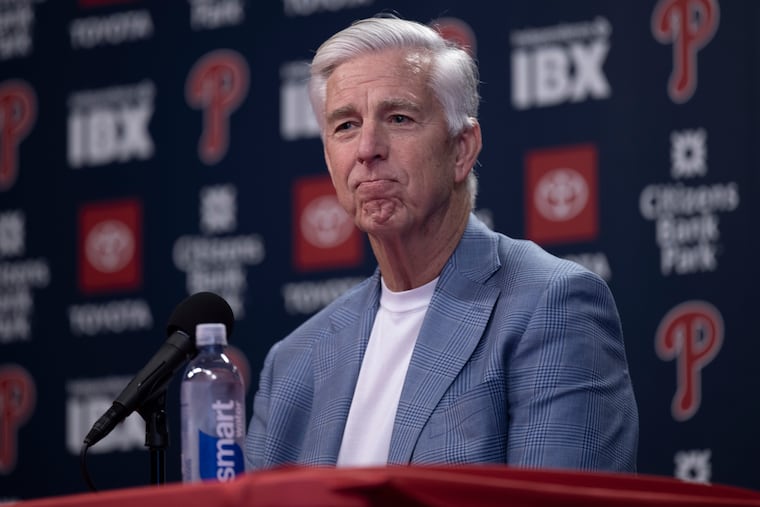
I’ve previously used the word “creativity” to describe what the Phillies’ roster-building efforts have lacked under Dave Dombrowski. A better word might be “proactivity.”
The Phillies have operated in a reactive mode for much of Dombrowski’s tenure. The majority of his most consequential decisions have been one of two flavors: 1. Outspend everybody else at the top of the market for whoever is best at the position of need; 2. Desperately fill the remaining gaps at the trade deadline.
It’s a tough way to make optimal decisions. It’s how you end up relying on Nick Castellanos or Taijuan Walker or David Robertson or J.T. Realmuto to be players they simply aren’t. Dombrowski’s best moves have come outside of this mode: trading Matt Strahm for Jonathan Bowlan, acquiring Jesús Luzardo after a down season, etc.
Even the Luzardo deal stretches the definition of forward-thinking. He was a fairly typical veteran trade candidate from a small-market team looking to sell at peak free-agency value.
» READ MORE: Trade season is upon us. Here are potential targets for the Phillies to address their big needs.
It isn’t hard to find examples of the types of deals that elite organizations should be making. Just look at the two that were in the World Series.
The last two months have featured an abundance of chin-stroking from folks eager to point out the lessons of the Tampa Bay Rays’ and Milwaukee Brewers’ runs to the World Series. Much of it has focused on the supposed antimodern approaches of both teams. Speed, contact, small ball ... the revenge of the non-nerds.
Those arguments aren’t without merit. Milwaukee and Tampa Bay finished in the bottom half of the league in extra-base hit percentage, and the Rays were in the bottom half in walk rate. That said, the Dodgers just won two straight World Series while finishing near the top of the majors in power and walks and in the bottom half in steals and contact percentage. It would be a mistake for a team like the Phillies to dive headfirst into a paradigm shift.
The real story of the Rays and Brewers isn’t one of roster composition but of roster construction. That is where the for-instances exist for the Phillies.
Four trades help illustrate the proactivity that made this year’s World Series what it was:
1. Rays trade 23-year-old minor league right-hander Tobias Myers to the Guardians for an 18-year-old Dominican Summer League rookie named Junior Caminero.
Myers was coming up on Rule 5 eligibility when the Rays traded him for Caminero in 2021. At the time, Caminero had 171 minor league plate appearances, all of them in the DSL. Two years later, he was in the majors as a consensus top-five prospect. At 23 years old, he just had his second straight 40-plus home run season.
2. Rays trade 19-year-old low-A infielder Angel Brachi to the Marlins for 24-year-old, out-of-options outfielder Victor Mesa Jr.
It’s probably unfair to suggest that moves like this are a product of mere philosophy. Whatever four-dimensional analytic witchcraft the Rays are practicing, it probably isn’t something a team like the Phillies can simply decide to replicate. You can argue Mesa is one such example. The 24-year-old Cuban had spent seven years in the Marlins system and never hit more than 18 home runs in 533 plate appearances in a season. The Marlins designated him for assignment in February, and the Rays scooped him up in what looked to be a minor deal. Mesa then proceeded to hit 14 home runs in 262 major league plate appearances for the Rays.
» READ MORE: Phillies offseason tracker: Free agency news, trades, key dates, and the latest on the lockout
3. Rays trade 23-year-old top-50 prospect Jake Bauers to the Guardians for 27-year-old Yandy Díaz.
Don’t let the age gap fool you. This was a like-for-like trade. Bauers was coming off a rookie season in 2018 that was a lot like ones we’ve seen from plenty of top Phillies prospects. He didn’t set the world on fire. But he hit 11 home runs with a near-league-average .700 OPS in 388 plate appearances. There was plenty to talk yourself into. Meanwhile, Díaz had bounced back and forth between triple A and the majors for two seasons, including a 39-game stint as a rotational player at the end of 2018. Bauers had the higher pedigree, but the Rays viewed Díaz as a better fit.
“It was two teams that appreciate similar attributes and players and more a matter of, ‘How do you make two rosters more functional?’” Rays president of baseball operations Erik Neander told MLB.com in October. “We were transacting off of that premise.”
Bauers never paid off for the Guardians: He posted a .656 OPS in 536 plate appearances in parts of two seasons. His breakout for the Brewers over the last two years came seven years after the initial trade.
Díaz became a rare long-term cornerstone for the Rays with an .818 OPS and 121 home runs in eight seasons.
4. Brewers trade 22-year-old Esteury Ruiz to the Athletics and receive 24-year-old catcher William Contreras from the Braves as part of a three-team deal.
The headline of this trade in 2022 will always be the Braves’ decision to trade for then-A’s catcher Sean Murphy and cut bait on Contreras after the latter hit 28 home runs with an .809 OPS in 571 plate appearances with Atlanta. That has not aged well. The Brewers had acquired Ruiz at the previous season’s trade deadline as part of a package in their trade of closer Josh Hader, another move that was proactive enough to warrant scoffs from those who wondered what they were thinking.
» READ MORE: Will the Phillies spend to beef up the middle of the order? Here are some free-agent options.
It’s not hard to spot the common theme in all of these deals. It’s the same one from years ago when the Cubs traded a young Andrew Cashner to the Padres for a young Anthony Rizzo. There are a heck of a lot of avenues for building a roster outside of the veteran free agent and trade markets. It doesn’t necessarily require a team to sit back and hope that its homegrown players pan out. Part of it is a willingness to take risk. Part of it is accurate evaluations or projections of one’s own players. Part of it is accurate evaluations or projections of young players on other teams.
Imagine who the Phillies would be if they hadn’t traded a young Curtis Mead for a young Cristopher Sánchez in 2019. Those are the types of deals that truly deserve a tip of the cap. The best front offices are those that make them regularly.

There’s only one Big Papi. And before his annual celebrity golf event last weekend, the Hall of Fame slugger sat down with Phillies Extra to discuss Kyle Schwarber’s pursuit of 500 homers, watching Bryce Harper take batting practice as a teenager, and how Dave Dombrowski can improve the Phillies’ roster. Watch here.
You can also subscribe to the podcast version of Phillies Extra on Spotify or Apple Podcasts.
Previous episodes: Justin Crawford | Jim Duquette | Garrett Stubbs | Tim Mayza | Aidan Miller | Scott Franzke | Larry Andersen | Matt Klentak | Jeff Francoeur | Luke Murton | Mike Hazen | Tony Gwynn Jr.