Waymo, now being tested in Philly, has a safer track record than people, new study says
A paper by the nonprofit Insurance Institute for Highway Safety indicates that Waymo self-driving vehicles are far less likely to cause accidents than people.
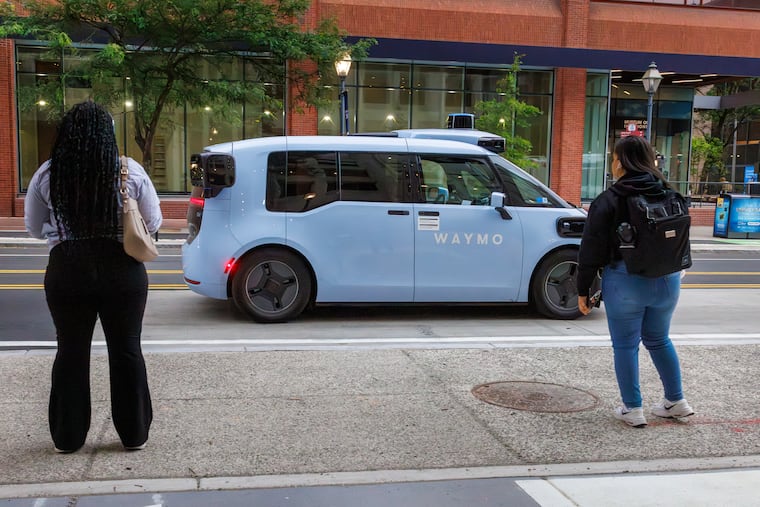
Buckle up, Philly, because new research suggests what could be the rise of the machines — at least on area roads.
A new study by the nonprofit Insurance Institute for Highway Safety (IIHS) reveals that Waymo’s fully autonomous vehicles are significantly less likely to be involved in traffic collisions than human drivers.
The paper indicates that the self-driving vehicles of Alphabet Inc.’s robotaxi service, which is testing the service in the city, are not only safer, but much safer than humans.
“The results provide further evidence that Waymo’s current L4 vehicles have lower crash involvement rates than human drivers,” the authors stated.
Such findings could help lessen fears around the vehicles, which are already ubiquitous in California and headed that way in some other states.
Philadelphia was not part of the study, but Waymo has been testing vehicles in the city without yet offering riderless service.
“We welcome this new research from IIHS, which confirms our previous peer-reviewed analyses and reinforces the significant safety benefits of the Waymo Driver,” Waymo spokesperson Ethan Teicher said in an emailed statement.
Teicher called the study “an important contribution to a growing body of research on AV [autonomous vehicle] safety data” and said more high-quality data like it would help build public trust.
The study’s findings
The authors found that the highly automated Level 4 (L4) vehicles operating without a human driver had a police-reportable crash rate 68% lower than human drivers in comparable areas.
The research also looked specifically at crashes resulting in injuries. Autonomous vehicles performed even better, boasting an 81% lower injury crash rate compared against the human benchmark.
Data indicate that Waymo vehicles were rarely instigators in collisions.
To draw their conclusions, the authors analyzed 736 autonomous vehicle crash reports submitted to the National Highway Traffic Safety Administration (NHTSA) between July 2021 and December 2024.
They found that the autonomous vehicles’ rate of rear-ending another vehicle was 91% lower than that of human drivers, and their rate of being rear-ended was 40% lower.
Furthermore, they were involved in 85% fewer single-vehicle crashes per mile traveled.
The IIHS, which conducted the study, is an independent, nonprofit scientific and educational organization, with the goal of reducing deaths, injuries, and property damage from motor vehicle crashes.
The same organization has been performing crash tests on regular vehicles since the 1990s to rate their safety.
Comparing the safety of robotaxis to human drivers has historically been difficult because of differences in how crashes are reported. Federal regulations require automated vehicle operators to report even the most minor incidents, such as scraping an undercarriage or hitting small road debris.
In contrast, human drivers typically only report crashes that meet state damage thresholds — often $1,000 — or involve injuries, and even then, over half human crashes go unreported.
To overcome that bias, IIHS researchers manually evaluated the descriptions of property damage and injuries. They estimated whether a “reasonable person” would have called the police.
The study found that 78% of the reported automated vehicle incidents were too minor to meet typical police-reporting standards.
Researchers then compared the adjusted crash data from Waymo — which voluntarily publishes its autonomous mileage — against police-reported human crash data from California, Arizona, and Texas. The analysis covered approximately 50 million miles of Waymo driverless operation and 222 billion human-driven miles.
The study’s limitations
Despite the promising safety record, the researchers acknowledged several limitations.
First, Waymo did not operate its driverless vehicles on interstates or freeways during the study period, environments that account for 22% of human drivers’ police-reported crashes.
Second, because autonomous vehicles often drive empty, fewer humans are exposed to injury risk during collisions, which can artificially lower the overall injury rate.
As self-driving fleets continue their rapid expansion, the study’s authors warn that manually reading crash narratives is an unsustainable method for monitoring public safety.
The study only looked at Waymo, not other self-driving vehicles. Waymo is the largest such company to offer robotaxis, but Tesla is also testing driverless vehicles.
The IIHS is calling for a standardized, national reporting system for automated vehicle crashes and mileage, arguing that streamlined data are essential for accurate and timely safety evaluations.
Waymo said it supports an industry-standard reporting system that would include air bag deployments and an injury scale.
When will Waymo be available in Philly?
Despite the limitations, the study could reassure Philadelphians hesitant to ride in an autonomous vehicle.
Waymo slowly began introducing the vehicles last summer, but they were driven manually by specialists in the most complicated to navigate parts of the city. They fanned out at all hours across various neighborhoods.
In December, Waymo began autonomous testing in the city but still with a specialist behind the wheel with permission from PennDot.
Teicher, the company spokesman, said Tuesday that Waymo is still currently testing. The next step would be to operate fully autonomously with employee-passengers, he said.
If the feedback is positive, Waymo would be ready to begin taking on public riders.
However, the company has declined to discuss timing and still needs regulatory approval to carry passengers in Pennsylvania.
» READ MORE: Activists and City Council want Waymo stopped in Philadelphia until concerns are answered
The robotaxi service has received intense local political scrutiny.
The Inquirer reported in May that some City Council members and a coalition of religious leaders, labor unions, and rideshare drivers urged PennDot to halt Waymo until safety and job-loss concerns were addressed.
Philly does not have the power to directly regulate Waymo.