The 22 must-see pieces at ‘Nation of Artists’ if you only have a few hours
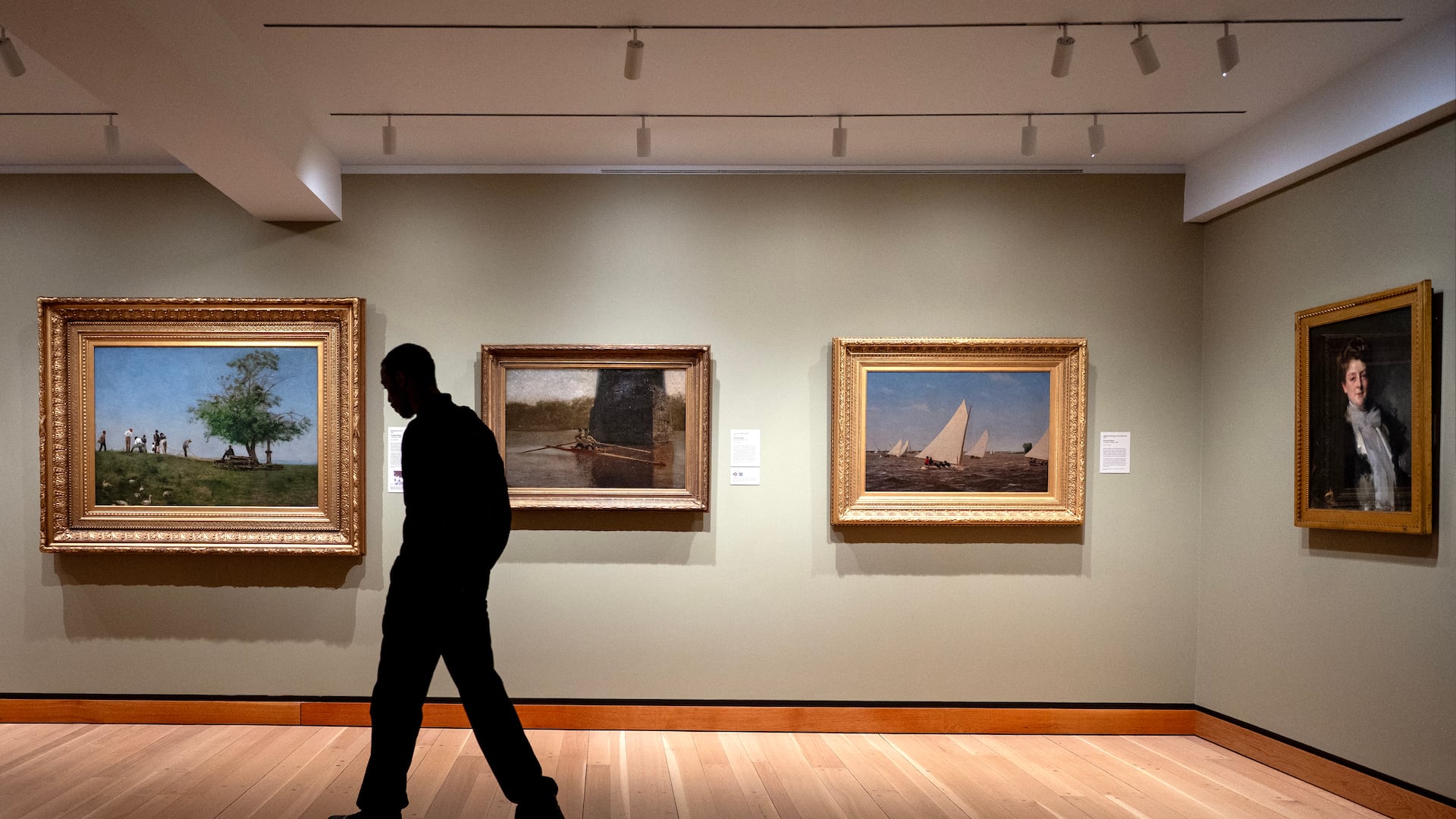
One of the most unusual offerings in the cornucopia of events occasioned by our country’s 250th birthday is “A Nation of Artists,” an extraordinary exhibition that takes a fresh look at the history of American art. Spread over two museums, the show implicates nearly 1000 artworks gathered from three collections that span four centuries.
The whole is indeed greater than the sum of its parts.
“A Nation of Artists” occupies 19 galleries at the Philadelphia Museum of Art (PMA) and nearly all available space at the Pennsylvania Academy of Fine Arts’ Landmark Building (PAFA). Intermixed with the museums’ permanent collections are about 100 masterworks from the Middleton Family Collection of American Art, on public view for the first time.
“The beauty of ‘A Nation of Artists,’” says PMA curator Kathleen Foster, “is that the two grandpas collaborated with the Middleton Collection to enhance their ability to tell the story of American art history.” To Foster, “there is no single story of American art — it’s a patchwork of different ideas, an amalgam.”
The dual installations, like non-identical twins, were simultaneously conceived yet endowed with distinct mien and appearance. To identify art that best exemplified history’s blended narratives, each curatorial team scrutinized the galleries and storage vaults of their respective collections. Burrowed within the origin story of each institution are clues to why and how the halves differ.
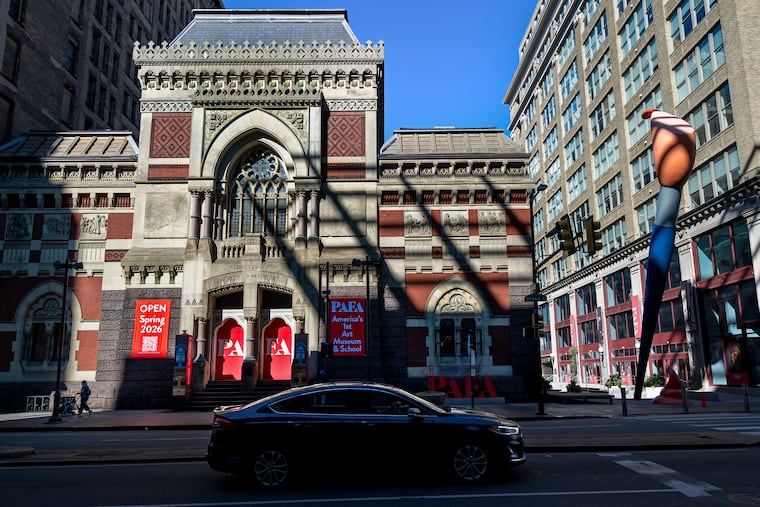
PAFA opened in 1805 as a museum and school with a curriculum modeled on traditional European academies. Not long after, it began to collect “the art of our time.” PAFA’s enduring identity as the nation’s first art museum and school reflects the founders’ intention to “promote the cultivation of the Fine Arts in the United States of America.” It helps explain why, in their portion of “A Nation of Artists” galleries, work by recent graduates hangs near legendary elders who studied at the school a century or two earlier.
The PMA, 75 years PAFA’s junior, was likewise established to teach and to present art. Then called the Pennsylvania Museum and School of Industrial Art, it started in Memorial Hall, the art gallery of the 1876 Centennial Exhibition in Fairmount Park.
PMA uniquely made space for “applied arts” such as furniture, jewelry and clothing, a clear sign of the modernity of their interests. Their purview widened in the 1890s when they began to buy and collect contemporary painting and sculpture.
Gems at PMA
From the vantage of the PMA’s Grand Stair Hall on the second floor, a supersized trailhead marks the route to “A Nation of Artists.” The way forward leads through a corridor with a small selection of American watercolors and drawings made in response to the terrain of the New World. The section’s title, “New Eyes,” is a fitting note to self for what’s ahead.
The PMA galleries designated for “A Nation of Artists” bracket the years from the 1680s to the 1950s. The newly renovated galleries on the second floor tackle the 19th and 20th centuries, while art from the first 200 years is on the first floor, in the museum’s splendidly reinstalled galleries of early American art, which opened in 2021. Seventeen works from the Middleton Collection are there, in companionable proximity to charismatic old timers.
The earliest United States flag to contain 13 red and white stripes, The Flag of the Second Continental Light Dragoons, (1776-77) is a Middleton loan, as is Charles Wilson Peale’s monumental George Washington at Princeton, (1779), painted a decade before the subject became president.
A few steps away is PMA’s Staircase Group (1795), Peale’s startlingly illusionistic 1795 portrait of his sons paused in mid-ascent. It was so realistic that, reportedly, a distracted Washington once nodded at it in passing. The entire first-floor area constitutes an “unadvertised special” of the upstairs galleries. Explore it the day of your visit or save it for another day — it’s that worthwhile!
Head over to PAFA
At PAFA, “A Nation of Artists” begins a few steps away from the front desk, in a section entitled “A Nation of Experimenters.” Relinquish expectations that art history here unfolds in chronological sequence, as it does at PMA. Throughout PAFA, intergenerational clusters of provocatively unalike art shelter under thematic umbrellas.
Every work in this introductory gallery references the American flag or issues of national identity. Standouts include Sonya Clark’s ongoing performance work, Unraveling (2015 to present), made with a Confederate battle flag that she partially deconstructed, thread by thread. In Andrew Wyeth’s Young America (1950), a rider isn’t looking where he’s going as he peddles across a desolate landscape. Both Norman Lewis’s painting Redneck Birth (1961), and William Rush’s emblematic sculpture, Eagle (ca. 1810) voice the unspoken query of Jaune Quick-to-See Smith’s large lithograph, (2001-03) What is an American?
Midway upstairs, there’s an independent, outwardly unrelated display of Fred Wilson’s MASTER PLAN (2004-2009), a suite of delicate photogravures commissioned by PAFA’s Brodsky Center. An intriguing, conceptual inquiry into the subtle ways museum floor plans affect visitors, it prompted me to draft another “note to self.”
A diverse nation
“A Nation of Artists” offers rich, tangible proof of the creative complexity of American art. The curator’s strategic arrangements stimulate many educational takeaways. Equally potent provocateurs are the juxtapositions and connections we notice on our own. Here are some of mine.
African Americans are integral to the narrative weave of the show. “Prosperity, Abundance, Inequity,” the overarching theme of a PMA gallery of mid-nineteenth century art, includes one less obvious thread.
Amid the eye-catching trappings of wealth, is a utilitarian stoneware vessel by Dave, an enslaved potter. Although literacy was illegal for enslaved people in South Carolina, Dave inscribed the jar with his name, a rhymed verse combining a biblical reference with the jar’s use, and the date, 1859.
That same year in West Virginia, an ardent abolitionist received a death sentence for raiding the federal armory at Harpers Ferry.
In PAFA’s John Brown Going to His Hanging (1942) Horace Pippin visualized a crowd of male onlookers facing the gallows-bound wagon in which Brown sits on his own coffin. The one Black woman may be his grandmother, who, while not an eyewitness, was the likely source of his information. Unforgettably, she’s the only person turned to meet our gaze.
The city of Philadelphia links two works painted 200 years apart at PAFA. John L. Krimmel’s Fourth of July in Centre Square (1811) is a delightfully detailed survey of a broad range of the population. It wasn’t people but the record of their actions that snared my attention a few galleries away. In Alex Lukas’ lengthy horizontal painting, Untitled (2012), the stigmata of old tires, vandalized walls and posters ornament an unidentified Philly riverbank.
Although I was acquainted with the modernist Florine Stettheimer’s whimsical paintings, it was a treat to find two of them. In PAFA’s Picnic at Bedford Hills (1918), the artist taps her memory of the languorous luncheon she enjoyed with a small group of friends, Marcel Duchamp among them. In PMA’s Spring Sale at Bendel’s (1923), a melee of bargain-crazed ladies behaves in amusingly unladylike ways.
Benjamin West’s familiarity with the customs and attire of Indigenous Americans is evident in his iconic, grandly scaled Penn’s Treaty with the Indians (1771—72) at PAFA. To paint it, he tapped firsthand knowledge, having grown up near Indigenous communities in what is today, Swarthmore.
In West’s painting, authentically garbed players enact an imaginary account of the founding of Pennsylvania a hundred years earlier, an ostensibly beneficent goods-for-land exchange between Penn and representatives of the Lenape. West’s prominent placement of a bare-breasted Native mother nursing her cradleboard-bound infant is less a compositional device than it is a nod to Eurocentric interest in exotic details.
Several works at PAFA catapult us forward by hundreds of years. Skywalker/Skyscraper (Allegory) (2012), a knockout, mural-sized rainbow made with reclaimed wool blankets, is by Marie Watt, a member of the Seneca Nation of Indians. She chose blankets as her material, because, like all everyday objects, they can carry “extraordinary histories of use.”
Dyani White Hawk, an artist of Sičáŋǧu Lakota ancestry, painted PAFA’s stunning She Gives (Quiet Strength VII) (2020). This monumental, abstract composition of marks in layered patterns alludes to the rhythms of traditional beadwork and porcupine quillwork.
Two hundred years after West, the Indigenous man in Andy Warhol’s screen print at PAFA, Cowboys and Indians (1986), was a person Warhol had never seen. As had other Pop artists, Warhol had only represented a representation. In this case, it was the U.S. coin known as the Indian Head Nickel.
At PMA, I connected paintings with works from their hitherto unexhibited collection of native artifacts. Dogfish Pile Driver (before 1893), is a masterfully carved tool by the Northwest Coast craftsman identified as a “Nuxalk Artist Once Known.” An invited advisory committee of Indigenous curators, scholars, and culture bearers selected the work on view. Many object labels include their commentary.
It takes a minute to spot the Native Americans in Sanford Gifford’s A Coming Storm (1863), a showstopper of a painting. A demon cloud commandeers attention as it approaches the banks of Lake George in upstate New York. Then we notice a small, marginalized group of Native people on the shoreline, a literal and metaphorical indication that the area was within the homelands of the Iroquois Confederacy.
Visitors find more than one important work by Pippin in each venue, as is true of other celebrated artists such as Thomas Eakins, Violet Oakley, Winslow Homer, Henry Tanner, and Cecilia Beaux. “A Nation of Artists” runs into 2027, encouraging multiple visits to both museums.
Of course, Hippocrates didn’t have the show in mind when he noted “ars longa, vita brevis.” Although his insight that “art is long and life is short” refers to the time required for proficiency, it’s another useful “note to self” when attempting to predict just how much time it might take to reap all the exhibition has to offer.