At 125, Philadelphia’s official tall ship isn’t done riding the waves
Recently, the Portugal-born ship set sail to Virginia’s Norfolk area celebrating the country's 250th birthday. It's now back in its Penn’s Landing home.
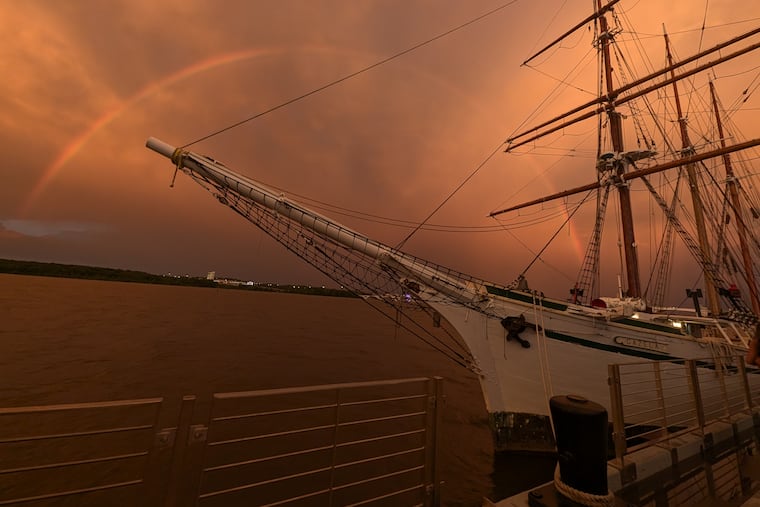
125-year-old Gazela weighs 299 gross tons and is 177 feet tall. The ship has traveled across the Atlantic, appeared in the 1994 movie Interview with the Vampire, and was once, according to one of the ship’s longtime volunteer custodians, blessed by a group of nuns.
It is also the official tall ship of Philadelphia, a role that requires it to take on some very serious duties. That included setting sail to Virginia’s Norfolk area, making stops at East Coast ports along the way, to represent the city at Sail250 Virginia, a celebration of the country’s 250th birthday, where the ship was one of the 60-plus visiting vessels from about 20 countries.
125 years of sailing
Hailing from Portugal, the Gazela was first a cod fishing vessel from 1901 — when the ship was built — to 1969. During those years, the ship traveled thousands of miles, fishing off the coast of Newfoundland, and getting packed with salt and cod to bring back to Europe.
In 1969, after a disastrous trip of horrible weather, broken gear, and a dismally low amount of fish caught, Gazela was finally laid up, putting the ship out of service. In 1971, Philadelphia philanthropist William Wikoff Smith brought the ship to the Philadelphia Maritime Museum. Just one year after arriving in America, Gazela was almost destroyed in an arsonist’s fire.
As part of the Bicentennial celebration in 1976, Gazela participated in a race to Bermuda, where, during the last five minutes, the ship was wedged between two other vessels and nearly crushed.
When the ship is not at sea, Gazela remains docked at Penn’s Landing, under the care of the Philadelphia Ship Preservation Guild, providing an education to tall ship enthusiasts. Groups tour the decks; volunteers learn about carpentry, knots, and ship maintenance. The ship provides a venue for the guild’s apprenticeship program and a slew of classes aiming to educate folks on building a maritime career.
All that grit has made Gazela a true Philadelphian: scrappy and enduring, no matter what punches life lands. A proud immigrant, the ship is a symbol of both global maritime history and Philly’s specific historical importance as a shipyard.
‘We’re from Philly, what of it?’
On June 18, David Goldman, the captain for Gazela’s trip to Portsmouth, one of the ports on their trip, stood with a slew of tall ships behind him. The ships were anchored outside of Norfolk, resting before a parade that would take them to dock alongside the city’s shore.
“This scene could be out of the page of a book from 150 years ago. Please treat it with the reverence it deserves,” he said to the crewmembers. The Gazela stood out a little in the crowd: older than most of the other ships and a bit worn down from its century-plus of sailing. Slightly ragtag, slightly punchy.
One crewmember referred to the ship as an “ugly duckling,” of course, with love.
“We’re from Philly, what of it?” is the attitude that Gina Pickton, PSPG’s executive director, thinks Gazela has.
“This has not been easy, this is not a vacation,” said Allison Grosso, who manages events and communications for the guild. “Everybody on this boat feels the same way, and cares that much that we’re doing all this, because it’s that special to us.”
Underway, the crew of 40 volunteers rotated through approximately five-hour shifts. Within each watch, a crewmember stood on lookout, checked the ship’s safety (including the ship engine — one was added in 1938 and updated in the late 20th century), helmed it, and kept it to the correct angle measured on a beautiful brassy compass.
Bunks were stacked in threes in the focsle, with about a foot and a half of space in between, and hung in twos in the hold.
Many of the volunteers have “land jobs” — one works at an environmental nonprofit, another attended art school, and another was in the Air Force. Some are hobbyist retirees; others, adults at the beginning or middle of a maritime career; one, a high school graduate spending as much time with the ship as he can before heading off to Temple in the fall.
They form a tight-knit community.
“You can just step on[board], and people will be so friendly to you,” said Gael Chang Ortiz, 18. “They’re willing to teach you so much.”
At 125, the tall ship remains an object of endless affection. While the ship was anchored outside of Portsmouth, a rowboat carrying four young men approached the ship’s flank and tossed a friendly offering of Goldfish crackers onto the ship’s deck.
“Gazela’s still a fishing vessel!” shouted a crewmember, holding the bounty high.
Documenting history
Beyond preserving the community, the guild is working on preserving Gazela’s history — and not just by repainting the ship’s hull. Nancy Linden, the journey’s third mate, is working on an oral history project about Gazela. Chang Ortiz said he’s considering participating in Gazela’s apprenticeship program; there are PSPG members who started as volunteers and have wound up seeking full-time maritime careers.
Gazela’s crew also thinks it’s important not only to preserve history, but to tell it truthfully.
“Historically, sailing was an interesting pathway for both enslaved Americans as well as free African Americans to make a living,” said Maura Hackett, the chief mate for this journey and a seafarer for about two decades. “It’s really unfortunate that the first thing a lot of people think about [ships] is old white guys.”
“It’s hard to see yourself doing something if you’re not mirrored in the crew or the representation,” Hackett said. “I’ve had little kids come up to me and say, ‘I can be a captain too?’ And [I’ve said,] ‘Yeah, you can!’”
After 29 days spent as much as 300 miles from home, Gazela returned to Philly.
And as fireworks lit up the sky on July 4, the Portuguese Gazela, half as old as the ship’s adopted country, was just another Philadelphian basking under the night sky of the city it calls home.